Tuesday, 20 October 2026

Clocks go back 2026: UK, US and Canada dates, and your phone

The UK changes on Oct. 25, most of the US and parts of Canada on Nov. 1, and several provinces not at all. Here's how to keep your devices right.

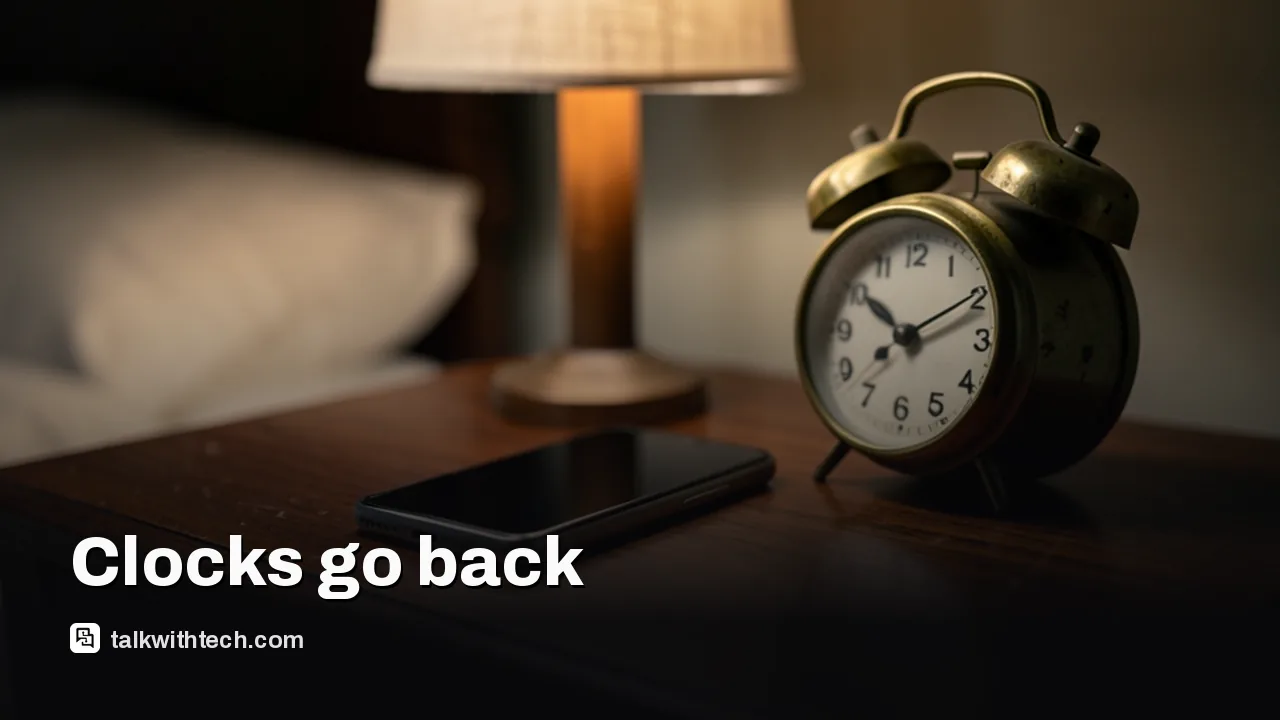
A smartphone beside an analog alarm clock on a bedside table at night

The short version

  • UK clocks go back one hour at 2 a.m. BST on Sunday, Oct. 25, 2026.
  • Most of the US falls back at 2 a.m. local time on Sunday, Nov. 1, the earliest possible date.
  • British Columbia, Alberta and Manitoba will not turn clocks back this year, reshaping Canada's time differences.
  • Phones and computers update themselves if automatic time is on, but car clocks and appliances usually need a manual fix.
Quick read · 1 min

The clocks go back in the UK on Sunday, Oct. 25, at 2 a.m. BST, and in most of the US on Sunday, Nov. 1, at 2 a.m. local time. Both dates are the earliest the rules allow. You gain an hour, and evenings get dark sooner.

Phones, computers and smartwatches update themselves as long as automatic date and time is on, which it is by default. Car clocks, ovens, older alarm clocks and some thermostats usually need fixing by hand.

  • In the week after Oct. 25, the UK-US time gap is an hour smaller, so check transatlantic meetings.
  • British Columbia, Alberta and Manitoba won't turn their clocks back this year.
  • Toronto and Vancouver will be two hours apart this winter instead of three.

If your phone shows the wrong time, install pending updates and restart it before switching to manual time.

This year the clocks go back at the earliest possible moment on both sides of the Atlantic, and in Canada, several provinces won’t move them at all. If you’re wondering when the clocks go back in 2026, the short answer is Sunday, Oct. 25, in the UK and Sunday, Nov. 1, in most of the US and much of Canada.

Your phone will probably handle it for you. The things that catch people out are the gadgets that don’t update, the week when transatlantic meetings shift by an hour, and a Canadian time map that has quietly been redrawn. Here’s what to check.

01

When the clocks go back in 2026, country by country

The dates differ because each country sets its own rules.

  • UK: Sunday, Oct. 25. At 2 a.m. BST, clocks go back to 1 a.m. and the country returns to Greenwich Mean Time. Most of Europe changes the same day.
  • US: Sunday, Nov. 1. Daylight saving time ends at 2 a.m. local time, when clocks fall back to 1 a.m.
  • Canada: Sunday, Nov. 1, in the provinces and territories that still change, including most of Ontario, Quebec and Atlantic Canada. Several others are sitting this one out (more on that below).

Both changes land early this year. The UK always switches on the last Sunday in October, and Oct. 25 is as early as that can fall. The US switches on the first Sunday in November, and Nov. 1 is the earliest possible date for that.

The clocks go forward again on Sunday, March 14, 2027, in the US and on Sunday, March 28, 2027, in the UK.

A hand adjusting a car dashboard clock in early morning light
02

Will my phone change automatically?

Yes, in almost every case. Smartphones, computers, tablets and most other connected devices update on their own, as long as automatic date and time is switched on. It is on by default, so unless you’ve changed it, you don’t need to do anything.

To check, or to switch it back on:

  • iPhone and iPad: open Settings, tap General, then Date & Time, and make sure Set Automatically is on.
  • Android phones: open Settings and search for Date & time. Turn on the option to set the time automatically. On Samsung phones it sits under General management.
  • Windows PCs: open Settings, then Time & language, then Date & time, and turn on automatic time and automatic time zone.
  • Mac: open System Settings, then General, then Date & Time, and turn on the automatic options.
  • Smartwatches: most take the time from your paired phone, so they follow along.

Your phone alarm also adjusts. An alarm set for seven still rings at seven by the new time, which is why you get the famous extra hour in bed.

03

The gadgets you still have to fix by hand

Anything that isn’t online probably won’t change itself. Make a quick list before the weekend:

  • car dashboard clocks, especially in older models;
  • ovens, microwaves and other kitchen appliances;
  • wall clocks, alarm clocks and older digital watches;
  • heating thermostats and timers that run on a schedule;
  • security cameras and doorbells that stamp the time on recordings, if they aren’t set to sync.

That last one matters more than it sounds. If you ever need footage for an insurance claim or a package dispute, a wrong timestamp makes it harder to use.

A laptop with a blurred calendar on a kitchen table, wall clock behind
04

The week your meetings with the US or UK will shift

Here’s the trap most people miss. Because the UK changes on Oct. 25 and the US on Nov. 1, there’s one week when the gap between them is an hour smaller than usual.

For that week, a call that is normally mid-afternoon in London and mid-morning in New York will land an hour earlier on the London side. Calendar apps such as Google Calendar and Outlook handle this correctly if the invite was created with a time zone, but the person in the other country will see the meeting move. People who set their own reminders, or who type times into chat, often get caught out.

A simple fix: for any recurring call across the Atlantic that week, send a quick note confirming the time in both places.

05

Canada’s new time patchwork, explained

Canada’s rules are set by each province and territory, and several have now dropped the twice-yearly switch. That changes the time difference between cities even where clocks don’t move.

  • British Columbia: made its final change in March 2026 and now stays on daylight time all year. No change on Nov. 1.
  • Alberta: has moved to permanent Alberta Time, formerly Mountain Daylight Time. No change on Nov. 1.
  • Manitoba: Premier Wab Kinew announced in September that the province will stay on daylight time year-round. No change on Nov. 1.
  • Saskatchewan: has used Central Standard Time year-round since 1966. Nothing new here.
  • Yukon: stopped changing its clocks in 2020.
  • Most of Ontario, Quebec, Atlantic Canada and Nunavut: clocks go back one hour on Nov. 1.

Two areas are worth double-checking locally. Reports differ on exactly how the Northwest Territories will handle Nov. 1 as it ends seasonal changes, and on which communities in northwestern Ontario, such as Kenora, will follow Manitoba. If you live there, check with your local government.

The practical result this winter:

  • Toronto and Vancouver will be two hours apart instead of three.
  • Alberta will be one hour behind most of Ontario instead of two.
  • Manitoba will share the same clock time as Toronto through the winter.

A forecaster’s advice sums it up: the old rule of thumb for time differences across the country no longer holds, so confirm local time before a call, a flight or a video interview.

What to do if your phone shows the wrong time

Phones know when to change because they carry a built-in rulebook of time zones that gets refreshed through software updates. When a government changes its rules, devices need that refresh.

  • Install updates before Nov. 1. If you’re in a Canadian province that has changed its rules, make sure your phone and computer have the latest software.
  • Restart the device. It often forces the clock to resync with your network.
  • Check your time zone. If the time is still off, look at which time zone is selected in your settings.
  • Use manual time as a last resort. Turn off automatic time, set the correct time yourself, and switch automatic back on once an update arrives.
06

Will daylight saving time become permanent in the US?

Not yet. The US House of Representatives passed the Sunshine Protection Act on July 14 by a vote of 308-117. It would make daylight saving time permanent and end the twice-yearly change. The bill then went to the Senate Committee on Commerce, Science and Transportation, where it remained as of Sept. 18. It still needs a Senate vote and the signature of President Donald Trump, who has voiced support. Until that happens, the Nov. 1 change goes ahead.

Hawaii and most of Arizona don’t use daylight saving time, so clocks there won’t change. The Navajo Nation, which covers parts of Arizona, Utah and New Mexico, does observe it. Puerto Rico, Guam, the US Virgin Islands, American Samoa and the Northern Mariana Islands don’t.

In the UK, there are no current plans to scrap the change. The country tried year-round BST between 1968 and 1971, but permanent summer time would mean very dark winter mornings, especially in Scotland, where some places don’t see sunrise until around 08:45 GMT in late December. Under permanent summer time, that would become 09:45 BST.

07

Quick answers

Do the clocks go back this weekend?

In the UK, yes, on Sunday, Oct. 25, at 2 a.m. In the US and most of Canada, no. That change is on Sunday, Nov. 1.

Do I gain or lose an hour when the clocks go back?

You gain an hour. Clocks move from 2 a.m. back to 1 a.m., so mornings get lighter and evenings get darker sooner.

Will my iPhone change time automatically?

Yes, if Set Automatically is on under Settings, General, Date & Time. It’s on by default.

You're reading the quick version.