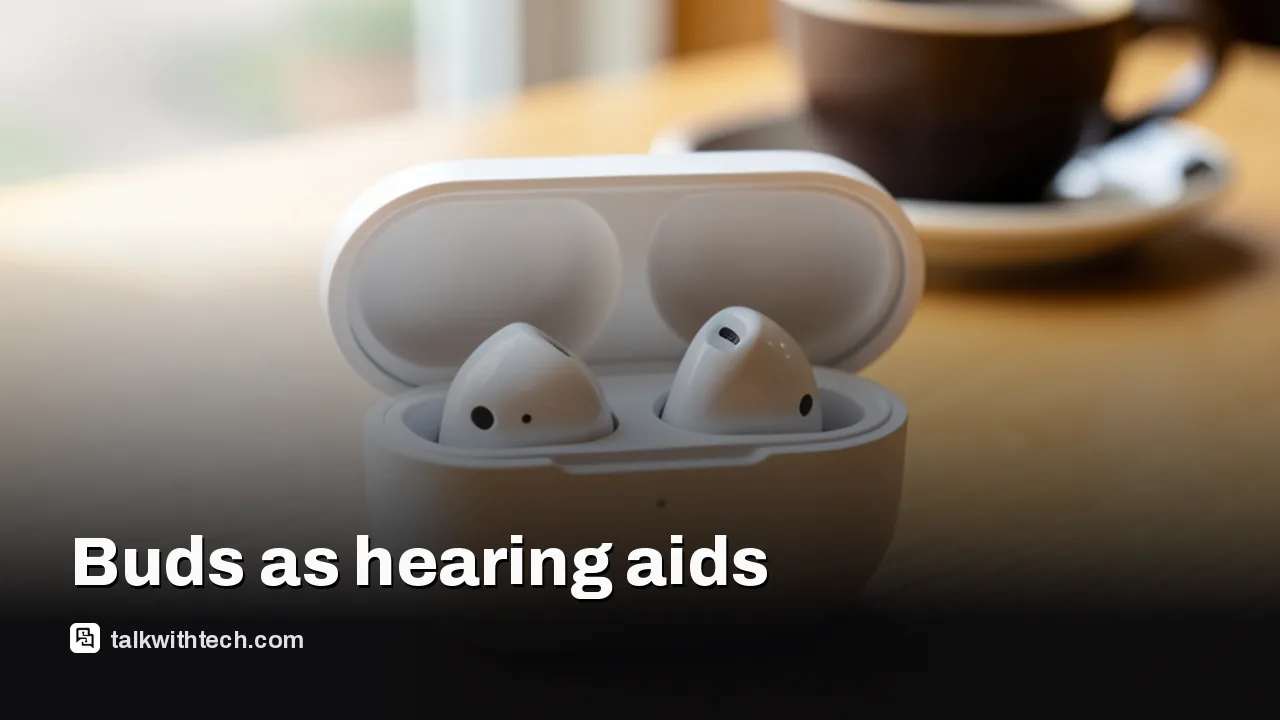
The Galaxy Buds hearing aid feature and a built-in Hearing Test are coming to the Galaxy Buds4 Pro and Galaxy Buds3 Pro only.
Samsung got FDA clearance in the US this summer and approval from South Korea's drug safety ministry this week.
Samsung's US target is the fourth quarter of 2026, while South Korea and other markets are due in early 2027.
The feature is meant for adults 18 and older with perceived mild to moderate hearing loss and needs a Galaxy phone on One UI 9 or later.
Quick read · 2 min
Samsung's earbuds are about to double as over-the-counter hearing aids, but only two models qualify: the Galaxy Buds4 Pro and the Galaxy Buds3 Pro. You also need a Galaxy phone running One UI 9 or later.
The update adds a five-minute Hearing Test that checks each ear and builds a personal hearing profile, then a Hearing Aid mode that boosts only the sounds you miss, using a clinical fitting formula plus noise reduction and beamforming. It is meant for adults with perceived mild to moderate hearing loss, not a replacement for a doctor.
US: Samsung's target is the fourth quarter of 2026, after FDA clearance this summer.
South Korea: approved this week, launching in early 2027.
UK and Canada: no dates or approvals announced yet.
Apple's AirPods Pro 2 and Pro 3 already offer a similar feature, so the choice comes down to which phone you use.
The Galaxy Buds hearing aid feature is real, it is regulator-approved, and it is coming to exactly two pairs of earbuds: the Galaxy Buds4 Pro and the Galaxy Buds3 Pro. Samsung’s US plan puts the switch-on in the fourth quarter of 2026, and South Korea’s Ministry of Food and Drug Safety signed off on the same software this week, with Korean owners due to get it in early 2027.
If you already own one of those pairs, this is a free software update that turns them into over-the-counter hearing aids for mild to moderate hearing loss. If you own older Buds, a Buds FE or a non-Samsung phone, the news is less friendly, and the details below explain why. Samsung itself names cost as one of the main reasons people who need hearing help go without it, so the stakes are real for a lot of people.
01
Which Galaxy Buds get the hearing aid feature
Only the Galaxy Buds4 Pro and Galaxy Buds3 Pro get the hearing aid feature, according to Samsung’s own fine print. No other model is on the list, which rules out the Buds FE, the regular Buds3 and the older Buds2 Pro for now.
There is a second requirement that is easy to miss. Samsung says full support needs a compatible Galaxy device running One UI 9 or later. So the earbuds alone are not enough: you also need a recent Samsung phone that has the One UI 9 update. Samsung has not said the feature works with iPhones or with Android phones from other brands, and its setup lives inside the phone’s Settings menu, so plan on a Galaxy handset.
Earbuds: Galaxy Buds4 Pro or Galaxy Buds3 Pro
Phone: a compatible Galaxy device on One UI 9 or later
Extra app: none, since the tools sit in the Galaxy Buds section of Settings, with results also shown in Samsung Health
Age: 18 or older
02
When the Galaxy Buds hearing aid arrives in the US, UK and Canada
For US owners, Samsung’s official target is the fourth quarter of 2026, which means by the end of December. That timing came with the FDA clearance announced in the summer, and the US is set to be first in line.
This week’s Korean announcement muddied things a little. It gave early 2027 as the start for South Korea and did not repeat a US date, so some coverage now reads as if every country is waiting until next year. Others still point to the fourth quarter for the US. Until Samsung posts a firm rollout note, treat late 2026 as the US goal rather than a promise.
The UK and Canada have not been named. Samsung’s wording is that the features will reach the US and “select approved markets”, and because this is classed as medical device software, each country’s regulator has to clear it first. We found no approval news for either country yet, so owners there should expect to wait past the US launch.
The FDA timing is also slightly fuzzy across reports. Samsung’s US newsroom post on the clearance went up in August, while one report from Seoul said the FDA cleared it in July. Either way, the US approval is done.
03
How the hearing test and amplification actually work
The feature comes in two parts: a Hearing Test and the Hearing Aid itself. You need the first to set up the second.
The Hearing Test takes about five minutes and checks each ear on its own. It plays pure tones at different pitches and finds the quietest one you can hear, a clinical-grade method called pure-tone audiometry. Samsung says the resulting audiogram, the chart of what you can and can’t hear, is comparable in accuracy to a professional test.
How the result is labeled depends on which description you read. Samsung’s US announcement says it sorts hearing into normal or one of four stages of loss: mild, moderate, severe or profound. The Korean announcement describes a finer scale with seven levels, adding slight and moderately severe. Either way, you also get guidance on what to do next.
Then the Hearing Aid mode uses that audiogram to boost only the sounds you struggle with, such as high frequencies, whispers or a voice across the room. It does that with NAL-NL2, a fitting formula from Australia’s National Acoustic Laboratories that clinics widely use to program prescription hearing aids. Samsung also lists noise reduction and beamforming, a trick that uses the microphones to focus on sound coming from in front of you, so a conversation stands out from a noisy room.
04
Who should use it, and who should see an audiologist
Samsung says the Hearing Aid feature is intended for adults 18 and older who think they have mild to moderate hearing loss. It is designed so those users can tune it themselves without visiting a hearing specialist.
That is also its limit. The test can flag severe or profound loss, but the amplification is not built for those levels, and Samsung says the feature is not a substitute for diagnosis or treatment by a qualified clinician. If the test places you in the severe or profound range, the earbuds aren’t meant to be your answer, and the follow-up guidance is the part to act on.
The scale of the problem explains why Samsung and Apple are both chasing this. The World Health Organization estimates more than 1.5 billion people have some degree of hearing loss, rising to a projected 2.5 billion by 2050. Many skip hearing aids because of cost, stigma or trouble getting to a clinic, and a feature inside earbuds people already wear is aimed squarely at those hurdles.
Galaxy Buds or AirPods Pro: how the two hearing aids compare
Apple got here first. Its Hearing Aid feature already works on the AirPods Pro 2 and AirPods Pro 3, and the basics line up closely with Samsung’s plan.
Who it’s for: both target adults 18 or older with perceived mild to moderate hearing loss.
Built-in test: both include their own hearing test that builds a personal profile.
Phone needed: AirPods need an iPhone or iPad on current software; Galaxy Buds need a Galaxy phone on One UI 9 or later.
Outside results: Apple lets you load an audiogram from your hearing professional instead of taking its test. Samsung has not said whether it will accept outside results.
Extras: Apple adds Media Assist for clearer music and calls; Samsung lists noise reduction and beamforming.
Availability today: Apple’s works now; Samsung’s is still waiting on its software update.
Apple also stores the settings on the earbuds, so its hearing aid keeps working if your iPhone isn’t nearby. Samsung hasn’t said how its version behaves without the phone, so that is one question to watch at launch. The practical takeaway is simple: you pick the one that matches the phone in your pocket, because neither works fully across the other camp.
What to do now if you own Galaxy Buds
There is nothing to switch on yet. Samsung says the features will arrive through a software update, so keep your earbuds and phone updated, and check that your phone has One UI 9.
When it lands, you’ll find the Hearing Test under the Galaxy Buds menu in your phone’s Settings, and your results plus your noise exposure levels will appear in the Samsung Health app. If you were thinking of buying earbuds partly for this, the Buds4 Pro and Buds3 Pro are the only two pairs that qualify.
06
Quick answers
Can Galaxy Buds be used as a hearing aid?
Yes, once the update arrives, but only the Galaxy Buds4 Pro and Buds3 Pro, paired with a Galaxy phone on One UI 9 or later.
Do the Galaxy Buds3 get the hearing aid mode?
Not the regular Buds3. Samsung’s list includes only the Buds3 Pro and Buds4 Pro.
Is the Galaxy Buds hearing aid FDA approved?
Yes. The FDA cleared it as an over-the-counter feature this summer, and South Korea approved it this week.