Tuesday, 24 November 2026

Bambu Lab P3C release date and price: $1,149 and a hand-fed AMS

The cheaper sibling of Bambu's $2,499 H3C is on sale now with five print heads, seven slots and one big shortcut: no motors in its filament box.

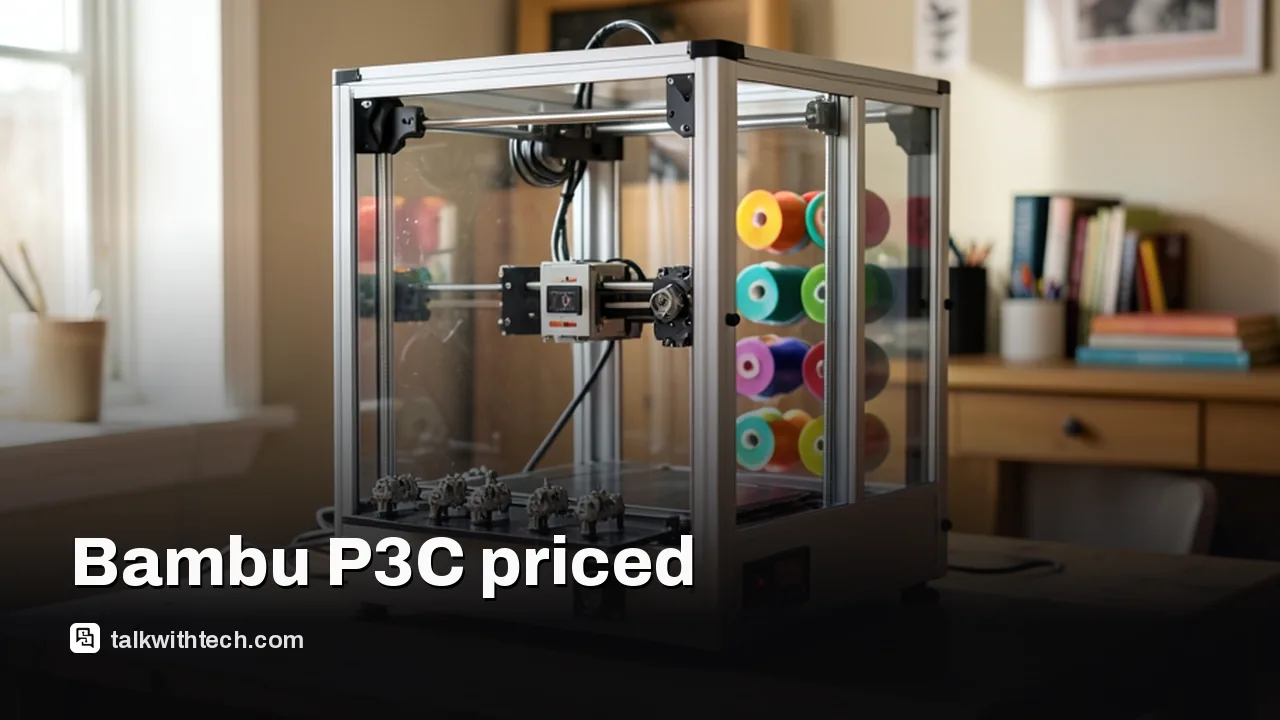
Enclosed multi-head 3D printer on a home workbench

The short version

  • The Bambu Lab P3C is on sale now, starting at $1,149 in the US and £999 in the UK with five print heads.
  • It uses the same Swaptek tool-changing system as the $2,499 H3C, with seven tool slots instead of nine and a smaller build area.
  • To cut the price, its AMS 3P filament box has no motors, so every spool has to be pushed to the nozzle by hand.
  • Bambu's launch prices on the bigger bundles rise after December 3, so the cheapest time to buy a seven-head setup is now.
Quick read · 2 min

Bambu Lab's P3C is on sale now from $1,149 in the US and £999 in the UK. It is a cheaper version of the $2,499 H3C, using the same tool-changing print heads that swap colors or materials in about 6 seconds.

The base bundle has five heads and two empty slots. Seven-head bundles cost up to $1,299 until December 3, then go up slightly. There is no Canadian price in the launch post yet.

  • Smaller build area and lower top temperature than the H3C.
  • No motors in the filament box, so you load each spool by hand.
  • Excellent with soft TPU through an optional thicker-filament head.

It suits hobbyists who want multi-material prints for half the flagship price. Beginners who want hands-off loading may prefer a simpler single-nozzle printer.

The Bambu Lab P3C release date was this week, and the price starts at $1,149 in the US and £999 in the UK. That money buys a tool-changing 3D printer with five ready-to-go print heads, room for two more, and the same 6-second material swaps as Bambu Lab’s flagship H3C, which costs $2,499.

Why should you care? Until this month, a printer that switches between seven separate heads, each holding its own color or material, was firmly prosumer gear. The P3C roughly halves the entry price. The trade-off is hidden inside its filament box, and it is one you will feel every time you change a spool.

01

Bambu Lab P3C price in the US, UK and Canada

The base P3C Combo costs $1,149 in the US and £999 in the UK. It includes the printer, the AMS 3P filament box and five print heads, which Bambu calls PrintTools, all fitted with 0.4mm nozzles. Two of the seven slots are left empty.

Bambu also sells bigger bundles, and three of them carry an early price until December 3:

  • Multi-Colorist Combo (two extra standard heads, so all seven slots are full): a lower early price until December 3, then $1,299.
  • Colorist Combo (the same, plus a red and a green spool of PLA Basic): $1,289 until December 3, a little more after that.
  • Multi-Material Combo (one extra standard head plus a head for thicker 2.85mm filament and a spool of soft TPU 75A): $1,299 until December 3, or £1,149 in the UK, with a small rise after that.
  • Complete Experience Combo (adds five CMYKW color-mixing spools, a yellow TPU spool, the E1 Air Purifier and the Bambu Lab Station stand): $1,699.

US prices exclude sales tax and include free shipping, while the UK prices include VAT. Bambu’s launch post lists dollar, pound and euro prices but no Canadian figure, so check the Canadian store before you budget. One more detail from the order page: the printer and the AMS 3P ship in separate boxes and may turn up on different days.

Extras add up. A spare print head costs up to $100, and the optional filament drying module is $159.90.

Close-up of a 3D printer swapping print heads mid-print
02

What a tool changer does, and why the P3C is different

A normal 3D printer has one nozzle. To print a second color, it pulls the old filament out, pushes the new one in and purges a blob of mixed plastic into a waste bin, again and again. That eats time and material.

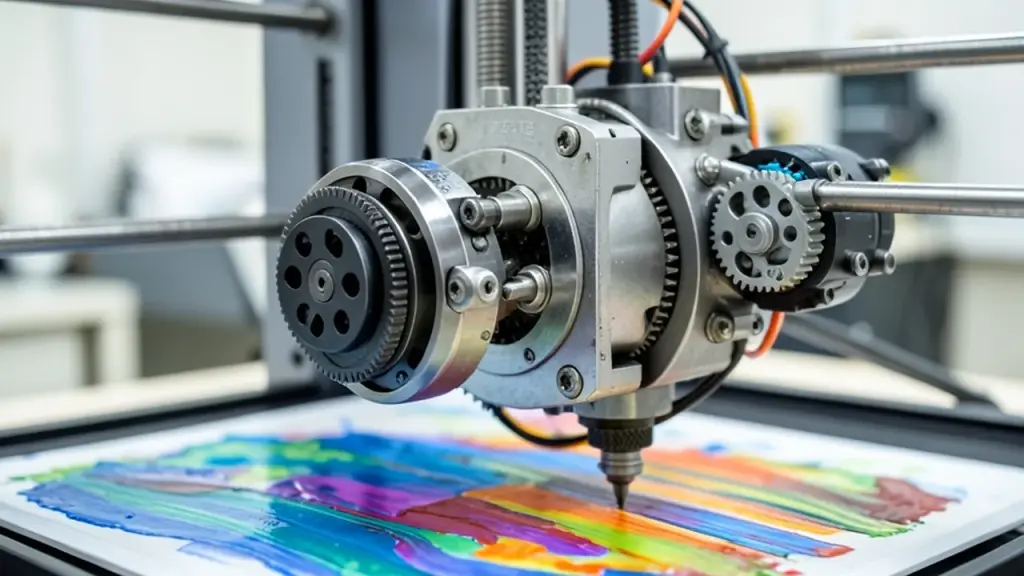
A tool changer skips most of that. Each print head on the P3C keeps its own filament loaded and has its own heater. While one head prints, the printer reads ahead and warms up the next one, then swaps it in from a rack at the front. Bambu says each change takes 6 seconds with very little purging.

It is not waste-free, though. A parked head cools to a standby temperature and can ooze a little, so the printer still builds a small prime tower to get each nozzle flowing cleanly again before it touches your model.

Because every head is separate, you can also mix nozzle sizes in one job. Bambu’s own demo is a watch: the fine dial from a 0.2mm nozzle, the body from a 0.4mm one, and a squishy strap from soft TPU. Nozzles come in sizes from 0.2mm to 0.8mm, all in hardened steel, which means carbon-fiber and glass-fiber filaments are fine.
03

The catch: you load every spool by hand

Here is the big cost cut. Bambu’s earlier AMS boxes had motors that fed filament to the nozzle automatically. The AMS 3P has none. You preheat a head, then push the filament all the way down its tube yourself, and do the reverse to unload it.

Reviewers who have used the P3C call this the most annoying part of owning one. Bambu says reloading all five heads should take around five minutes, and it plans a software update that aims to cut the hands-on time to under a minute. A company spokesperson said the motors were left out to reach roughly half the price of the H3C.

There is an upside. With no powered rollers, the box accepts almost any spool up to 1kg, including odd cardboard ones that jam motorized feeders. And once five colors are loaded, they stay ready, so you only face the chore when you change materials.

Changing the heads themselves is fiddly too. The front panel has to come off and there is little room to work, so most owners will pick a setup and leave it.

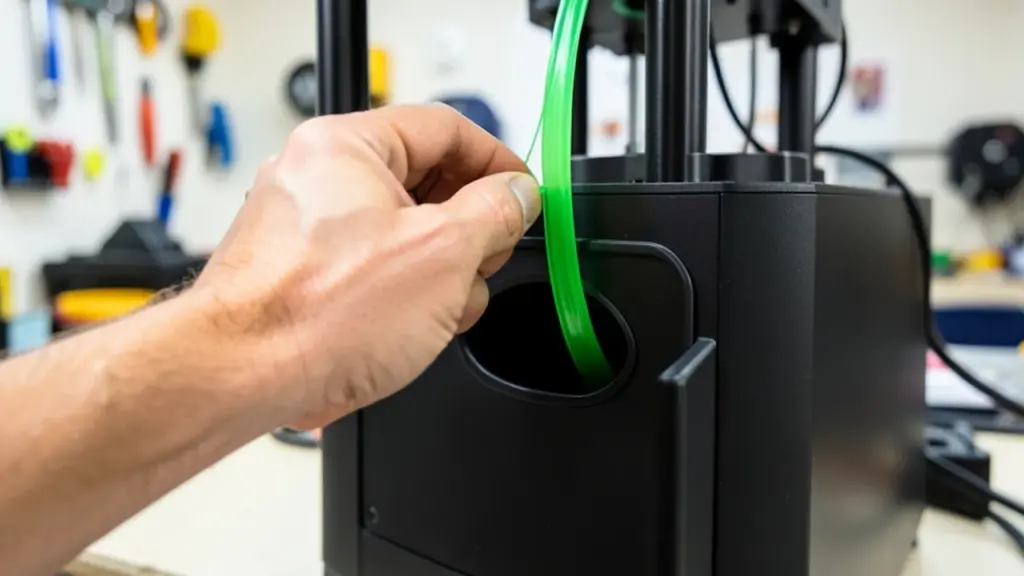
Hand loading flexible filament into a 3D printer by hand
04

Bambu Lab P3C vs H3C: what the extra money buys

The P3C uses the same Swaptek head design as the H3C. The heads are not cut-down versions. The differences sit around them:

  • Tool slots: seven on the P3C, nine on the H3C.
  • Build area: 256 x 256 x 260mm, against 330 x 320 x 325mm on the H3C.
  • Heat: the P3C’s nozzle tops out at 300°C and its bed at 110°C. The H3C reaches 350°C.
  • Filament box: no motors and an optional dryer that works on two slots at up to 75°C, versus automatic loading on the H3C.
  • Chamber: the H3C has a heated chamber; the P3C does not.

If you print mostly PLA, PETG and TPU, the P3C gives up little. If you want high-temperature engineering plastics, a bigger build plate or hands-off loading, the H3C still earns its price.

05

Who should buy the P3C, and who should wait

The P3C makes sense for hobbyists who already know their way around a printer and want true multi-material prints: rigid parts with soft TPU joints, five-color CMYKW mixing, or several colors without a bin full of purged plastic. Its TPU setup is a real strength. The thicker 2.85mm head handles very soft 75A TPU at up to three times the flow rate of a typical printer.

It makes less sense as a first printer. Manual loading and fiddly head swaps lean toward tinkerers. For comparison, Bambu’s own P2S Combo sells for about $800 with four-color printing through a single nozzle, and Snapmaker’s U1 tool changer costs $849 with four heads.

Measure your space, too. The P3C needs almost 4ft (1,212mm) of height for the filament box lid to open fully. And like other Bambu printers, it still leans on Bambu’s cloud for many features.

Later, the empty slots can hold more than nozzles. Bambu plans tools for cutting, drawing, debossing and foil transfer, though only two of the seven slots can take those non-printing tools.

06

Quick answers

When was the Bambu Lab P3C released?

Bambu Lab launched the P3C and opened orders this week, in late November 2026. The printer and its filament box may arrive in separate deliveries.

How much is the Bambu Lab P3C?

It starts at $1,149 or £999 with five print heads. Seven-head bundles cost up to $1,299 before December 3, and the early prices go up slightly after that date.

Does the P3C have a filament dryer?

Not by default. An optional drying module costs $159.90 and dries two of the seven slots at up to 75°C.

You're reading the quick version.