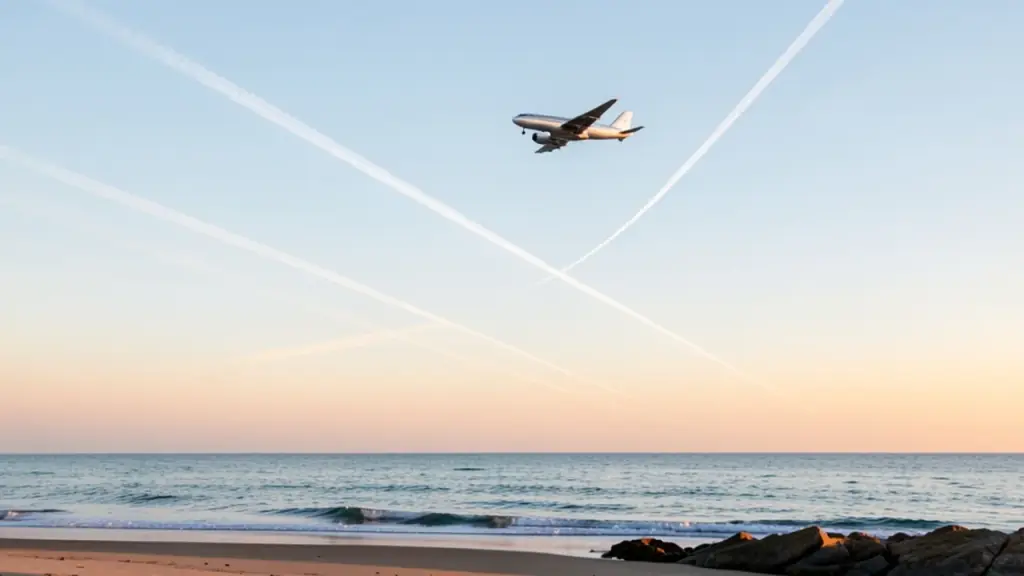
What causes GPS interference? Inside the 20-minute BA, easyJet jam
About 140 flights lost GPS over the North Sea on Nov. 9. Here is how jamming works, why it differs from spoofing, and why passengers were never in danger.
About 140 flights lost reliable GPS for roughly 20 minutes over the southern North Sea on November 9.
A British Airways flight to Stockholm, an easyJet flight to Egypt and a Ryanair flight to Rome were among them.
Analysts traced the signal to a single radio transmitter at sea, near a Russian-escorted convoy, but nothing is officially confirmed.
No flight was disrupted, because airliners carry backup navigation and pilots train for losing GPS.
Quick read · 1 min
On November 9, about 140 flights over the southern North Sea lost reliable GPS for roughly 20 minutes. They included a British Airways flight to Stockholm, an easyJet flight to Egypt and a Ryanair flight to Rome, based on an analysis by aviation data group Hexbird.
The likely cause was jamming: a powerful radio transmitter at sea drowning out weak satellite signals. Hexbird traced it to one transmitter about 190 miles off the English coast, near a sanctioned Russian convoy with a warship escort. Experts suspect the warship, but Hexbird says its data can't prove it and the UK government won't comment.
No flight was disrupted, and planes landed normally.
Airliners carry backup navigation, and pilots train for GPS loss.
Experts fear jamming combined with another failure, like an air traffic control outage.
Travelers don't need to do anything. Watch for whether UK authorities formally name a source.
For about 20 minutes on the evening of November 9, roughly 140 airliners over the North Sea suddenly stopped trusting their GPS. Among them were a Ryanair service out of Edinburgh bound for Rome, an easyJet jet that left Manchester for the Egyptian resort of Hurghada and a Stockholm-bound British Airways plane from Heathrow, according to an analysis by the aviation data group Hexbird.
So what causes GPS interference like this? In plain terms, a powerful radio transmitter drowned out the faint signals that come down from navigation satellites, so the receivers on board could no longer work out where they were. Nobody was hurt and no flight was disrupted. But the incident, which only came to light this week, is the reason “GPS interference” is suddenly a top search in the UK, and it raises fair questions for anyone with a flight booked.
01
What causes GPS interference on a plane?
GPS interference happens when something stops a receiver from hearing the satellites clearly. GPS satellites orbit far above the Earth, and by the time their signals reach the ground they are very weak. That makes them easy to overpower.
The most common deliberate cause is jamming. A jammer blasts out strong radio noise on the same frequencies, so the receiver can’t calculate its position or the exact time. Think of trying to hear someone whisper across a room while a leaf blower runs next to you.
The second cause is spoofing, which is sneakier. Instead of drowning out the real signal, a spoofer broadcasts fake satellite signals built to look normal, or replays genuine ones recorded somewhere else. The receiver then believes it is in the wrong place, or at the wrong time. Spoofing is harder to spot than jamming, which simply blocks the service.
The North Sea event looks like jamming. Hexbird found that affected aircraft reported a sudden drop in how accurate their position was, but there was no sign that they were all being fed the same false location, which is what spoofing would usually produce.
02
How analysts traced 140 flights to one transmitter
Airliners constantly broadcast where they are, along with a figure showing how confident they are in that position. Hexbird, run by aviation data analyst John Wiseman, studied those broadcasts and spotted something odd: on aircraft spread across roughly 510 km, the accuracy figures all dropped within six seconds of one another, then recovered quickly.
That kind of near-simultaneous drop across a huge area points to a single radio transmitter. The group counted up to 92 aircraft affected at the same moment. Around 40 of the planes were in or near UK-controlled airspace, and the rest were scattered across eastern England, north-west Germany, the Netherlands and the open water of the southern North Sea.
One more clue: the jets hit hardest were at cruising altitude. That fits a transmitter close to the sea surface, because the curve of the Earth stops its signal from reaching lower-flying aircraft further away. Hexbird’s modelling put the likely source in the southern North Sea, north of the Dutch island of Texel, about 190 miles off the English coast, though it stressed it had low confidence in the exact spot.
03
The Russian convoy at the center of the suspicion
At the time, three sanctioned Russian-flagged cargo ships, the Lady R, the Lady D and the Maia-1, were sailing south toward the English Channel with a Russian warship as an escort. French and Dutch naval vessels were reportedly following the convoy.
Hexbird itself is careful here. Its data, it said, can neither show that the convoy was the source nor rule it out. The UK government declined to comment on what it called operational security or intelligence matters, and UK authorities have not publicly blamed anyone.
Outside experts are more willing to point a finger. James Droxford, a former naval intelligence officer, said the escorting warship was “almost certainly” the origin rather than the cargo ships, and suggested the short burst may have been meant to put off Western surveillance of the convoy. The head of the Royal Institute of Navigation, Ramsey Faragher, said the sheer size of the area hit suggested powerful equipment, most likely on a dedicated military vessel.
Electronic warfare specialist Thomas Withington said he knew of nothing like it this far west, and doubted it would be the last. Interference of this kind has been reported thousands of times near Russia’s borders in Eastern Europe and near conflict areas such as the Gulf, but it is rare over Western Europe.
04
Were passengers ever in danger?
No. The interference had no operational impact on the flights, and the planes landed normally. In the Netherlands, controllers at LVNL helped seven crews who had flagged a GPS loss make their approach into Amsterdam’s Schiphol Airport, which is exactly what is supposed to happen.
Airliners don’t rely on GPS alone. They carry other navigation equipment that keeps working when satellite signals vanish, and pilots train for flying without GPS. The UK’s Civil Aviation Authority advises airlines to teach crews how to recognize interference and to have another way of navigating ready whenever an approach or other procedure relies on satellite signals that start to look untrustworthy. It also warns that some effects can linger after a plane has left the affected area.
Interestingly, the reports didn’t all line up. NATS, the UK’s air traffic control provider, said no pilots reported satellite navigation interference anywhere on its network that day. Dutch controllers, by contrast, did receive reports from crews, and KLM said it flagged the incident to the authorities, calling jamming and spoofing a growing problem worldwide that it takes very seriously.
The concern isn’t one jamming burst on its own. Eric Schouten, a former Dutch intelligence officer who now runs the aviation security firm Dyami, said the danger would rise sharply if jamming happened at the same time as a separate failure, such as a breakdown in air traffic control systems. He called that combination a doomsday scenario.
Faragher also pointed out that Britain was lucky the source was so far offshore. Interference that strong closer to land could have spilled into everyday systems, including mobile phone networks and DAB digital radio.
This isn’t the first time a UK flight has been hit. In 2024, a plane carrying then defence secretary Grant Shapps lost its satellite signal near the Russian enclave of Kaliningrad, and there were reports in May of an RAF aircraft carrying Defence Secretary John Healey being jammed near the Russian border. EU governments have warned that tens of thousands of flights have had their navigation disrupted in recent years.
06
What this means for you as a traveler
If you’re flying to or from the UK or Europe this winter, there is nothing you need to do. The crew has backup tools and procedures, and the main effect of widespread interference is extra workload for pilots and controllers, especially in busy airspace.
Your phone is a different matter. Its map app depends on the same kind of satellite signals, so strong jamming over land could leave it unsure of where you are. That is one reason experts were relieved the November 9 source sat so far out to sea.
The CAA says it works with airlines and aircraft makers to update systems and cut the effects of jamming. The next thing to watch is whether UK authorities publicly attribute the November 9 event, and whether similar bursts show up again as more Russian-escorted convoys pass through the North Sea.
07
Quick answers
What causes GPS interference?
Usually a strong radio signal that drowns out the weak satellite signals (jamming), or fake signals that trick a receiver about its location (spoofing). The November 9 North Sea event looked like jamming from a single transmitter at sea.
Which flights were affected by the North Sea GPS jamming?
About 140, including British Airways from Heathrow to Stockholm, easyJet from Manchester to Hurghada and Ryanair from Edinburgh to Rome. None were disrupted.
Is GPS jamming dangerous for passengers?
Not on its own. Airliners have backup navigation and pilots train for losing GPS. Experts worry most about jamming that coincides with another failure, such as an air traffic control outage.
A checkout company most shoppers have never heard of says card numbers and security codes were copied. Here is what its notice says, and what it leaves out.