Trust Center tools help Snowflake tame enterprise AI risks
At Snowflake’s World Tour London, executives argue that reliable governance is what makes AI agents actually work for everyday business.
Talk With Tech Newsroom
The short version
Snowflake frames AI adoption as a balance between capability and guardrails.
Trust features like the Trust Center are central to safe AI use in business.
Automation should grow in steps, with humans supervising higher-stakes tasks as confidence builds.
Quick read · 1 min
Snowflake’s London tour centered on a simple idea: enterprise AI works best when it’s trusted and well-governed. The company emphasizes guardrails and clear data controls as essential for safe AI agents in business. This means more visibility into who can access data and when, and a staged approach to automation that grows as confidence builds.
For everyday readers, the takeaway is practical: if your company uses AI agents, expect stronger security processes, your data stays safer, and your AI can handle more tasks over time. What happens next is a push toward broader adoption with stronger governance tools and audits.
Guardrails and security tools are no longer blockers.
Humans remain in the loop for high-stakes decisions.
Automation scales up gradually as trust increases.
Snowflake used its London World Tour to push a straightforward message: for AI to truly benefit a business, trust and careful governance aren’t afterthoughts, they’re the foundation. In a setting filled with governance slides, Mayank Uphadyay, Snowflake’s Chief Security & Trust Officer, laid out the two sides of the coin when it comes to agentic AI in the enterprise: protect the data perimeter from external AI missteps, and keep the internal AI from wandering into data it shouldn’t access.
“Rock solid” is how Uphadyay described the aim. He said that when customers trust a data platform, security should enable, not block, their AI ambitions. The idea is to pair powerful AI models with guardrails so that data stays protected even as automation handles repetitive tasks and gradually moves into more complex work.
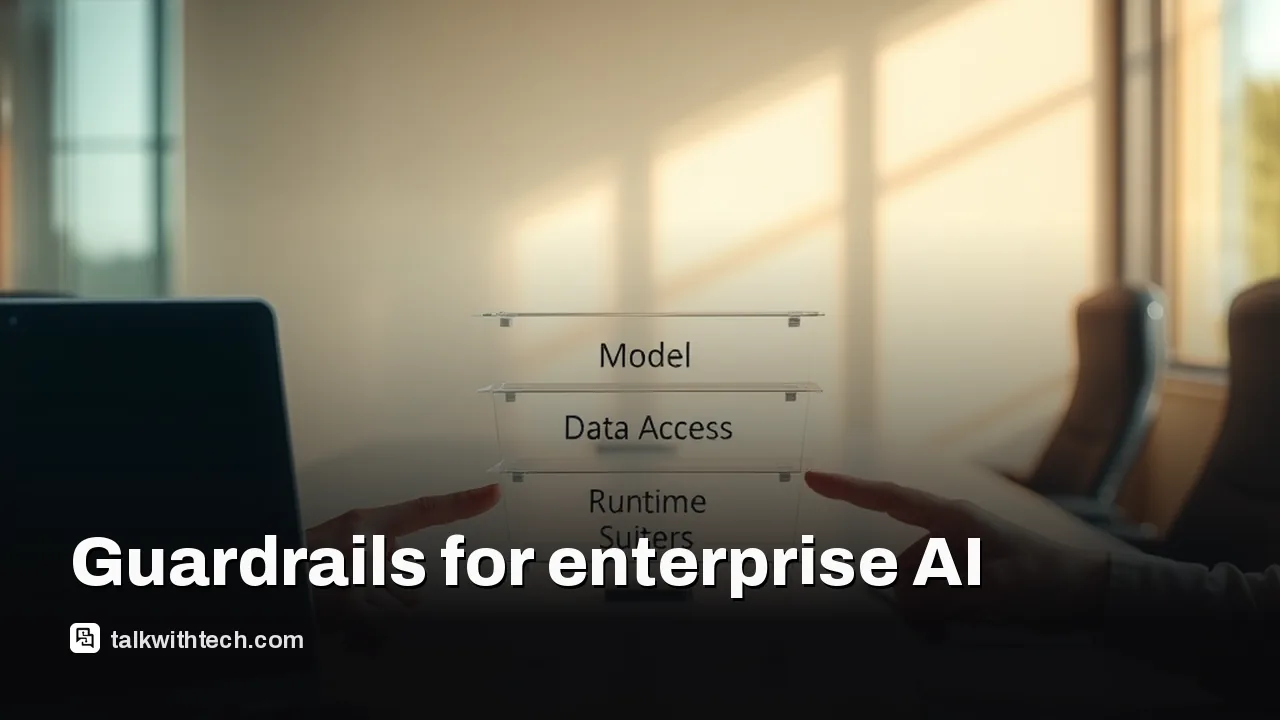
Snowflake’s approach centers on giving customers clear visibility and control through what the company calls a Trust Center. The system spans three layers of protection, linking model choice, data access, and runtime actions, and it’s designed to help customers see where permissions are outdated and prune them before they create risk. Uphadyay stressed that permissions matter because agents, by their nature, can operate without obvious boundaries, so the platform must enforce the “who, what, where, and why” of data access.
The interview also touched on practical governance. Snowflake’s prototypes, Coco and CoWork, were shown as examples of how agents and humans can share the workload. The human in the loop is key, Uphadyay said, especially for tasks where mistakes carry real consequences. It’s a pyramid of automation, he explained: a broad base of routines automated safely, then more advanced automation backed by higher confidence, culminating in tight human oversight for the very top layers.
What this means for everyday users is simple: if your business wants to lean on AI agents to save time and money, you’ll need strong protection and clear processes to prevent data leaks, perimeter breaches, or unintended data moves. Snowflake’s stance is that security isn’t a roadblock anymore; it’s the doorway to reliable AI that can scale up over time.
In short, the message from Snowflake is practical, not theoretical. Companies should expect more guardrails, better visibility into who has access to data, and a staged path to more automation as confidence grows. The implication is that AI agents are here to stay in the enterprise, but only with solid, auditable security practices backing every step.
What happens next is straightforward: expect more firms to rely on governance tools like Snowflake’s Trust Center and similar platforms as they roll out more agentic capabilities with measurable oversight.