Google rolling keyboard brings 116 moving keys to your fingertips
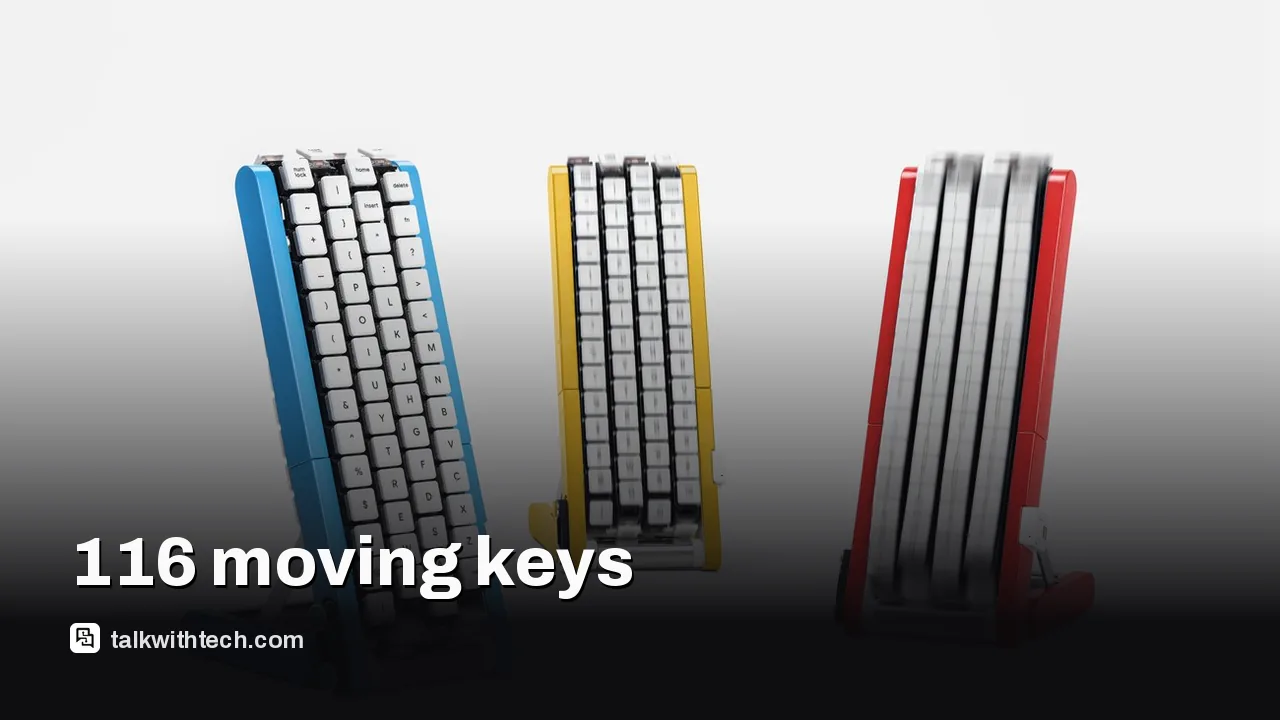
Google Japan’s Gboard team reveals a DIY conveyor-belt keyboard with 116 keys that glide toward the user, designed for one-handed typing and open-source playfully serious.
Google Japan's Gboard team unveiled a DIY conveyor-belt keyboard with 116 keys on four belts that move toward the user.
The concept targets one-handed or single-finger typing and is released as an open-source project on GitHub.
This is a research/demonstration project, not a consumer product, with documentation available for builders.
Quick read · 1 min
Google’s Japan-based Gboard team unveiled a DIY conveyor-belt keyboard that brings 116 keys to a fingertip, using four moving belts. It’s pitched as one-handed typing and is open-source, with design files on GitHub. This isn’t a consumer product, but a research project for makers who want to experiment with input methods and keyboard ergonomics.
The Moving Keys edition is the most documented, while other editions like a Bluetooth-capable version are listed as coming soon. Don’t expect a consumer release any time soon.
For everyday readers, the takeaway is simple: this is a creative concept from a major company that could influence future ideas about how we type, especially for special needs or alternative workflows. If you’re curious, check the GitHub files and wait to see if the community builds a working prototype.
Google is testing an unusual approach to text input that moves the keyboard to your hands. Google Japan’s Gboard team revealed a DIY conveyor-belt keyboard that carries 116 keys on four looping belts, designed to glide toward the user for typing. It’s not a commercial product; Google published the design files on GitHub under an open-source license so makers can print parts, assemble the rig, and experiment with new ways to type.
The project is pitched for one-handed or single-finger typing, flipping the traditional idea of a keyboard on its head. Each of the four belts carries 29 keys, bringing the total to 116. Capital letters are handled by dedicated keys, so users don’t need to press Shift for uppercase. Google frames this as a “Copernican turn” in input design, putting the typing action at the center by making the keyboard move toward the fingertip instead of the hands reaching for the keys.
Google stresses that this is a research and maker project, not a product roadmap. The most fully documented version is called the Moving Keys edition. Other editions, including a Bluetooth-enabled typing version and related board files, are listed as coming soon with no announced dates. The files include KiCad schematics, PCB layouts, and firmware, but building a working unit will require time, tools, and patience.
The idea sits within Google’s long-running series of experimental keyboards that began as April Fools’ gags in 2010. After a hiatus, the series returned in 2021 and has since featured a range of quirky layouts and input ideas. Google says it’s shifted from jokes to shareable hardware concepts for hobbyists and researchers who want to test new ways to type.
01
What this could mean for everyday typing
For most people, this isn’t a simple replacement for a standard keyboard. The setup demands 3D printing, electronics work, and a curious mindset. Still, it raises questions about accessibility and how we type when one hand is occupied or when multitasking. If a consumer version ever appears, it would have to balance comfort, reliability, and cost with the DIY spirit shown here.
02
What parts are documented and what isn’t yet
The Moving Keys edition is the most complete, but Google has not announced a market release or commercial product. A Bluetooth edition and related board files are listed as coming soon, with no dates provided. Builders should expect a phased process from parts manufacturing to electronics integration to firmware testing.
03
Open-source hardware in the wild
Publishing the design files under an open-source license invites experimentation rather than exclusion. Hobbyists can adapt the layout, test different key arrangements, or experiment with belt speeds. For readers, this is a rare instance of a major tech company sharing a complex hardware concept outside a product strategy.
04
What happens next
If you’re curious, you can check the project on GitHub to see the current files and instructions. Expect further updates or new editions as communities test the hardware in real-world setups. For now, there’s no consumer release on the horizon; this remains a research-and-maker project with an invitation to tinker.
Google revealed a DIY conveyor-belt keyboard with 116 keys on four belts that move toward the user, designed for one-handed typing and open-source collaboration.
Is this a product I can buy?
No. Google frames this as a DIY project and research concept, not a commercial product.
Where can I find the instructions?
The design files are published on GitHub under an Apache 2.0 license, with the Moving Keys edition being the most documented.