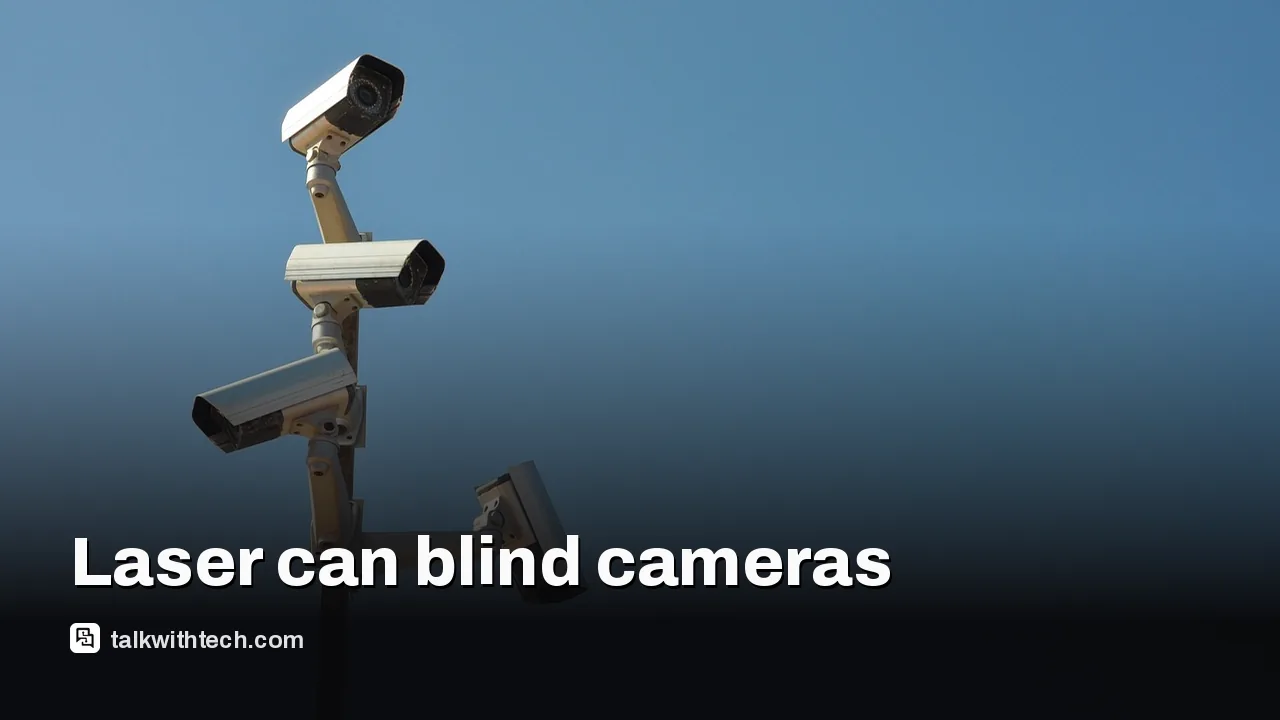
A laser pointer can blind a security camera for a moment, and a powerful one held still can leave permanent dead spots.
Lasting damage needs three things at once: a high-powered laser, an older camera and a very steady aim for about 10 seconds.
Handheld pointers over 5mW are illegal to market or sell in the US, and a 2021 Florida case led to an arrest.
Mounting cameras high, overlapping their views and turning on tamper alerts makes a laser attack far less useful.
Quick read · 1 min
A laser pointer can blind a security camera for a moment by flooding its image sensor with light. In rare cases it can do more: a high-powered laser held still on the lens for about 10 seconds can burn in dead pixels or dark patches that never go away.
In practice it is hard. Testers found it very difficult to keep a beam on a lens from about 5 feet away, and they could not cause permanent damage. Newer cameras are also better protected. Pointers under 5mW mostly cause glare, and in the US stronger handheld pointers are not allowed to be marketed or sold.
Mount cameras high or at an angle.
Overlap views so one blinded camera isn't a blind spot.
Switch on tamper or light-change alerts in your camera app.
A Florida man once aimed a laser pointer at several surveillance cameras and left them with dead spots worth more than $2,000 in damage. He was still caught, on those same cameras. That 2021 case sums up the laser threat to a security camera better than any spy movie: it can work, but not nearly as well as people think.
If you have a doorbell camera, a backyard camera or a few cameras watching a small shop, this is worth two minutes. A laser can blank out your footage for a moment or, in rare cases, ruin a camera for good. The fixes are cheap, and most of them live in where you mount the camera and which settings you switch on.
01
Can a laser pointer really blind a security camera?
Yes, a laser pointer can blind a security camera, at least for a moment. Cameras work by turning light into electrical signals on a small chip called an image sensor. That makes them far more sensitive to a concentrated beam than your eye is.
You have probably seen a milder version already. Car headlights or a flash of sunlight can wash out part of a video frame, leaving glare or a white blob. A laser does the same thing, only harder, because all its light is packed into one tight beam.
The camera lens makes it worse. A lens is built to gather light and focus it onto the sensor, so it squeezes a laser beam into an even smaller, more intense spot, a bit like a magnifying glass focusing sunlight. Most security cameras use one of two sensor types, CMOS or CCD, and both react this way.
02
When glare turns into permanent damage
A quick flash usually leaves no mark. Research on camera sensors describes a sliding scale: at low intensity the image is simply overexposed and recovers on its own, while at higher intensity individual pixels stop responding properly, and at the extreme end the whole sensor can fail.
The damage comes mostly from heat and electrical disruption at the focused spot. In footage, it shows up as dead pixels or dark patches that stay in the same place no matter what the camera is pointed at. Larger dead areas can make a camera useless.
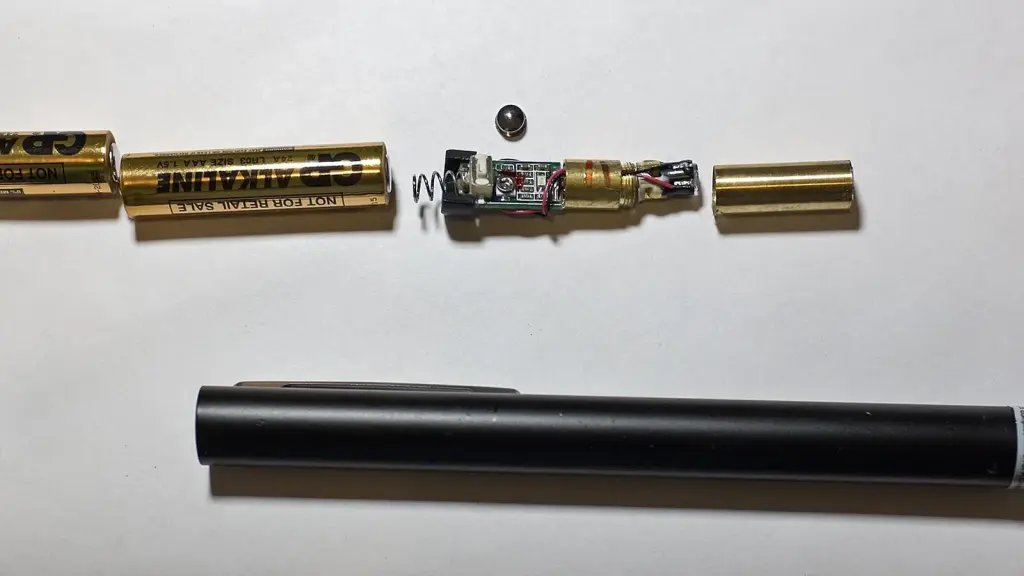
Getting there is hard, though. Lasting damage generally needs a high-powered laser held still on the lens for about 10 seconds. A laser under 5mW, the level of a typical presentation pointer, is unlikely to do more than cause temporary glare.
03
Why the movie trick rarely works in real life
The idea got famous from an episode of Better Call Saul, where a character escapes by pointing a laser at a camera and leaving dead pixels on the monitors. The show’s co-creator, Vince Gilligan, later admitted on a podcast that the trick would only work on a camera from the 1960s.
Real tests back him up. When the security research group IPVM tried to blind cameras with lasers, its team found it very hard to keep a beam on a lens from roughly 5 feet away without their hands drifting. At that distance, they could not cause permanent damage to the cameras they tested, whatever laser they used.
Newer cameras also have better sensor protection than older models. So the realistic risk is an older camera, a strong laser and someone with a very steady hand, all at once. Possible, but uncommon.
04
The legal side: lasers over 5mW
In the US, the Food and Drug Administration does not allow handheld laser pointers over 5mW to be marketed, sold or promoted. That means anyone holding a laser strong enough to hurt a camera already has a device that should not be on the market, and using it to damage someone else’s property can bring criminal charges on top.
The Clearwater, Florida case is the clearest example. The targets were cameras belonging to the Church of Scientology, and the man hit more than one of them. The cameras survived with dead spots on their lenses, the damage topped $2,000, and the footage still showed who did it.
The same goes for phones and personal cameras. Pointing a laser into someone’s lens is not a harmless prank.
For most homes and small businesses, a laser attack is a low risk, because it needs the right laser, the right camera and a lot of patience. Still, a few simple moves make your setup much harder to blind:
Mount cameras high or at an angle. The harder it is to stand in front of the lens, the harder it is to hold a beam on it for seconds at a time.
Overlap your coverage. If two cameras see the same doorway, knocking out one still leaves the other recording.
Use moving cameras where you can. A camera that pans is a harder target to keep a laser on.
Turn on tamper or light-change alerts. Many modern systems can spot a sudden change in light or a blocked view and send an alert to your phone right away.
It is not possible to make a normal home camera fully laser-proof. The goal is to make an attack slow, awkward and useless.
How to tell if your camera has been damaged
Look for persistence. A bright flash or white blob that disappears within seconds points to temporary dazzling, which does no harm. A colored dot, dark spot or line that stays in exactly the same spot across different scenes and lighting is a sign of lasting sensor damage. If you see that, the camera may need repair or replacement, and a second camera covering the same area becomes more important.
06
Quick answers
Can a laser pointer permanently damage a security camera?
Yes, but rarely. It usually takes a high-powered laser held steadily on the lens for about 10 seconds, and newer cameras are harder to damage.
Is it illegal to point a laser at a security camera?
Damaging someone else’s camera can bring criminal charges, as a 2021 Florida arrest showed. In the US, handheld pointers over 5mW are also not allowed to be marketed or sold.
Will a normal laser pointer hurt my camera?
Probably not. Pointers under 5mW mostly cause temporary glare that clears on its own.
Attackers are locking files on outdated Synology NAS boxes with the .L0CK3D extension. Here are the DSM builds that fix it and the steps Synology recommends.
Russia-linked hackers paired an old Chrome bug with a Qualcomm graphics flaw to rob Android phones. Two quick checks show whether yours was ever exposed.
An unreleased OpenAI model found and exploited hundreds of Linux kernel bugs for about $1,279 each. Here's what's patched, who's exposed and what to do.
7 min read
We use cookies to understand how readers use Talk With Tech, so we can make it better. Is that OK? Privacy policy
The Daily Brief
Today's biggest tech stories, in 5 minutes
Every morning, the news that matters from AI, phones, apps and the people shaping tech. Explained in plain English. Free.
One email a day. No spam, unsubscribe anytime. Privacy policy