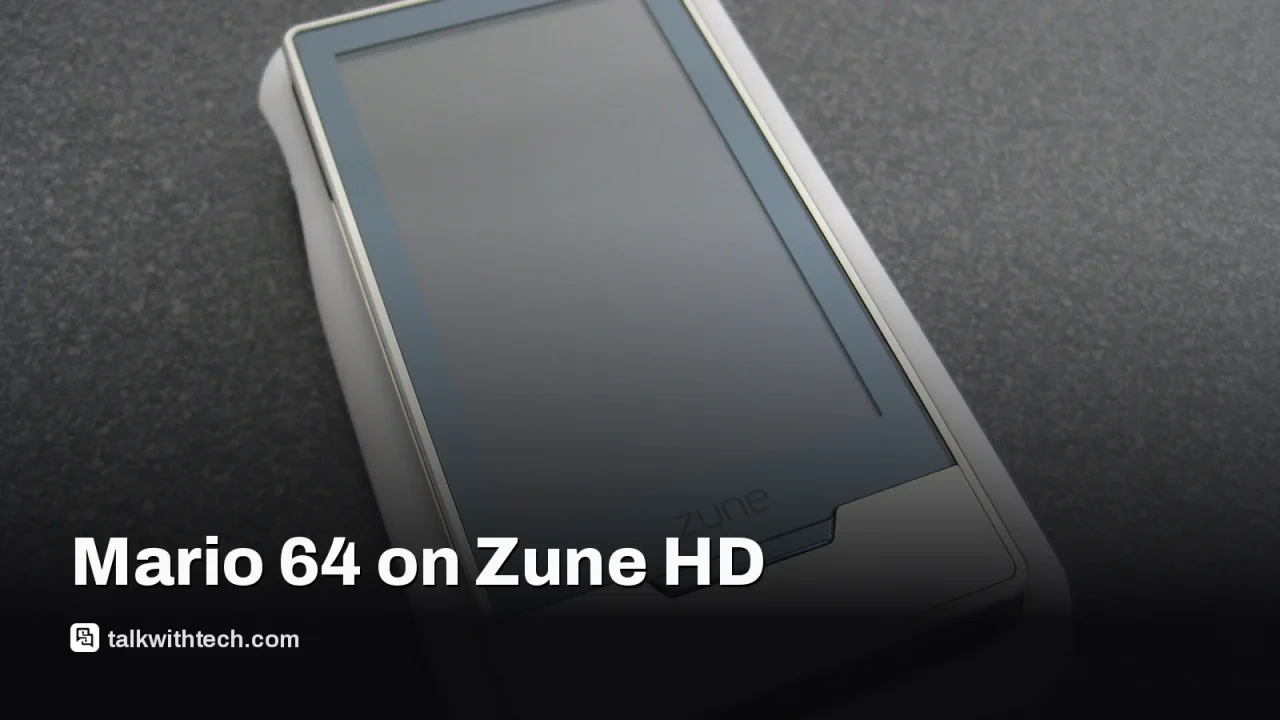
A community project ports Super Mario 64 to the Microsoft Zune HD using OpenZDK, enabling native-style play on the device hardware.
The port runs with a touchscreen overlay and requires users to supply their own ROM, since assets aren’t included in the project.
The Zune HD’s Nvidia Tegra APX 2600 chip and Windows CE-based OS frame the setup, originally priced between $219.99 and $289.99.
Developers built on sm64ex, a decompiled PC port fork, and employ OpenGL ES 2 rendering with several device-specific workarounds.
Quick read · 1 min
A fan project ports Super Mario 64 to the Microsoft Zune HD, letting the 2009 device run the classic game using OpenZDK and a touchscreen control overlay.
You need your own ROM and a Linux Docker-based build. The port uses an OpenGL ES 2 renderer with device-specific workarounds to fit the Zune’s Tegra GPU and Windows CE OS.
Native-style Mario 64 on a handheld from 2009
Requires ROM and self-built software
Highlights ongoing retro-port enthusiasm
A quirky bit of retro hacking is giving the Microsoft Zune HD one more moment in the spotlight. A fan project now runs Super Mario 64 directly on the Zune HD hardware, using an unofficial OpenZDK kit and a touchscreen control overlay. It’s not a commercial release; you must provide your own game ROM and build the port yourself.
How it works is a blend of old hardware and modern tinkering. The Zune HD runs on Nvidia’s Tegra APX 2600 chip and uses a Windows CE-based operating system. The port’s authors rebuilt the game on top of sm64ex, a fork of a decompiled Super Mario 64 PC port, and then bridged it to the Zune through native ARM code. Because the Zune’s GPU can’t compile standard GLSL shaders the usual way, the project uses an OpenGL ES 2 renderer with a few shader workarounds and prebuilt shader variants. The result is a version of the game that aims to run at about 30 ticks per second, with audio and video often keeping pace as long as the device can manage its workload.
The control scheme is a touchscreen overlay that imitates an analog stick and mimics the classic A, B, Z, R, Start and other buttons. It’s a hands-on proof of concept more than a polished port, and the project notes that there can be lag if the Zune struggles to keep up. Since the ROM isn’t included with the project, players must dump a copy from their own cartridge for use with the build. The team emphasizes this is a homebrew effort built on a Linux-based Docker workflow, with no official releases or distribution from Microsoft or Nintendo.
What makes this interesting beyond nostalgia is how it reflects the hobbyist ecosystem around retro gaming. The Zune HD itself is a footnote in tech history, a 2009 multimedia player that competed with early iPods and used an Nvidia Tegra processor. This project shows how fans repurpose aging hardware to run software originally designed for very different platforms, pushing the idea that “retro playable” can still surprise us decades later.
Two Steam games earned $560,000 over five years, but the co-creator says he and his partner took home just about $15,000 a year before taxes and other costs.