Tesla FSD v15 release date: early access now, the rest in December
Tesla's new driving software reached its first owners on November 21. Here is who gets it next, what Reality View shows, and the gap in the 25x safety claim.
Tesla began sending FSD v15 to Early Access Program members on November 21.
Elon Musk says the wide release of v15 will happen in December, with no exact day given.
Tesla claims a 25x better critical intervention rate but has not shared the starting figure.
Reality View, speed camera slowdowns and Bike Rack Mode are the main new features.
Quick read · 1 min
Tesla started rolling out FSD v15 on November 21, beginning with members of its Early Access Program. Elon Musk says the wide release will come in December, but Tesla has not said which vehicles get it first.
The headline feature is Reality View, a generated live picture of the street around the car that shows where it plans to turn or park. Tesla also claims a 25x better critical intervention rate, credited to a vision system trained on millions of internet videos. It has not shared the starting figure, so the claim cannot be checked from outside.
Better detection of potholes, signs, debris and standing water.
The car can slow for speed cameras, and you can cancel that.
Bike Rack Mode allows FSD with a hitch rack attached.
It is still FSD (Supervised), not unsupervised driving.
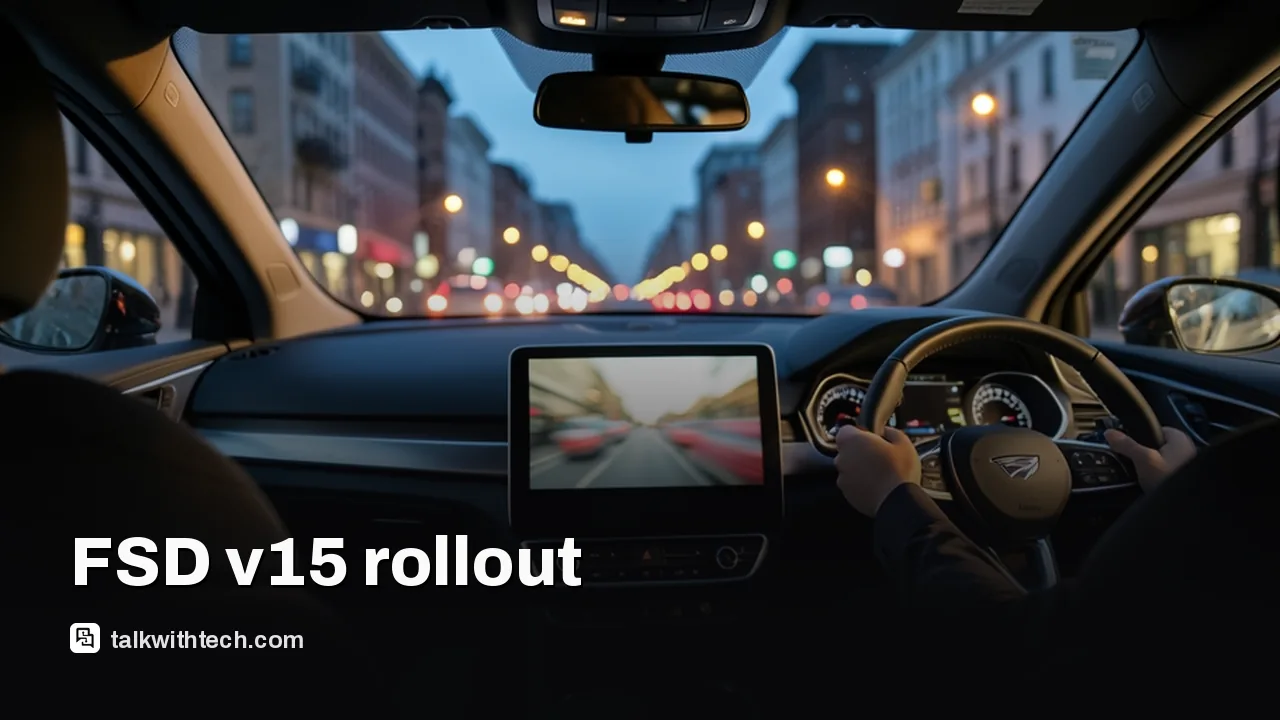
Tesla’s newest driving software redraws the street around your car as you move, a bit like the chase camera in a video game. The Tesla FSD v15 release date for the first owners was November 21, when the company started sending it to members of its Early Access Program, and Elon Musk says a wide release follows in December.
For owners, the appeal is that v15 goes after the things people complain about most: road signs the car misses, potholes it drives straight through, and odd speeds near schools. Tesla also claims the software copes with safety-critical moments 25 times better than before. There is a hole in that number, and it matters.
01
When is the Tesla FSD v15 release date for most owners?
For most owners, the month to watch is December. Musk said on the morning of November 21 that v15 would go wide that month, though he did not name a day. Later the same day, Tesla announced on X that the rollout had begun.
The first builds are going to the Early Access Program, a group of owners who receive new software ahead of everyone else. Ashok Elluswamy, who leads AI at Tesla, described the recipients as the first wave of customers.
Tesla has not said which vehicles get the update first. What it has told investors before is that its AI4 computer, also called HW4, is enough to run v15. Musk has added that the new Reality View display runs on half of one of that computer’s AI accelerators.
One label has not changed. This release is still FSD (Supervised), not the unsupervised driving Tesla has talked about for customer cars.
02
What Reality View puts on your screen
Reality View swaps the old driving display for a live, generated picture of the street, seen from a virtual camera that sits above the car. The earlier display drew outlines of nearby objects. The new one rebuilds your surroundings as you drive and shows where the car plans to turn or park.
Three layouts: the picture can fill the whole screen, share it with the map, or step aside so the map takes over.
Turns in the scene: upcoming turns appear inside the picture itself. Musk describes arrows placed in the sky, and a floating arrow shows which roundabout exit the car will take.
Tap to direct: Musk says you can tap a spot in the picture to send the car there.
Quiet mode: a calmer cabin setting. Turn signal clicks also fade out after the first few.
Musk says the image comes from real-time AI video generation and not from a gaming engine.
One early-access driver could see which parking space the car had chosen, but tapping a different space did nothing. He had to switch to manual, pick the space, then turn FSD back on, at which point it parked where he wanted.
The same driver felt the new version treated people on foot with more care than v14 did. He described a moment in one parking lot when someone ran in front of the car and it was already braking before he had noticed them.
03
The 25x safety claim, and the number Tesla left out
The 25x figure refers to what Tesla calls the critical intervention rate, a measure of how often a human has to step in at a serious moment. Tesla’s release notes tie the gain to an upgraded vision encoder, the part of the software that interprets what the cameras see.
That encoder was trained on millions of internet videos, and Tesla shares it across three programs: FSD, its Robotaxi service and the Optimus robot.
Here is the hole. Tesla gives the multiplier and nothing else. It does not say how far the previous version went between critical interventions, or under what conditions that was measured.
There is also a track record to weigh. In April, Musk predicted v15 would beat human drivers on safety even without supervision, and he had made similar promises about v12 and v14. When v14 arrived in October 2025, it came with harsh braking and excessive speeding before it got a lot better.
04
Potholes, school zones and speed cameras: what changes on the road
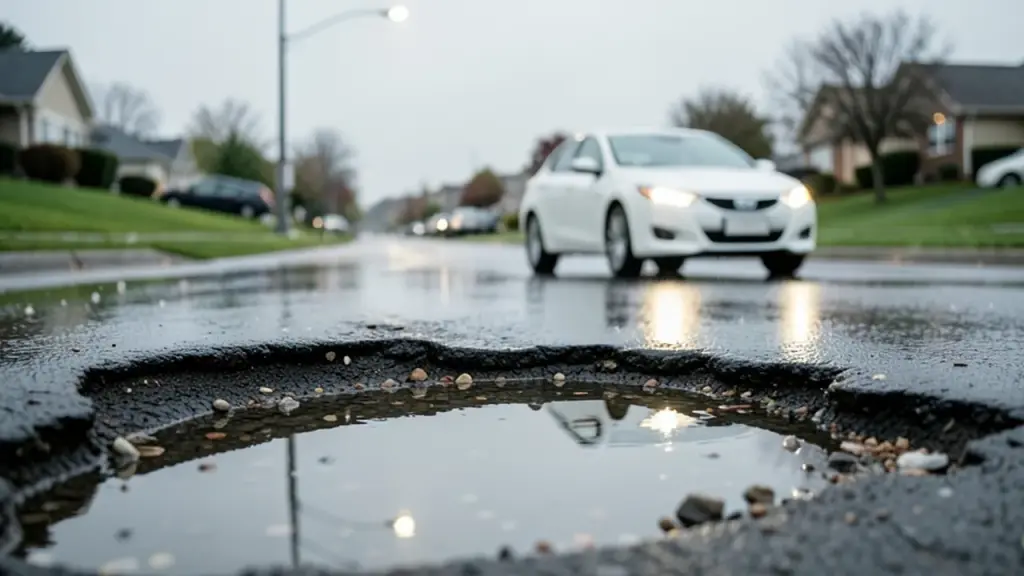
Tesla says v15 is better at spotting the hazards FSD has struggled with. The list covers potholes, deep standing water (which the car should now avoid), road signs, small animals, debris and chains lying in the road. Speed choices in school zones and in bad weather are supposed to feel more natural too.
Speed cameras get their own feature. When the car detects one, it can slow down. You cancel that by pressing the accelerator or raising your speed profile. Cancel twice at the same camera and the car saves the location and stops slowing there. Saved cameras can be cleared later from the service section of the car’s settings.
Navigation changes as well. Routes at the start and end of a trip now draw on the paths other Teslas really take, and Tesla says later v15 releases will stretch that to the whole journey. At your destination, the map can show several parking options, and the car uses your own parking history to help pick one.
The driver monitoring change that cuts the other way
Not every change in v15 tightens things up. Tesla says its camera-based attention checks now work more often when the driver is wearing a hat or sunglasses. In the same line, it says it is reducing how strict monitoring is in the higher-speed driver profiles.
That loosening lands while Tesla is tightening driver monitoring in Europe at the request of regulators. In the US, the safety agency NHTSA opened an investigation in October 2025 into FSD breaking traffic laws, such as running red lights. It is also reviewing a petition that claims Tesla’s Robotaxis speed through active school zones.
06
What this means if you own a Tesla
If you are in the Early Access Program, v15 may already be on its way to your car. Everyone else is looking at December, based on Musk’s comment, and since Tesla has not said which vehicles go first, you may have to wait before it shows up.
If you carry bikes, there is a practical gain. Bike Rack Mode lets you use FSD (Supervised) with a rack or a similar accessory on the hitch. While the mode is active, the car stops close to where you are going instead of backing into a space, so parking is up to you. Autopark, Summon and the backup chimes and warnings are switched off.
As for the 25x claim, a first drive cannot settle it. The December wide release will put v15 in front of far more drivers.
07
Quick answers
Is Tesla FSD v15 available now?
Yes, but only for some owners. Tesla began rolling out the first v15 builds to Early Access Program members on November 21, and Musk says the wide release comes in December.
Will Tesla FSD v15 be unsupervised?
No. The release is labeled FSD (Supervised). It is not the unsupervised system Tesla has discussed for customer cars.
What is Tesla Reality View?
It is the new driving display in v15. It generates a live picture of the street from a virtual camera above the car and shows where FSD plans to turn or park. Tesla’s release notes also call it Tesla Augmented Reality.
An Anthropic mathematician says he and Claude cracked math's most famous open problem. Nobody has confirmed it yet, and the proof exists only as computer code.
Cambridge Dictionary picked "human" over "agent" and "analogue". The reason says a lot about how AI is changing everyday speech, and what people now want to protect.
6 min read
We use cookies to understand how readers use Talk With Tech, so we can make it better. Is that OK? Privacy policy
The Daily Brief
Today's biggest tech stories, in 5 minutes
Every morning, the news that matters from AI, phones, apps and the people shaping tech. Explained in plain English. Free.
One email a day. No spam, unsubscribe anytime. Privacy policy