Tuesday, 20 October 2026

Salesforce buys Braze for $5.66B: the firm behind your app alerts

Braze powers the personalized pushes and emails from apps like Venmo, Instacart and Canva. Salesforce is paying a 58% premium to own that moment of contact.

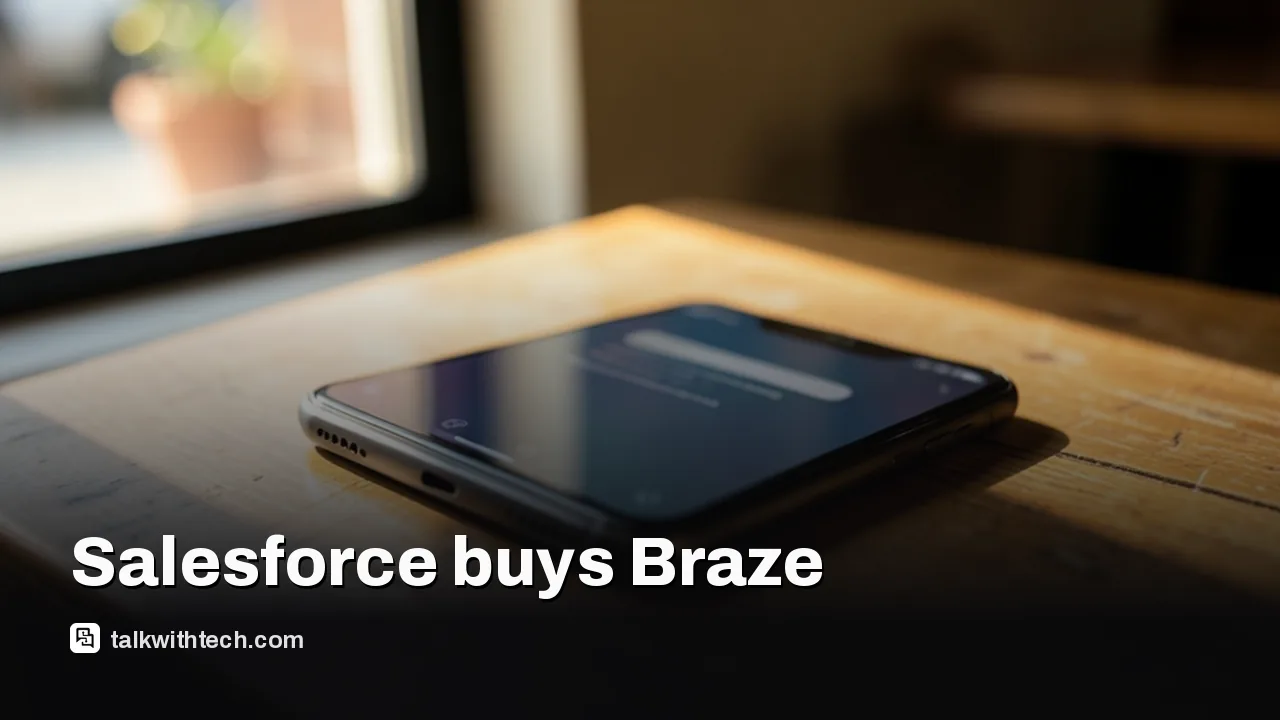
A smartphone on a cafe table lighting up with a blurred notification

The short version

  • Salesforce agreed to buy Braze for about $5.66 billion, paying $47.50 in cash for each Braze share.
  • That price is roughly 58% above Braze's last close of $30.04, and Braze stock jumped more than 50%.
  • Braze sends real-time, personalized messages for about 2,770 brands, including Canva, Instacart, Venmo and Urban Outfitters.
  • The deal needs shareholder and regulatory approval and is expected to close in Salesforce's fiscal 2028, which starts in February 2027.
Quick read · 1 min

Salesforce has agreed to buy Braze, the company behind many of the personalized push notifications, emails and texts that apps send you, in a deal worth about $5.66 billion. Braze shareholders will get $47.50 in cash per share, roughly 58% more than the stock's last close, and Braze shares jumped more than 50%.

Braze works with about 2,770 brands, including Venmo, Instacart, Canva and Urban Outfitters. Its software reacts to what people do in apps in real time. Salesforce wants to connect it with Marketing Cloud, its customer data tools and its Agentforce AI agents.

  • Nothing changes for app users right away; the companies stay separate until closing.
  • Braze keeps its brand and its CEO, Bill Magnuson.
  • The deal needs shareholder and regulatory approval and should close in Salesforce's fiscal 2028, starting February 2027.

If Venmo, Instacart or Canva has ever pinged you at exactly the moment you were about to abandon a cart or forget a task, there’s a good chance Braze sent that message. On Tuesday, Salesforce agreed to buy the New York company for about $5.66 billion, offering Braze shareholders $47.50 in cash for every share.

That price is roughly 58% above where Braze stock closed the day before, at $30.04. Braze shares jumped more than 50% in early trading, which is why “braze” suddenly started trending in US searches. Salesforce stock went the other way, slipping about 3%. For most people, though, the bigger story is quieter: one of the companies deciding when and how apps talk to you is about to belong to the biggest name in business software.

01

What Braze actually does on your phone

Braze makes software that watches what customers do inside an app or on a website and then sends them a message, email or offer in real time. Think of the push notification that arrives after you browse a product, or the email that follows when you stop halfway through signing up for something.

The company works across apps, websites, email, text messages and WhatsApp. Its AI tools help brands decide which content, offer, channel and timing are most likely to get a response. About 2,770 companies use it, including Canva, Dairy Queen, Equinox, Instacart, Urban Outfitters and Venmo.

It’s a fast-growing business, not a rescue job:

  • Quarterly revenue: $227.2 million in the three months to July, up 26% from a year earlier.
  • Full-year outlook: about $910 million in sales this financial year.
  • Big accounts: 361 customers were each paying at least $500,000 a year at the end of July.
A marketing office at dusk with blurred dashboards on large monitors
02

Why Salesforce is paying a 58% premium for Braze

Salesforce wants to shrink the gap between a customer doing something and a brand reacting to it. It already sells Marketing Cloud, its own marketing product, but Braze is built around live behavior and mobile apps, an area where speed counts in seconds.

Salesforce plans to connect Braze with Marketing Cloud, its Data 360 and Customer 360 customer data tools, and Agentforce, its brand for AI agents that can carry out tasks on their own. Patrick Stokes, Salesforce’s president of applications and marketing, said Braze “was built to turn live customer behavior into personalized engagement at scale.”

There’s also a bigger worry driving the deal. Investors have been fretting that fast AI adoption could cut demand for traditional business software, and Salesforce has responded by buying its way deeper into AI. Earlier this year it signed up to pay $3.6 billion for Fin, which makes AI agents, and it bought usage-billing startup m3ter to help charge for its agents, and struck an $8 billion deal for data company Informatica last year.

03

The price tag, in plain numbers

Salesforce says it will pay with cash it already has and doesn’t currently expect to borrow. Robin Washington, Salesforce’s president and chief operating and financial officer, put the deal in context with a few comparisons:

  • The price is about five times the revenue Braze is expected to make in Salesforce’s fiscal 2028.
  • It equals roughly 2.5% of Salesforce’s own enterprise value.
  • The cash involved is about four months of Salesforce’s expected free cash flow for fiscal 2027.

Salesforce expects the deal to help its growth but to dent profits in the near term before cost savings kick in. It says its fiscal 2027 forecast won’t change, and it hasn’t given a fiscal 2028 forecast yet.

Both sides have money on the line if things fall apart. If Salesforce backs out, it owes Braze $300 million. If Braze is the one to abandon the deal, it owes $191.4 million.

A hand holding a phone over a shopping basket in a grocery aisle
04

What changes for app users and the brands you deal with

In the short term, nothing you’ll notice. Salesforce says the two companies will stay independent and keep operating separately until the deal closes. After that, Braze will keep its own brand, and chief executive Bill Magnuson and the leadership team will join Salesforce. Co-founder Jon Hyman also still leads the business. Magnuson said Salesforce’s platform would help Braze build new products faster.

The longer-term question is about data. Braze’s whole job is reacting to how people behave inside apps. Plugging that into Salesforce’s customer data products and AI agents could let brands respond faster and more precisely, with less human input. That’s the selling point for companies. For you, it’s a reminder that the timing of that “you left something in your cart” message is rarely an accident.

If you’d rather hear less from apps, the controls are already on your phone. On an iPhone, go to Settings, then Notifications, and pick the app. On Android, long-press a notification and choose to turn off that category, or open the app’s notification settings. Most marketing emails also carry an unsubscribe link at the bottom.

05

The awkward overlap with Marketing Cloud

Marketers already using Salesforce have a practical headache ahead. Braze and Marketing Cloud both handle customer journeys and messaging, so businesses will want to know which product will own what: where the customer profile lives, which tool runs campaigns, and which overlapping features they’re expected to keep paying for.

Salesforce has said Braze will complement Marketing Cloud, but it hasn’t published a product roadmap. Handled well, the deal could cut steps and integrations out of a company’s setup. Handled badly, it could leave marketing teams juggling one more interface under the same logo.

More automation also raises familiar questions about permissions, data quality and who is responsible when an AI system sends the wrong message to the wrong person.

06

What happens next

The deal still needs approval from Braze shareholders and from regulators. Salesforce expects it to close during its fiscal 2028, which begins in February 2027. J.P. Morgan is advising Salesforce, and Qatalyst Partners is advising Braze.

Until then, the companies run as rivals in name and partners in waiting. Watch for Salesforce’s first roadmap details on how Braze fits beside Marketing Cloud, which will show whether this is a true merger of products or just a bigger portfolio.

07

Quick answers

How much is Salesforce paying for Braze?

About $5.66 billion in enterprise value, with Braze shareholders getting $47.50 in cash per share, about 58% above the previous close.

When will the Salesforce Braze deal close?

Salesforce expects it to close in its fiscal 2028, which starts in February 2027, once shareholders and regulators approve it.

Will Braze change its name or shut down?

No. Salesforce says Braze will keep operating under its own brand, with CEO Bill Magnuson and his team joining Salesforce.

You're reading the quick version.