Wednesday, 25 November 2026

What is the EU Quantum Act? Europe’s buy-local quantum bet

Brussels wants its quantum labs to become quantum companies. The plan favors EU-controlled suppliers, tackles code-breaking risk and still faces years of debate.

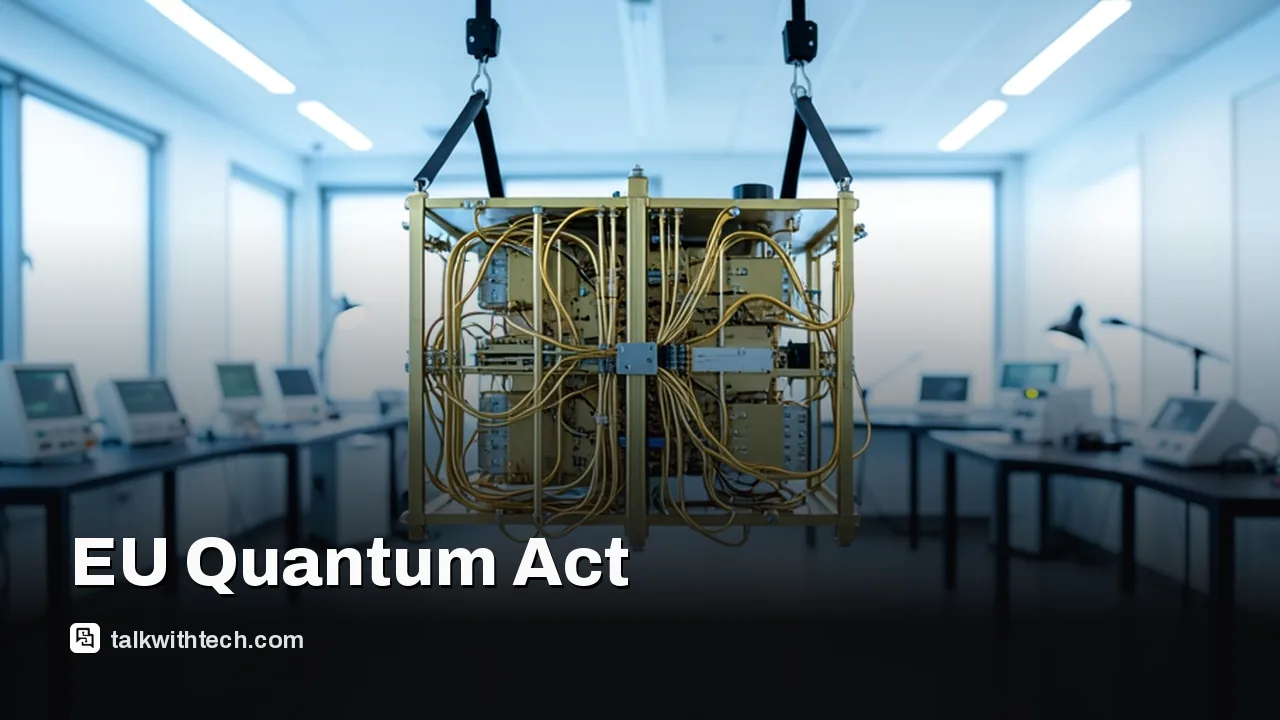
A gold quantum computer cryostat hanging in a research lab

The short version

  • The European Commission proposed the Quantum Act on November 25 to turn Europe's quantum research into companies, factories and products.
  • A draft of the law would restrict some public quantum purchases to EU-controlled suppliers, with room for partner countries that have agreements.
  • The Act also prepares government systems for post-quantum encryption and paves the way for a Sovereign Tech Equity Fund reported at up to €50 billion.
  • It is only a proposal: the European Parliament and EU member states must each approve it, a process that usually takes years.
Quick read · 2 min

The European Commission proposed the EU Quantum Act on November 25. It's a framework law meant to turn Europe's strong quantum research into real companies and products, rather than a big new budget.

Three things stand out:

  • A draft would steer some public quantum purchases to EU-controlled suppliers, which could squeeze out American, British and Canadian firms unless their countries strike deals.
  • It prepares government and critical systems for post-quantum encryption, the new security meant to survive quantum code-breaking.
  • It paves the way for a Sovereign Tech Equity Fund, reported at up to €50 billion, for AI, quantum and other critical tech.

Europe hosts about a third of the world's quantum firms but gets only around 5% of private quantum investment. Nothing changes yet: the European Parliament and member states must approve the plan, which usually takes years. The debate starts at a Dublin conference from November 30.

Europe is home to roughly a third of the world’s quantum companies, yet they win only about 5% of global private quantum investment while US firms take more than half. That gap is the whole reason for the EU Quantum Act, which the European Commission proposed in Strasbourg on Wednesday, November 25.

So what is the EU Quantum Act? In short, it’s a proposed EU law that tries to turn Europe’s strong quantum science into real products, steer public buyers toward European suppliers and get government systems ready for a day when quantum computers can crack today’s encryption. If you live in the US, the UK or Canada, it matters for two reasons: it could shut some non-EU companies out of European contracts, and it is part of a wider race with the United States and China over who builds this technology first.

01

What is the EU Quantum Act, in plain terms

The EU Quantum Act is a framework law, not a spending bill. Thomas Skordas, a deputy director-general in the Commission’s digital department, has described it as an “enabling framework” and said that the act “is not about budget.” Its job is to get EU countries pulling in the same direction instead of running overlapping national programs.

Quantum computers use the odd behavior of very small particles to tackle problems that ordinary computers can’t handle in any useful time. The Commission talks up uses such as faster drug discovery, new materials and navigation that works without satellites.

The Commission’s own summary says the Act has two broad goals. One is to keep Europe’s science lead and build industrial muscle. The other is to make quantum supply chains safer and prepare for quantum-safe security. To get there, it would:

  • Create a Quantum Europe Framework Initiative, a shared EU program that member states must line their national quantum plans up with.
  • Fund targeted challenges, such as quantum computers that keep working when errors creep in.
  • Build shared infrastructure across Europe, including quantum computers and simulators that researchers and companies can use.
  • Set up hubs that give startups and smaller firms engineering help, testing support and access to investors and public buyers.
  • Map supply chains, spot critical suppliers and components, and cut reliance on a few non-EU sources.
Blue flags outside a modern glass government building at dusk
02

Why Europe wants its own quantum industry

Europe is good at quantum research and bad at turning it into big companies. That’s the Commission’s own diagnosis. Officials worry that promising startups get bought by foreign rivals, or move abroad to find investors, before they can grow.

The numbers are stark. By the Commission’s count, European quantum firms attract only about 5% of the world’s pre-seed and seed funding, compared with more than half going to US companies. The United States leans on private money from big tech firms, while China builds infrastructure with public funding.

Some countries haven’t waited. France has put €500 million into homegrown quantum champions, and Finland’s IQM runs what is described as Europe’s only private quantum chip factory. The Act is meant to stop those efforts from competing against each other for the same people and customers.

03

The buy-European clause outside companies will watch

This is the part with teeth for anyone outside the bloc. Draft text of the Act says it is necessary to limit some procurement to quantum products, systems and services from “Union controlled entities,” citing security and technological autonomy. Earlier leaked drafts also suggested that firms from countries with reciprocal deals with the EU could still qualify.

In practice, that means a hospital, research lab or government agency in the EU could be told to pick a European-controlled quantum supplier over a cheaper or more advanced foreign one. Ownership would sit next to price and performance as a deciding factor. For American, British and Canadian quantum firms, access to these contracts may depend on whether their country lands a qualifying agreement with Brussels.

The Commission’s public summary talks more softly about “targeted procurement safeguards” and working with international partners on supply chains. The exact rules could still change before anything becomes law.

A padlock beside a laptop with a dark screen on a desk
04

What it means for your bank, your messages and your data

The security side is the part most likely to touch ordinary people. A powerful enough quantum computer could break the encryption that protects online banking, messaging, digital IDs and state secrets. The Commission warns that public administrations, financial services and critical infrastructure would all be exposed.

The fix is post-quantum cryptography, meaning new encryption methods built to resist quantum code-breaking. The Act sets up a coordinated move to these methods across the EU, with checks on how prepared organizations are. Public buyers in critical sectors would be expected to use systems that can withstand quantum attacks.

None of this changes your phone or bank app tomorrow. The rules aim at how public bodies and critical services buy and secure their systems over the coming years.

05

The money: a fund reported at €50 billion

Alongside the Act, the Commission laid the groundwork for a Sovereign Tech Equity Fund. It would buy stakes in companies working on technologies Europe sees as critical, including AI and quantum, and take bigger, riskier and longer-term bets than existing EU schemes.

The fund has been reported at up to €50 billion (about $54.73 billion). The Commission says it will set it up with the European Investment Bank Group and member states, and hopes it will draw in hundreds of billions in private money. For comparison, the EU’s Scaleup Europe Fund holds €5 billion, and a 2023 fund of funds for late-stage startups holds €3.75 billion.

06

When the EU Quantum Act could actually take effect

Not soon. What happened this week is a proposal. The European Parliament and the Council, which represents member state governments, must each approve it and settle their differences, and that kind of process usually takes years.

The first big public debate comes quickly, though. The Act tops the agenda at the European Quantum Technologies Conference in Dublin from November 30 to December 2. The wider goal it serves, the Quantum Europe Strategy adopted in July 2025, aims to make Europe a world leader in quantum by 2030.

07

Quick answers

Is the EU Quantum Act already law?

No. The Commission proposed it on November 25. The European Parliament and EU governments still have to debate, amend and approve it.

Does the EU Quantum Act affect US companies?

It could. Draft text would reserve some EU public quantum purchases for EU-controlled suppliers, with possible room for firms from countries that have deals with the bloc.

Is the €50 billion fund part of the Quantum Act?

The Act allows the Sovereign Tech Equity Fund to be created. Its reported size of up to €50 billion covers AI and other critical technologies, not just quantum.

You're reading the quick version.