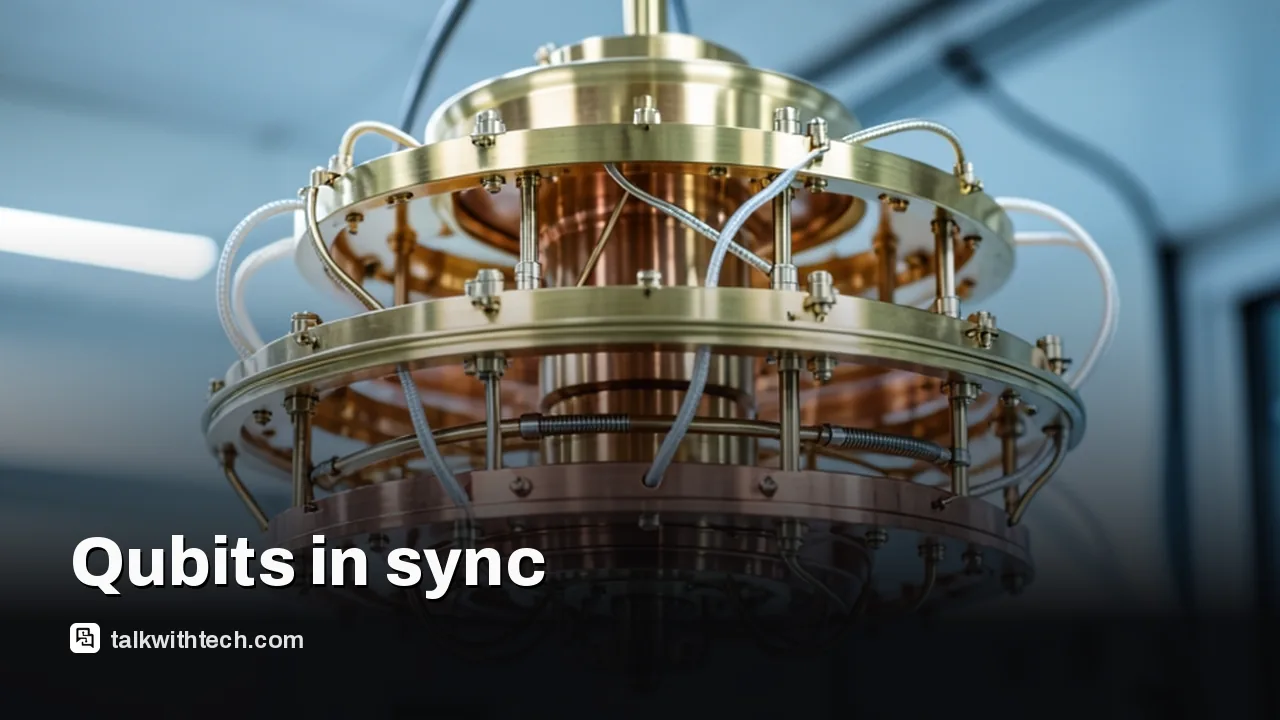
Silicon quantum computer qubits finally work together at 99.9%
RIKEN scientists ran five silicon qubits at once on one shared control wire without losing accuracy, fixing a problem that has held chip-style quantum computers back.
RIKEN-led researchers operated five silicon spin qubits at the same time through a single shared microwave line.
All five kept about 99.9% accuracy together, and up to three stayed above 99.99%, results published in Nature Physics.
The team traced the main error to the AC Stark shift and canceled it with a simple calibration between pairs of qubits.
Silicon qubits can be made with ordinary chip factory methods, which could make larger quantum processors easier to build.
Quick read · 1 min
Researchers led by Japan's RIKEN have shown that silicon qubits can work together without losing much accuracy. In a study in Nature Physics, they ran five qubits at once through a single shared microwave control line and kept accuracy around 99.9%, a level often cited as the bar for error-corrected quantum computing.
The problem they solved was crosstalk. Microwave pulses aimed at one qubit were shifting the phase of its neighbors, an effect called the AC Stark shift. The team measured how each pair of qubits affects the other and used that to cancel the errors.
Up to three qubits at once stayed above 99.99% accuracy.
Silicon qubits can be built with standard chip-making methods.
Extra microwave power still causes some errors, which better magnets could reduce.
Five silicon qubits, one control wire, all running at once, and about 99.9% accuracy across the board. That is the result a team led by Japan’s RIKEN research institute has published in Nature Physics, and it removes a stubborn roadblock for a type of quantum computer that could be built in ordinary chip factories.
Why should anyone outside a physics lab care? Quantum computers promise to crack problems in chemistry, materials and medicine that today’s machines can’t touch, and they worry security experts because a large enough one could break some of today’s encryption. Getting there means running many qubits at the same time without errors piling up. This study shows one way to do that with silicon, the same material in your phone’s processor.
01
Why silicon quantum computers are worth the trouble
A qubit is the basic unit of a quantum computer. A normal bit is either 0 or 1, while a qubit can hold a mix of both. There are several ways to build one, from superconducting circuits to trapped atoms.
Silicon spin qubits store information in the spin of a single electron trapped in silicon. In this experiment the electrons sit in tiny structures called quantum dots, in a device made of silicon and silicon-germanium. Their big selling point is manufacturing. They can be made with the same semiconductor methods the chip industry already uses for billions of processors a year, which in theory makes scaling up far easier than inventing new production lines.
The catch has always been crowds. Silicon qubits behave beautifully alone but get sloppy when several are controlled at the same time.
02
The hidden error that spoiled teamwork
Qubits like these are steered with microwave pulses. Send pulses to several at once, and a signal meant for one qubit nudges its neighbors. In earlier experiments, that kind of crosstalk dragged accuracy down from about 99.95% to roughly 99.5%. That sounds small, but quantum error correction, the scheme that lets a quantum computer survive its own mistakes, needs operations to be very accurate before it can work.
Parallel operation isn’t optional, either. Idle silicon qubits lose their delicate quantum state much faster than ones being actively driven, so error correction routines need many qubits working at the same moment.
The RIKEN team found the main culprit: the AC Stark shift. When a microwave pulse passes near a qubit, it slightly changes that qubit’s effective energy levels. That shifts the phase of its quantum state, a bit like a clock quietly running a few seconds fast, and the planned operation comes out wrong.
03
A pair-by-pair fix that scales
The key finding was that these phase errors add up in a predictable, linear way. So instead of calibrating every possible combination of qubits, which quickly becomes impossible as numbers grow, the team measured how each pair of qubits affects the other and used those measurements to cancel the shifts.
First author Yi-Hsien Wu, who ran the experiments as part of his PhD, said the method avoids a separate calibration for every combination. Combined with a better device design and tuned microwave pulses, the results were:
One at a time: each of the five qubits scored well above 99.99% accuracy, the best close to 99.999%.
Up to three at once: accuracy stayed above 99.99%.
All five at once: about 99.9%, through a single shared microwave line.
That 99.9% mark matters because it is a widely used threshold for fault-tolerant quantum computing, the point where error correction can keep up. It does not mean a fault-tolerant machine exists yet.
The work involved researchers from RIKEN’s Center for Emergent Matter Science along with National Taiwan University, ETH Zurich and TU Delft. Co-first author Leon Camenzind, who supervised the experiments, called it an important step toward scaling up silicon-based quantum processors.
04
What still stands in the way
The fix didn’t remove every error. Driving five qubits at once takes more microwave power, and that extra power causes some loss of quantum coherence, the fragile state the calculations depend on. Camenzind described it as a limitation that better device designs could reduce.
The team has ideas. It suggests replacing the small magnets on top of the chip, which help steer the electron spins, with tiny magnets built into the chip’s wiring layers. That could make the local magnetic field stronger, allowing faster operations at lower microwave power. The researchers see modules of about ten qubits per shared control line as a possible next step, though that is a goal, not a result.
Sharing one control line between many qubits is a practical win. Giving every qubit its own wiring gets messy fast, adds heat inside the ultra-cold fridges these machines need, and makes chips harder to build. Fewer wires per qubit is one of the things that has to happen before silicon quantum chips can grow from a handful of qubits into the thousands or millions needed for useful work.
For now, nothing changes for your phone, your bank or your passwords. This is lab progress on five qubits. But it moves silicon, the material the chip industry knows best, a step closer to being a serious contender in the quantum race. Seigo Tarucha, who leads a silicon quantum computing project under Japan’s Moonshot research program, said the long-term goal is a fault-tolerant quantum computer built on silicon spin qubits.
06
Quick answers
What is a silicon spin qubit?
It is a qubit that stores information in the spin of a single electron trapped in silicon. It can be made with methods similar to those used for ordinary computer chips.
What did the RIKEN team achieve?
They ran five silicon qubits at the same time through one shared microwave line and kept accuracy at about 99.9%, by correcting an error called the AC Stark shift.
Does this mean quantum computers can break encryption now?
No. This is an early lab result on five qubits. Breaking modern encryption would need far larger, error-corrected machines.
On Europe's first exascale supercomputer, Nvidia modeled an error-correcting quantum processor in record detail. Here's why faking a quantum computer on ordinary chips matters.