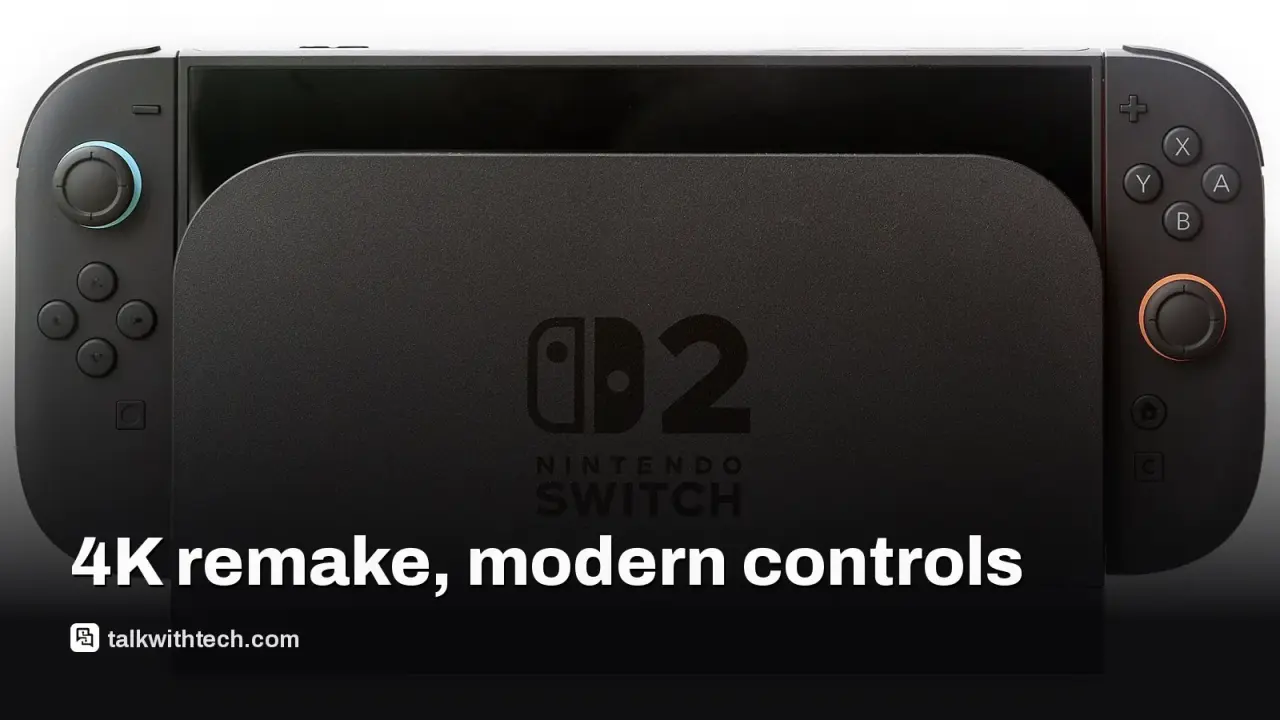
Zelda Ocarina of Time Switch 2 remake adds 4K and modern controls
The Zelda Ocarina of Time Switch 2 remake is out now, with sprinting, jumping, a free camera and fresh music, plus a few changes fans are arguing about.
Nintendo released its Switch 2 remake of The Legend of Zelda: Ocarina of Time on November 5, and it is exclusive to Switch 2.
Link can now sprint, jump on command and look around with a free camera, while menus give way to a quick item bar.
Several boss fights were reworked, Great Fairy upgrades now cost rupees, and story scenes are fully voiced except for Link.
Some changes annoy fans, including a single manual save slot per profile and a weaker hookshot in Kakariko Village.
Quick read · 2 min
Nintendo's remake of The Legend of Zelda: Ocarina of Time came out on November 5, only on Switch 2. It rebuilds the 1998 classic with 4K visuals, newly orchestrated music and voiced cutscenes, and it plays far more like a modern game.
Link can sprint and jump on command, with a free camera on the right stick.
A quick item bar replaces menu trips, and a new tracker guides newcomers.
Boss fights were reworked and Great Fairy upgrades now cost rupees.
Reviews are very positive, and one report calls it the highest-rated game of 2026 so far. Fans do have gripes: there is only one manual save slot per profile, the hookshot can't reach Kakariko rooftops anymore, and Link's glossy new face splits opinion. The download needs 24.5 GB, and reported prices range from $60 to $70, so check your store first. If you want two playthroughs, use a second user profile.
The man who runs the shooting gallery in Castle Town is having a terrible year. In the Zelda Ocarina of Time Switch 2 remake, a motion-aimed slingshot and a smoother frame rate mean his targets drop on the first try, and the rupees he used to squeeze out of frustrated players stay in Link’s pocket.
That small joke from an early preview sums up the whole project. Nintendo has rebuilt its 1998 Nintendo 64 classic from the ground up for Switch 2, with 4K visuals and controls that finally behave like a modern game. If you loved the original, or never played it because it looked too dated, this is the version Nintendo now wants you to play. It went on sale on November 5, and the early verdicts are glowing, with a few real complaints mixed in.
01
When the Ocarina of Time remake came out and what it costs
The remake launched on November 5 as a Switch 2 exclusive. Like most eShop games, it unlocked at local midnight, so players on the West Coast of North America could start on the evening of November 4. Preloads opened on October 29, and the download takes 24.5 GB of storage, so clear some room if your console is nearly full.
Reports list the price differently. One review gives it as $60, while another lists it at $70 in the US. Check your store before you buy, because the gap is worth knowing about. It is not available on the original Switch, and there is no PC or other console version from Nintendo.
02
What changes when you pick up the controller
The biggest difference is how Link moves. In 1998 he jumped automatically whenever he ran off a ledge, and crossing Hyrule Field meant endless forward rolls. Now he can sprint, and you press a button to jump wherever you like.
The camera has changed just as much. The original game had no second stick for looking around, so you leaned on Z-targeting to face enemies or reset your view. The remake gives you a free camera on the right stick, and targeting moves to a trigger, the way most modern action games work.
Other quality-of-life fixes follow the same idea:
A scrolling item bar replaces trips into the pause menu to swap gear.
Link’s wallet holds more rupees.
Aiming items like the bow or hookshot now uses an over-the-shoulder view, with optional gyro (motion) aiming.
A new story tracker called Threads of Time helps newcomers keep track of the main quest.
You still won’t find fast-travel points. Instead, as in the original, you play songs on the ocarina to warp to the Temple of Time and dungeon areas.
The music has been newly orchestrated. Tunes that once squeezed through the N64’s compressed instrument samples now have full brass and strings, and the remake adds calmer nighttime versions of some of Koji Kondo’s area themes, arranged by sound director Masato Ohashi.
Story cutscenes are now fully voiced for every character except Link. Reviewers found the acting a bit cartoonish, and one felt the voiced scenes run longer than the old text boxes did.
Hyrule itself is far more detailed. Castle Town, once a fixed backdrop, can now be explored in large part. The day and night cycle runs much slower and keeps going inside towns, so you can watch characters walk to their evening spots in real time. The catch is that the Hyrule Field drawbridge no longer rises at night.
Link’s face is the most argued-over change. His big, glassy eyes and shiny cheeks led some critics to accuse Nintendo of chasing a glossy next-gen look. Former Zelda art director Takaya Imamura suggested on X that the design reflects Shigeru Miyamoto’s love of Japanese puppet theater, which would explain the doll-like finish.
04
The changes fans don’t like
Not every tweak has gone down well, and a few are worth knowing about before you start.
One manual save slot. The N64 game had three save files. The remake gives each user profile a single manual save. Starting a new game warns you that auto-saves will be overwritten, but it does not spell out that you can’t keep two manual files. At least one player lost a full 100% playthrough this way. The only clean workaround is to use a second Switch 2 user profile for a second run.
A weaker hookshot. Many grapple points that used to be natural features, like branches, are now clearly marked targets, and the hookshot can no longer latch onto the rooftops in Kakariko Village.
No first-person look. You can no longer zoom into a first-person view to study your surroundings up close.
On the other side, some changes earn praise. Several famous boss fights now have new attacks and animations, so even veterans get surprises. Great Fairy upgrades, free in 1998, now cost rupees, sometimes hundreds of them. That gives you a reason to chase side content and Gold Skulltula tokens.
Should you buy the Zelda Ocarina of Time Switch 2 remake?
If you own a Switch 2 and like Zelda, reviews say yes. One longtime player called it the most fun they’d had replaying any game and said its redone graphics outshine Breath of the Wild and Tears of the Kingdom. Another review described it as a polished victory lap for a game with little left to prove. By mid-November, one report called it the highest-rated game of 2026 so far.
For newcomers, it is the easiest way to see why this game is famous without squinting at blurry N64 graphics on a flat-screen TV. The dungeons are tighter and more puzzle-heavy than the sprawling open worlds of the recent games, which many players will find a welcome change.
For veterans, expect the story and structure you remember, with enough reworked moments to keep you guessing. If you plan more than one playthrough, set up a second user profile before you start, so the save-slot limit doesn’t cost you a finished file.
06
Quick answers
Is the Ocarina of Time remake on the original Switch?
No. Nintendo released it only for Switch 2, on November 5.
How big is the download?
The preload needs 24.5 GB of free storage on your Switch 2.
Can I keep more than one save file?
Not on one profile. Each user profile gets a single manual save, so use a second profile for a separate playthrough.
Nintendo's new patch unblocks a story event that left some Switch 2 players stranded, and your stuck save comes along for the ride. Here's how to grab it.