iPhone 18 Pro orders slowed as Apple trims October component buys
Apple reportedly cut October iPhone 18 Pro part orders by at least 15% after a $100 price rise. Since then, waits have shrunk and resale prices have slipped.
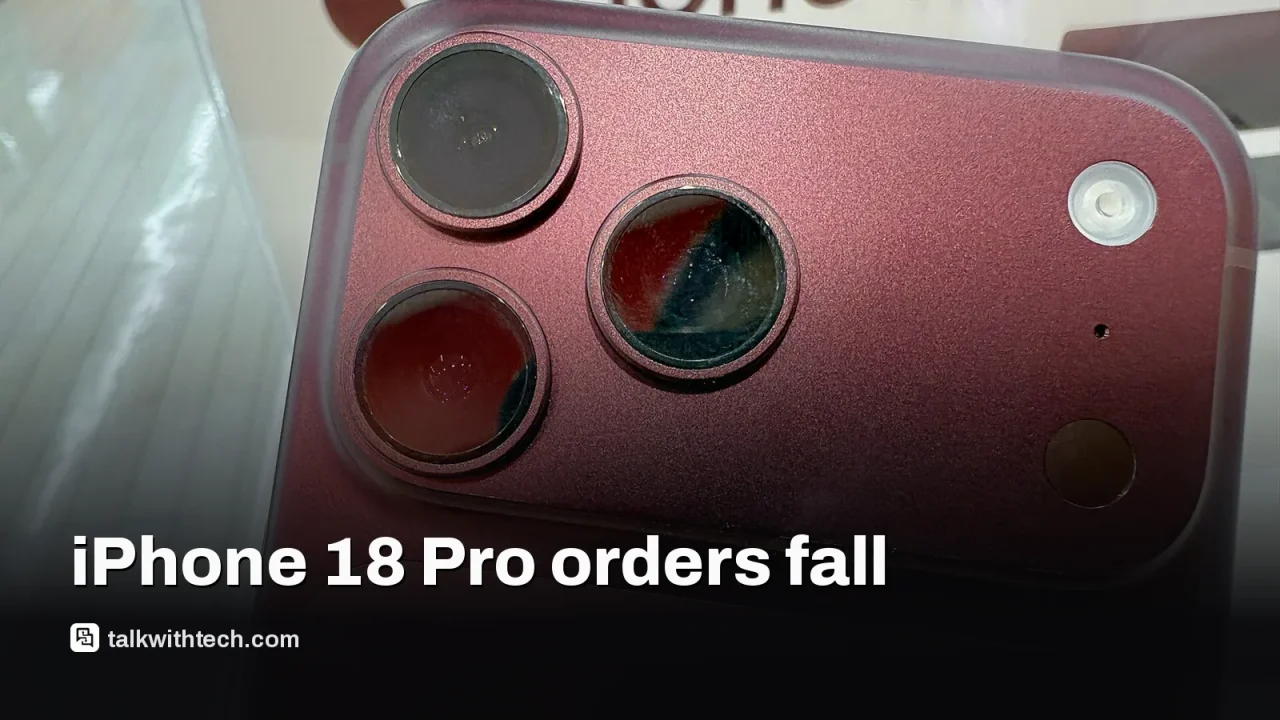
Apple reportedly cut October component orders for the iPhone 18 Pro and Pro Max by at least 15%, with some sources saying up to 20%.
Both phones cost $100 more than last year, starting at $1,199 and $1,299, which Apple blames on rising memory chip prices.
Since then, analysts have tracked shrinking delivery waits, resale prices below retail and discounts in China.
Apple reports its quarterly results on November 6, the first official look at how the new iPhones are selling.
Quick read · 1 min
Apple has reportedly told suppliers to cut October parts orders for the iPhone 18 Pro and Pro Max by at least 15%, and possibly 20%, because demand is weaker than expected.
The likely reason is price. Both phones cost $100 more than last year, starting at $1,199 and $1,299 in the US, and Apple blames pricier memory chips. Apple's new launch schedule also matters: the standard iPhone 18 won't arrive until spring 2027, so this fall only premium models are on sale.
Delivery waits in China have dropped to zero.
Resale prices fell below retail from late September.
The $1,999 iPhone Duo foldable goes on sale October 23.
For buyers, that means easy availability and possibly better deals. Apple's November 6 earnings report will show how sales are really going.
A $100 price rise may be costing Apple buyers. Apple has asked suppliers to make fewer parts for the iPhone 18 Pro and iPhone 18 Pro Max, cutting October component orders by at least 15% from what it first requested, according to a Nikkei Asia report that cites people in Apple’s supply chain. Some of those sources put the cut at 15% to 20%.
Why should you care? Because the reason looks a lot like your wallet. Both Pro phones went on sale on September 18 at $1,199 and $1,299 in the US, $100 more than the models they replaced, and Apple blames the rise on memory chips that have become far more expensive as AI data centers buy up supply. If shoppers are pushing back, that affects how easy the phones are to find, how quickly they get discounted and what next year’s iPhones might cost.
01
Why Apple slowed iPhone 18 Pro orders
Apple has been more careful about shipments since early September, the report says, because demand for the new Pro models has been weaker than for last year’s phones. The cause appears to be price. Memory costs have pushed up prices across Apple’s lineup, including MacBooks, iPads and older iPhone 16 and 17 models.
The squeeze shows up in the specs too. The iPhone 18 Pro models have 12GB of RAM, the same as the iPhone 17 Pro. One rumor says Apple planned 16GB but dropped the idea because of cost.
The wider phone market is in the same bind. Research firm IDC expects global smartphone shipments to fall 16.7% in 2026, while average selling prices rise 27.6%. In plain terms, fewer phones are selling, and each one costs more.
A different launch calendar is muddying the picture
There is a second reason the numbers look soft. This year Apple broke with tradition and launched only its three premium iPhones in the fall. The regular iPhone 18, the cheaper iPhone 18e and the thin iPhone Air 2 are expected in spring 2027 instead.
That matters because the standard iPhone usually drives a big share of fall sales. Without it, the lineup leans entirely on its most expensive phones. Some buyers may also be waiting for the iPhone Duo, Apple’s first foldable, which starts at $1,999 for 256GB and opened for preorders on October 16. It goes on sale on October 23 across 70 countries and regions.
03
What has happened since the report
Follow-up tracking points the same way. In a note to clients, Jefferies analyst Edison Lee said demand weakness for the Pro and Pro Max was continuing:
Waits have vanished in China. Lead times there fell to zero, compared with six days for last year’s Pro and 25 days for last year’s Pro Max. Waits in Japan are also much shorter, though US waits for the Pro Max are longer than last year.
Resale values dipped. Every Pro variant has traded below its retail price on the resale market since late September, while last year’s models sold at a premium of 1% to 6%.
Discounts started. Chinese shopping platform PDD began cutting the Pro by 6% and the Pro Max by 9% on Oct. 16.
Jefferies also heard that Apple trimmed orders for some parts, including 2nm chips, by 10% to 15%, though the net cut to assembly orders so far is only about 2 million phones. Lee said further cuts are possible if demand stays weak. Earlier, UBS analysts noted that delivery waits were shrinking across more than 30 markets.
Not every signal is bad. iPhone sales in China jumped more than 40% from a year earlier in the two weeks after launch, before slowing to about 8% in early October. Jefferies puts some of that early strength down to discounted sales of leftover iPhone 17 Pro stock. Meanwhile, waits for the iPhone Duo stretched past 90 days after preorders opened.
04
What it means for iPhone buyers
For shoppers, softer demand is mostly good news. The iPhone 18 Pro and Pro Max should be easy to get with little or no wait in most places. Weak resale prices also mean that if you are patient, carrier promotions and trade-in deals could become more generous over the holidays, although Apple has not cut its own prices.
Lower orders do not automatically mean Apple earns less. The new Pro models cost about 10% more than last year’s, so higher prices can make up for some of the lost volume. Apple has not commented on the reported cuts.
If you are deciding now, ask what you really need. If you want Apple’s best phone this fall, the Pro models are the only new choice. If price matters more, the standard iPhone 18 and iPhone 18e are expected in spring 2027.
The clearest answer comes on November 6, when Apple reports results for its fiscal fourth quarter, covering the first weeks of iPhone 18 Pro sales. The iPhone Duo’s launch on October 23 is the other test, showing whether buyers will pay $1,999 for a foldable at a time when $1,199 already looks like a stretch.
06
Quick answers
Did Apple cut iPhone 18 Pro production?
Reports say Apple cut October component orders for the iPhone 18 Pro and Pro Max by at least 15%, and possibly up to 20%. Apple has not confirmed it.
How much does the iPhone 18 Pro cost?
The iPhone 18 Pro starts at $1,199 and the Pro Max at $1,299 in the US, both $100 more than last year’s models.
Will iPhone 18 Pro prices drop?
Apple has not cut prices, but some retailers in China are discounting the phones and resale values have fallen below retail.
Both 2026 Kindles share the same 7-inch screen and 12-week battery. The $249.99 model wins on looks, storage and one accessory that matters to button lovers.