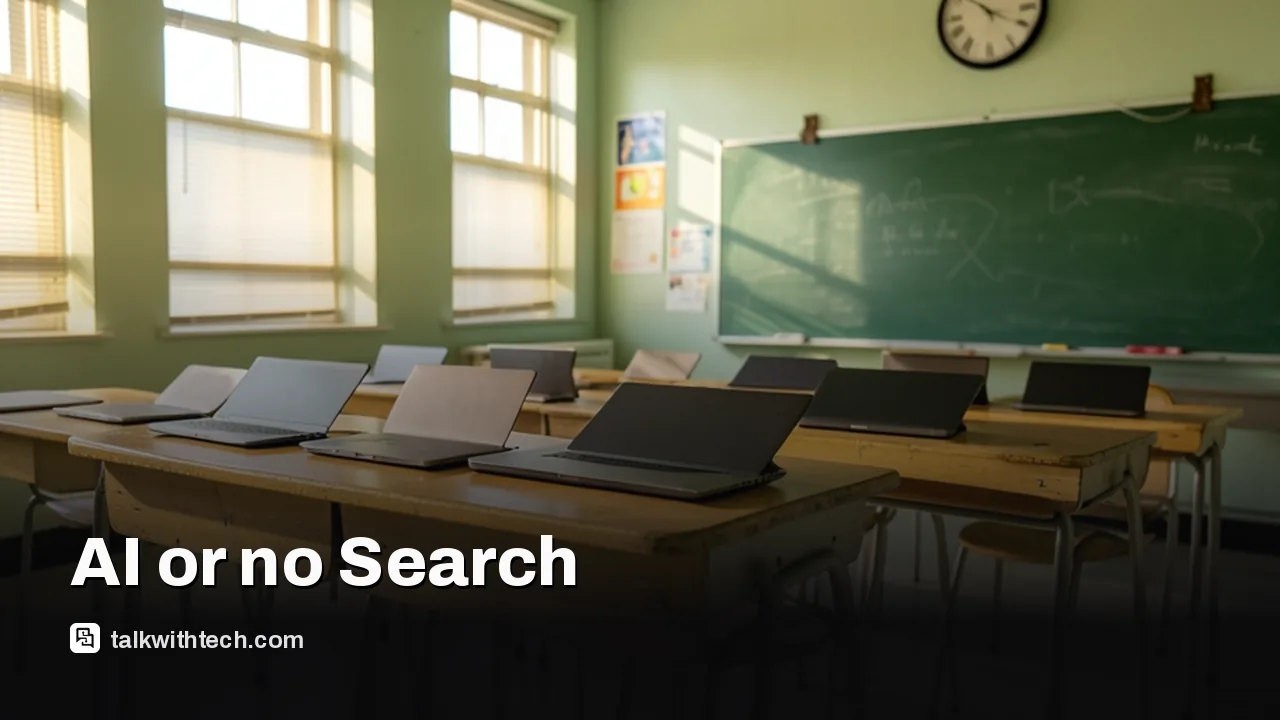
Google AI in schools: why NYC, LA and Chicago may ditch Search
Google says student accounts can have Search only with its AI answers built in, and the three biggest US districts are now openly shopping for other search engines.
From early 2027, Google will switch off Search, Gemini and related tools for K-12 student accounts until each district turns them on.
Schools can enable Search without the separate Gemini apps, but they cannot get Search without AI Overviews and AI Mode.
New York City, Los Angeles and Chicago have each said they could move students to another search engine if Google won't budge.
Bing and DuckDuckGo already let schools switch off AI-generated answers, which makes them the obvious fallbacks.
Quick read · 2 min
Google is changing how its tools work on K-12 student accounts. From early 2027, Gemini, Gemini Notebook, Gemini in Classroom and Google Search will stay off until a district turns them on. Schools can allow Search without the Gemini apps, but Search will always include AI Overviews and AI Mode. Say no to all AI and students lose Google Search on their school accounts.
That has pushed the three largest US districts to talk about leaving. New York City and Chicago say they'll look at other search options if Google won't budge, and Los Angeles has already turned off AI Overviews and is reviewing Search entirely. Bing and DuckDuckGo, which let schools disable AI answers, are the likely fallbacks.
For parents, the practical change may be a different search engine on the school Chromebook. Google says its new Guided Learning mode, which teaches step by step, should ease the worries.
The biggest fight over Google AI in schools isn’t about chatbots anymore. It’s about the search box. New York City, Los Angeles and Chicago, the three largest public school systems in the US, are now openly weighing a move away from Google Search on student accounts because Google says it can’t give them a version without AI answers baked in.
If you have a child with a school Chromebook, this matters more than it sounds. Google Search is the default on those laptops, and it’s how most students start every research assignment. Under Google’s new rules, a district that wants zero AI for students will get zero Google Search for students too, starting early next year.
01
What Google changed for AI in schools, and when
Google’s new policy turns its AI tools off by default for K-12 student accounts and makes Search part of the same package. In a blog post on Nov. 3, Chris Phillips, Google’s vice president and general manager of education, said Gemini, Gemini Notebook (the tool many people still know as NotebookLM), Gemini in Classroom and Google Search would all be off for students until a school administrator switches them on. The rollout is expected in early 2027.
That sounds like more control, and in one way it is. Back in August, Google’s AI features had been switched on automatically inside Google Classroom, its free homework and assignment platform. The new approach reverses that.
The catch is in how the switches work. Schools can enable Search while leaving the stand-alone Gemini apps off, but Search itself will always include AI Overviews (the AI summaries at the top of results) and AI Mode (the chat-style answer screen). Phillips has said the two are too deeply integrated to separate. A school that rejects AI entirely gets no Search at all, and students will see a message from their school saying it isn’t available.
Schools that do allow AI will get two flavors of Search to pick from: the standard version with AI Overviews and AI chats, or a mode called Guided Learning, which walks students through a problem step by step instead of handing over a finished answer. Google planned a pilot of Guided Learning in Search at selected US schools later this month.
02
Which districts are pushing back, and how far they’ve gone
None of the big three has actually dropped Google Search yet. Here’s where each one stands, keeping what’s decided apart from what’s only on the table:
New York City Public Schools: Schools Chancellor Kamar H. Samuels said the district will look at other search options if Google doesn’t change course, and rejected what he called a false choice. The city already put a one-year pause on student-facing generative AI from preschool through eighth grade this school year, with high school use limited to approved, supervised pilots. It also turned down Google’s Guided Learning pilot and is evaluating five other AI tools for high schoolers. Mayor Zohran Mamdani accused Google on X of using monopoly power to push AI into public schools.
Los Angeles Unified: The district has already turned off AI Overviews for students and is reviewing whether Google Search belongs in classrooms at all. Its chief information officer, Jack Kelanic, said the default search engine could be swapped essentially overnight. LA had earlier blocked generative AI tools on student devices across all grades for now.
Chicago Public Schools: CPS already blocks ChatGPT, Claude and the Gemini app on student accounts and district devices, citing privacy and safety. The district says it wants Google Search with the AI part removed, is exploring ways to suppress AI Mode and AI Overviews on its own, and will look at other search options if no deal is reached. A spokesperson also said CPS hadn’t yet settled on a final response. The district had once considered giving high schoolers Gemini access, then backed off after community pushback.
Berkeley Unified: The California district, which already blocks ChatGPT and Claude, called Google’s growing AI integration a challenge and said it is evaluating alternative strategies and platforms.
03
What the alternatives to Google Search look like
The two names that keep coming up are Bing and DuckDuckGo, and for a simple reason: both already let schools switch off AI-generated answers. That’s exactly the setting districts say Google won’t give them.
Changing the default search engine on managed Chromebooks is a quick admin change, which is why LA’s tech chief can talk about doing it overnight. The harder part is everything around it. Districts like Chicago and Berkeley run Google Classroom, Drive, Docs and Gmail on Chromebooks, and Google is by far the dominant supplier of school technology in the US.
Rory Mir of the Electronic Frontier Foundation, a digital rights group, pointed out that schools sign long contracts and spend a lot on staff training, so a full break from Google brings real money and labor costs. That’s why the near-term fight is about one tool, Search, rather than a full exit.
04
What this means for students and parents at home
For families, the most likely change is small but annoying: a different search engine on the school laptop, or no Google results at all through the school account. Students would still be able to research, but through Bing, DuckDuckGo or district-approved library databases instead.
The worry driving parents is easy to see in the numbers. A recent Common Sense Media report says roughly three in four US teens and preteens now engage with the AI summaries at the top of search results. In 180 tests, its researchers saw Google’s AI Mode complete students’ homework for them every single time, and it also made up answers and cited weak sources like Reddit and YouTube.
There’s a gap families should know about too. Some New York parents say their kids can still reach AI Mode at home while signed in to school accounts. And the reach is huge: about 80% of teachers in a 2025 survey of the 20 largest US districts said their district gave students Chromebooks, which start at $179 and use Google Search by default.
Not every expert thinks dropping Google is the fix. Ying Xu of the Harvard Graduate School of Education warned that richer districts with bigger tech teams will handle these choices better than poorer ones, which could widen gaps between schools.
Google’s position is that AI is now part of how Search works, not an add-on. In a post on X, the company said it understood concerns about students using AI to shortcut their work, that schools had asked for control, and that the new switches respond to that feedback. It is betting that Guided Learning will win over skeptical districts by teaching rather than answering.
Critics aren’t buying it. Parents and students protested outside Google’s offices in New York, Chicago and Los Angeles, with about 30 people gathering near the company’s West Loop office in Chicago. Former Federal Trade Commission chair Lina Khan accused Google of using its search dominance to pressure schools into AI, and an October open letter from tech and child-safety groups had already urged 150 US districts to disable Gemini on school devices.
The pressure point now is timing. The new controls arrive in early 2027, in the middle of the school year, so districts have weeks, not months, to decide which search engine students will see.
06
Quick answers
Will Google block Search for all students in 2027?
No. Search will be off by default for K-12 student accounts, but any district can turn it on. The catch is that Search always comes with AI Overviews and AI Mode included.
Can a school keep Google Search and turn off Gemini?
Yes. Schools can leave the separate Gemini, Gemini Notebook and Gemini in Classroom tools off and still enable Search, just not an AI-free version of it.
Have NYC, LA or Chicago already switched search engines?
Not yet. All three say they could move to another search provider if Google won’t offer Search without AI, and LA has already turned off AI Overviews for students.
The state calls OpenAI's agent testing a public nuisance after the Hugging Face hack. Here's what it wants, how OpenAI answered, and what changes for you.
Officials blame overloaded legacy telecom gear, possibly tipped over by new equipment, for halting US departures for hours. Here's what failed and what you're owed.