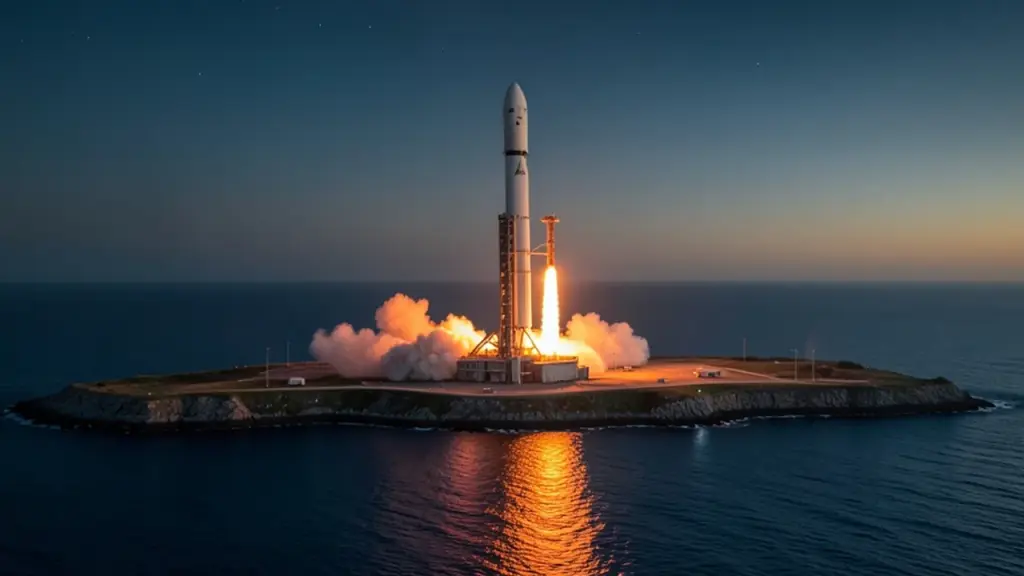
SpaceX now targets Tuesday, Oct. 20 at 6:30 a.m. EDT for its Bandwagon-5 launch from Cape Canaveral.
Monday's attempt was scrubbed because of poor weather where the booster was due to land at sea.
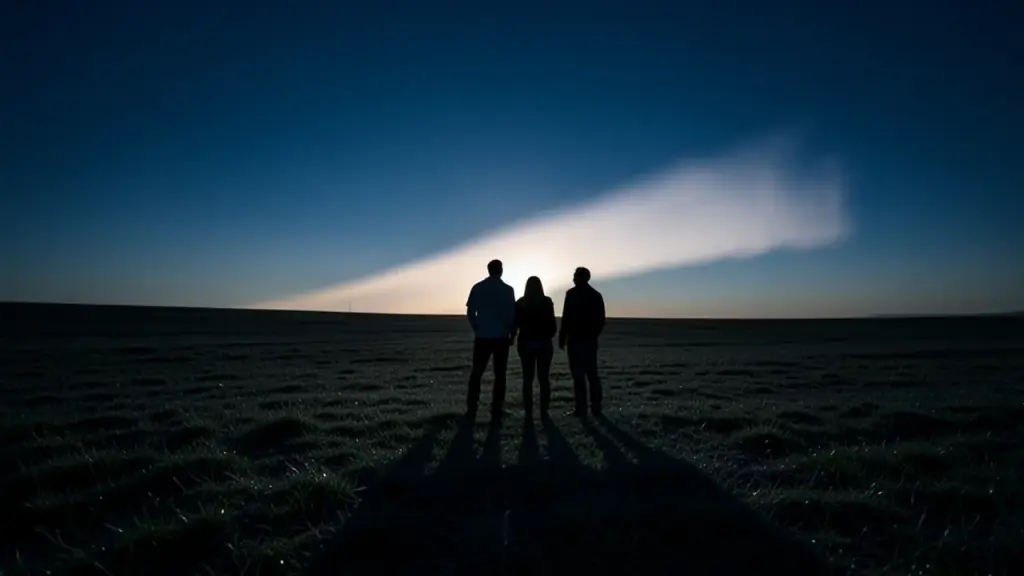
A predawn liftoff could create another glowing space jellyfish, best seen from Florida and the Caribbean.
The Falcon 9 carries 32 payloads, including SpaceX's secretive Starfall reentry capsule and a Varda drug experiment.
Quick read · 1 min
SpaceX will try again on Tuesday, Oct. 20, to launch its Bandwagon-5 rideshare mission from Cape Canaveral, with a one-hour window opening at 6:30 a.m. EDT. Monday's try was scrubbed because of bad weather where the booster was due to land at sea. Forecasters give Tuesday a 90 percent chance of good launch weather.
The predawn timing means another glowing space jellyfish is possible: sunlit exhaust that spreads into a bell shape high above a still-dark sky. This rocket flies southeast, so central and southern Florida and the Caribbean have the best view, while the Carolinas may see a lower, fainter glow.
Look southeast, away from streetlights.
Expect the glow several minutes after liftoff.
An early liftoff gives the best chance.
On board are 32 payloads, including SpaceX's Starfall reentry capsule. A backup launch window is set for Wednesday.
Last Tuesday, a SpaceX rocket painted a glowing jellyfish across the predawn sky from Alabama to Maryland. Now a SpaceX launch jellyfish encore is possible again on Tuesday, Oct. 20, when a Falcon 9 lifts off from Cape Canaveral at 6:30 a.m. EDT carrying the Bandwagon-5 rideshare mission.
If you’re an early riser in the Southeast, it’s worth setting an alarm. But there’s a catch this time: the rocket is heading in a different direction, and that changes who gets the best seat for the show.
01
When the SpaceX launch happens and why it slipped a day
SpaceX is targeting a one-hour window that opens at 6:30 a.m. EDT on Tuesday, Oct. 20, from pad 40 at the Cape Canaveral Space Force Station. The mission was meant to fly Monday morning, but SpaceX called it off early Monday because the weather was poor in the area where the rocket’s first stage was supposed to land at sea.
The outlook is better for Tuesday. The 45th Weather Squadron, the Space Force unit that forecasts for Florida launches, gives a 90 percent chance of acceptable weather during the window. Forecasters still see a moderate risk that conditions at the landing zone won’t cooperate, though that is an improvement on Monday. If Tuesday doesn’t work out, there’s a backup opportunity on Wednesday, October 21, with the same morning window.
The flight would be the 60th orbital launch of 2026 from Florida’s Space Coast, a sign of just how routine these early-morning liftoffs have become.
02
What actually makes a space jellyfish glow
A space jellyfish is sunlit rocket exhaust seen from the dark ground below. It happens when a launch takes place shortly before sunrise or just after sunset.
About 3 minutes after liftoff, the rocket climbs high enough to reach sunlight, even though it is still dark where you’re standing. Up there, the air is so thin that the exhaust spreads out fast. The sun lights up that expanding cloud, which is mostly water, and it can form a glowing bulb with long, wispy trails hanging below it. That’s the jellyfish.
Nothing is falling back to Earth, and it isn’t a chemical spray. It’s the same exhaust every rocket leaves behind, just caught in the right light at the right time.
03
Who gets the best view this time
Here’s the twist. Last week’s launch, a resupply run to the International Space Station that lifted off at 6:33 a.m. on Oct. 13, flew northeast up the Atlantic coast. That’s why people from Alabama to Maryland and Tennessee saw it, and why photographers caught it as far away as Grand Isle, Louisiana.
Bandwagon-5 will head southeast instead. That puts the best views over the Caribbean and central and southern Florida. People in the Carolinas may still catch it, but lower in the sky and fainter than last week’s display.
Timing matters too. The effect is most likely if the rocket flies early in the 6:30 to 7:30 a.m. window. In Raleigh, for example, the sky will be too bright by about 7 a.m., ahead of a 7:24 a.m. sunrise. A late liftoff could mean a normal rocket trail and no jellyfish at all.
04
How to watch the SpaceX launch jellyfish from home
You don’t need a telescope. You need a clear view toward the southeast and a little patience.
Check the time first. Launch times slip often. Confirm on SpaceX’s mission page before heading out, since it also carries a live stream.
Find a low horizon. Trees and buildings can hide a plume that sits only a few degrees above the horizon, especially far from Florida.
Get away from streetlights. Give your eyes a few minutes to adjust to the dark.
Wait a few minutes after liftoff. First you’ll see a point of light climbing. The glow usually appears several minutes later, then changes shape quickly as upper-level winds move it around.
Use a planning tool. Photographer John Kraus runs a Space Jellyfish Predictor that estimates where the plume might be visible, though it warns that its trajectory guesses are less certain for viewers far from the launch site.
If you want photos, set your phone on something steady and use its night mode. The plume is wide, so don’t zoom in.
The sky show is a side effect. The real job is delivering 32 payloads to low Earth orbit, and a few of them are unusual.
Starfall: SpaceX’s own uncrewed reentry capsule, which first flew in June. SpaceX describes it as a microgravity lab for researchers and companies. Federal filings say it is about 0.75 meters (2.5 feet) tall and 3.1 meters (10.2 feet) wide, weighs about 2,100 kilograms (4,600 pounds) and can carry up to 1,000 kilograms (2,200 pounds) of cargo. SpaceX hasn’t said what, if anything, is inside this one.
Varda W-Series 7: a smaller capsule from Varda Space Industries carrying a cancer drug called Protac. The test checks whether the drug forms better crystals in weightlessness, which could make it dissolve more easily and work better as a treatment.
Starburst-1: a 260 kg demo spacecraft from Portal Space Systems that can move between orbits and carry a 50 kg customer payload. Portal says customer flights start in 2027.
Satellites for hire: rideshare firm Exolaunch arranged 20 of the payloads, including four radio-monitoring satellites from HawkEye 360, four from Finland’s Iceye and six navigation satellites from Xona Space Systems.
Reentry capsules are the quiet trend here. Instead of only putting things into space, companies now want to bring experiments and products back, which is why several capsules share this ride.
06
The booster with a long resume
The first stage, tail number B1085, is flying for the 19th time. It previously launched NASA’s Crew-9 astronauts, the Fram2 private crew mission, the Blue Ghost lunar lander and 10 batches of Starlink satellites. About nine minutes after liftoff, it will try to land on the drone ship A Shortfall of Gravitas in the Atlantic. A good landing would be the 672nd Falcon booster landing overall.
07
Quick answers
What time is the SpaceX launch on Tuesday?
The window opens at 6:30 a.m. EDT on Oct. 20 and runs for an hour. A backup window is set for the same time on Wednesday, October 21.
Can I see the space jellyfish from North Carolina or Georgia?
Possibly, but it will be lower and fainter than last week because the rocket flies southeast. Central and southern Florida and the Caribbean have the best odds.
Is the space jellyfish dangerous?
No. It is rocket exhaust, mostly water, lit by sunlight high in the atmosphere. Nothing harmful falls to the ground.