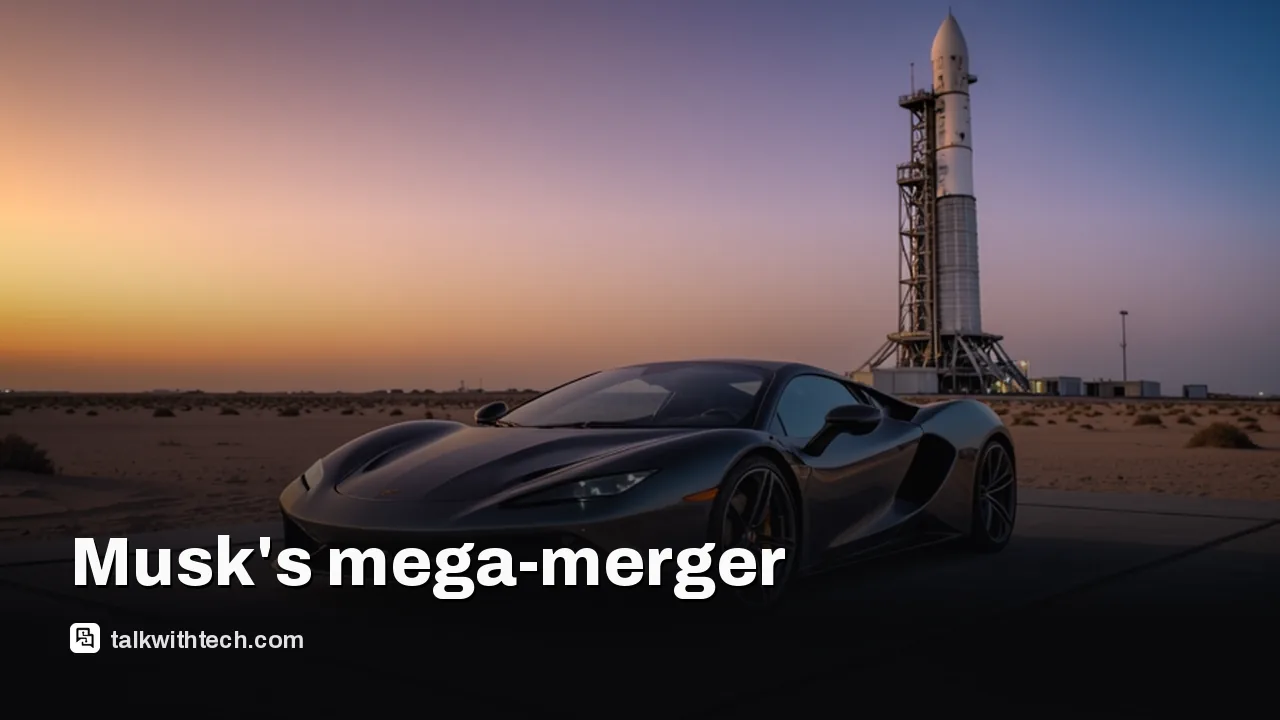
SpaceX and Tesla have each formed special committees of independent directors to study a possible merger.
Elon Musk says the deal is a good idea but not a certainty, and he cannot join the talks himself.
Tesla needs half of all its shareholders to approve, a bar Musk himself called a high hurdle.
With SpaceX valued near $2 trillion and Tesla near $1.5 trillion, it would be the largest merger ever.
Quick read · 1 min
SpaceX and Tesla have each set up special committees of independent directors to look at merging, Elon Musk said on SpaceX's third-quarter earnings call. Musk says it's a good idea but not a sure thing, and as a conflicted party he can't take part in the talks.
The stakes are huge. Tesla is valued near $1.5 trillion and SpaceX near $2 trillion, so this would be the largest merger ever. SpaceX shares rose 8% after hours and Tesla 2%.
Musk already controls the SpaceX vote.
Tesla needs half of all its shareholders to say yes.
Tesla drivers shouldn't expect big changes soon.
No terms have been agreed. If you own Tesla shares, watch for proxy materials, because under this rule not voting counts against the deal.
Elon Musk runs both companies, owns more of each than anyone else, and still isn’t allowed in the room. On SpaceX’s third-quarter earnings call on Tuesday, Musk revealed that the boards of SpaceX and Tesla have each set up special committees of independent directors to study a SpaceX Tesla merger, and that he has to sit the talks out.
If it happens, this would be the biggest corporate merger ever. Tesla is valued at roughly $1.5 trillion (about £1.1 trillion) and SpaceX at around $2 trillion. SpaceX shares rose 8% in after-hours trading on the news, while Tesla climbed 2%. So is it a done deal? Not yet, and the reason sits in an unusual voting rule on the Tesla side.
01
What Musk actually said about the SpaceX Tesla merger
Musk confirmed the committees exist but stopped well short of promising a deal. He said people who treat a combination as certain are getting ahead of themselves, and that shareholders will have the final say. Asked whether merging would be a good idea, his answer was simply yes.
He also said the committees were formed because shareholders asked for them, and that they have not agreed on any terms. Because he leads and owns large stakes in both businesses, Musk is a conflicted party, which is why he can’t take part. He described the setup as an odd kabuki dance, with two groups talking while he waits outside.
His pitch for the deal is about technology, not cars. He pointed to shared work on AI software, robotics and chip design, plus two joint projects: Starmind, SpaceX’s plan for AI data centers in orbit, and Terafab, a chip manufacturing effort shared by the two companies. He argued there is a lot of merit in combining them.
02
The Tesla rule that makes this hard
The two companies face very different approval math. At SpaceX, which went public this year, Musk already controls more than half the voting power, with one estimate putting it near 82%. In practice, his vote decides the SpaceX side.
Tesla is another story. A merger there would need the approval of 50% of all Tesla shareholders, not just 50% of the people who bother to vote. That matters, because every shareholder who skips the ballot effectively counts against the deal. Musk himself called it quite a high hurdle.
Still, Tesla investors have backed Musk before. Last year they approved a pay package for him valued at around $1 trillion. One industry analyst told reporters the merger is a matter of when, not if, while a wealth adviser predicted Musk will likely get his way within a few years.
03
Who is on the committees deciding this
Musk didn’t name the committee members, saying only that they are independent directors. Tesla’s October 19 proxy filing lists seven independent board members: chair Robyn Denholm, former chief technology officer JB Straubel, Ira Ehrenpreis, Joe Gebbia, Jack Hartung, James Murdoch and Kathleen Wilson-Thompson. Neither Elon nor his brother Kimbal Musk counts as independent.
SpaceX lists six independent directors: Roelof Botha, Luke Nosek, Steve Jurvetson, Randy Glein, Donald Harrison and Ehrenpreis. That last name is the awkward one. Ehrenpreis joined the SpaceX board in February while still chairing committees at Tesla, and both companies treat him as independent. Critics are likely to ask how one person can fairly represent both sides of the same deal.
The two companies are already tangled together. Tesla invested $2 billion in xAI, Musk’s AI company, and that stake turned into SpaceX stock when SpaceX bought xAI. SpaceX also absorbed X, the social network formerly called Twitter, before its stock market debut. Valor Equity Partners, the firm run by longtime Musk ally Antonio Gracias, holds a 3.4% stake in SpaceX.
04
What changes for Tesla drivers and SpaceX stock owners
If you drive a Tesla, probably not much, at least soon. Analysts quoted this week expect little drastic change for car owners in the near term. One described the vehicles as almost an afterthought next to the AI and space technology. Tesla had already said this year it would focus on its best sellers, the Model 3 and Model Y, and it now builds Optimus humanoid robots at a California plant.
There could be upsides. Pairing Tesla’s self-driving and robotics work with SpaceX’s satellites and AI computing could produce more capable cars, one adviser argued. Last week’s Tesla Roadster reveal, a car using SpaceX rocket thrusters, was seen by some as a preview of that crossover. The open question is how much attention cars will get inside a company increasingly built around AI infrastructure, especially with BYD having passed Tesla as the world’s biggest EV maker in January.
If you own shares, the picture is more mixed:
Tesla shareholders would likely end up with a smaller slice of a much bigger and more complicated business, and there’s no real precedent for pricing that.
SpaceX shareholders would gain exposure to Tesla’s car, energy and robot businesses, for better or worse.
Everyone would be more dependent on one man’s decisions. The deal wouldn’t make Musk richer by itself, but it would concentrate his fortune in a single stock and likely give him more voting control than he has at Tesla today.
A practical tip: if you hold Tesla through a brokerage app, watch for proxy materials and vote if a deal ever comes to a ballot. Because the rule counts all shareholders, a shareholder who doesn’t vote has effectively voted no.
Musk, who became the world’s first trillionaire earlier this year, is a polarizing figure in the US, and a deal this large would draw scrutiny. Analysts noted that regulatory pressure could grow if Democrats, many of them critical of Musk, gain seats in next month’s midterm elections.
For now there are no terms, no timeline and no vote scheduled. The next concrete signal will come from the committees themselves, so watch for any Tesla or SpaceX filing that mentions an agreement or a proposed exchange ratio.
06
Quick answers
Are Tesla and SpaceX merging?
Not yet. Both boards have formed special committees to study a merger, but Musk says nothing has been agreed and it isn’t guaranteed.
Why did SpaceX stock go up?
SpaceX shares rose 8% after hours following its earnings call, where Musk confirmed the merger committees. Tesla rose 2%.
What vote does a Tesla merger need?
Half of all Tesla shareholders must approve, not just half of those who vote, which makes turnout critical.
Braze powers the personalized pushes and emails from apps like Venmo, Instacart and Canva. Salesforce is paying a 58% premium to own that moment of contact.
Google's former CEO reportedly owns about 1% of the Claude maker. With an IPO expected within weeks, here's what that stake says about the AI money boom.
A planned 23,040-chip AI hub in Essex may not get grid power until the 2030s, and losing Microsoft lands weeks before Nscale's planned New York listing.
6 min read
We use cookies to understand how readers use Talk With Tech, so we can make it better. Is that OK? Privacy policy
The Daily Brief
Today's biggest tech stories, in 5 minutes
Every morning, the news that matters from AI, phones, apps and the people shaping tech. Explained in plain English. Free.
One email a day. No spam, unsubscribe anytime. Privacy policy