Wednesday, 25 November 2026

What is Decart AI? Lucy, Oasis, and the part Amazon is buying

A three-year-old Israeli startup built software that squeezes more speed out of AI chips. Amazon wants it to make Trainium a real rival to Nvidia.

Rows of server racks with blue status lights in a data center aisle

The short version

  • Decart is an Israeli AI startup, about three years old, best known for real-time video and world models.
  • Amazon is buying its Decart Optimization Stack software and hiring its three co-founders and research team.
  • Bloomberg reports the price at about $7.5 billion; Amazon has not disclosed terms and the deal needs regulatory clearance.
  • The goal is to make Amazon's Trainium chips faster and easier to use, so more companies pick them over Nvidia GPUs.
Quick read · 2 min

Decart AI is an Israeli startup, about three years old, known publicly for real-time AI video (Lucy) and interactive virtual worlds (Oasis). Its real prize, though, is software called the Decart Optimization Stack, which tunes AI models to run faster on chips from Nvidia, Google and Amazon.

Amazon said on Monday that it will take over that software and hire Decart's three co-founders and team. It gave no price, but Bloomberg reports about $7.5 billion, and Amazon isn't reported to be buying the video models. The deal needs regulatory approval.

  • Why it matters: Amazon wants to sell its Trainium chips to outside companies as an Nvidia alternative.
  • Track record: Amazon says Decart ran real-time video four times faster on Trainium at half the cost of GPUs.
  • Who else tried: Anthropic held talks at about $6 billion, and Nvidia was an investor.

For ordinary users, the payoff would be cheaper AI services over time and more competition in AI hardware.

A startup most people had never heard of is now worth a reported $7.5 billion to Amazon, and the thing Amazon wants isn’t its flashy AI video. So what is Decart AI? It’s an Israeli company, founded about three years ago, that writes software to make AI models run much faster on the chips they already sit on. Amazon confirmed on Monday that it will take over that software, called the Decart Optimization Stack, and hire the startup’s founders and engineers.

Why should you care about a chip deal? Because the price of every AI chatbot, image tool and smart assistant you use depends on how cheaply the hardware behind it runs. Right now Nvidia sells most of the chips that train and run AI. Amazon wants its own chips, called Trainium, to be a real alternative, and Decart’s software is its shortcut.

01

What is Decart AI, in plain terms

Decart AI is a small Israeli startup with two sides. The side the public saw makes real-time AI video. The side Amazon is paying for is a layer of software that sits between an AI model and the chip running it, and tunes the work so the chip does more with less.

On the visible side, Decart built two families of models:

  • Lucy, which edits live video as it plays. You can swap a character, change clothing or place a product into a scene without rendering it offline first. Lucy 2.0 arrived in January 2026, version 2.5 in July (running at 30 frames per second) and version 2.6 in November, pitched at live shopping streams.
  • Oasis, an interactive world model. That means an AI that generates a virtual world on the fly and reacts as you move through it. The first Oasis demo came out in October 2024, and Oasis 3, aimed at training robots, followed in June 2026.

Under all of that sits DOS, the Decart Optimization Stack. Decart describes it as working across Google’s TPUs, Amazon’s Trainium and Nvidia GPUs, and claims it can pull up to 100 times more performance out of existing hardware. That’s the company’s own marketing figure, not an independent test, but it explains why big buyers came knocking.

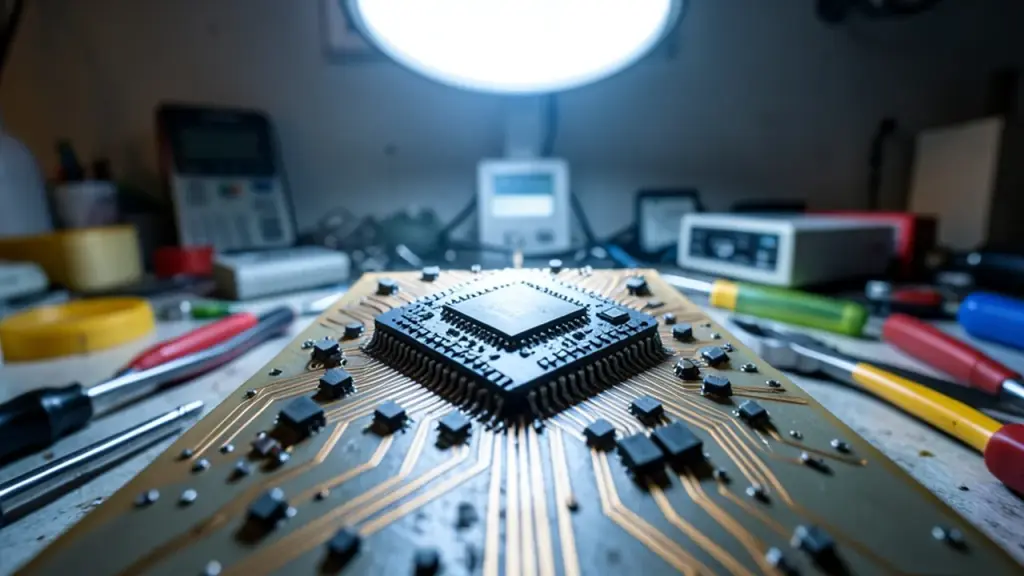
Close-up of a computer chip on a circuit board in a lab
02

What Amazon is buying, and what it is leaving behind

Amazon is taking the DOS technology plus Decart’s three co-founders: chief executive Dean Leitersdorf, his brother Orian Leitersdorf, and Moshe Shalev, along with their team of AI researchers and engineers. Amazon announced the deal in a blog post but didn’t give a price.

The $7.5 billion figure comes from a Bloomberg report citing a person familiar with the matter. That same report says Amazon is not buying Lucy or Oasis. Amazon hasn’t said what happens to those models, or to existing Decart customers such as eBay, which is also an investor.

Israeli business paper Globes has added more detail, none of it confirmed by Amazon:

  • The deal runs through Annapurna Labs, Amazon’s chip design unit, and Annapurna co-founder Nafea Bshara led the talks.
  • Payment is in shares and depends on hitting performance targets over five years.
  • The founders own about 64% of Decart, could collect about $4.8 billion between them, and have agreed to stay at Amazon for five years.
  • The software will be used to speed up both Trainium and Inferentia, its other AI chip.

The deal still needs approval from regulators before it closes.

Peter DeSantis, who runs Amazon’s foundational AI models, custom silicon and quantum computing work, framed it simply: “Every leap forward in AI starts with getting more out of every chip.” Dean Leitersdorf said joining gives his team the scale, customers and infrastructure to move faster than it could alone.

03

Why a software company is worth billions in a chip war

Nvidia’s lead isn’t only about silicon. Developers write their code for Nvidia hardware first, and moving that code to another chip takes time and often costs performance. That software habit is what keeps many companies paying Nvidia prices.

Amazon is attacking that habit from two directions. Last month it released TorchNeuron, a tool that lets common AI code run on Trainium with few changes. Now it is adding Decart’s tuning software, which could make the same code run faster once it gets there.

There’s already a track record. Amazon and Decart have worked together since 2025, and Decart was one of the first customers on Trainium3. Last December, Amazon said Decart was running real-time video four times faster on Trainium than on GPUs, at half the cost. If Amazon can offer that kind of result to every AWS customer, the pitch against Nvidia gets much stronger.

Amazon also has a bigger plan. Chief executive Andy Jassy told investors on last month’s earnings call that the company expects “a very significant business selling chips externally.” Until now, Trainium has mostly lived inside Amazon’s own data centers, which Anthropic already uses. Selling it to outside companies is a different game, and buyers will compare it head to head with Nvidia.

Engineer's desk at night with blurred monitors and hand-drawn diagrams
04

Anthropic and Nvidia wanted Decart too

Amazon wasn’t the only suitor. Anthropic held talks to buy Decart for about $6 billion, Bloomberg reported in August, then walked away in September. Nvidia had its own earlier acquisition talks, according to Israeli outlet CTech, and it put money into Decart’s $300 million funding round in May. That round, led by Radical Ventures, valued Decart at $4 billion.

So in roughly six months, the startup’s price tag nearly doubled. Part of that jump reflects how hard every big AI company is now fighting for the people who know how to get speed out of chips.

The timing was striking, too. Amazon announced the deal on the same day Nvidia’s board brought Jensen Huang back as chief executive, ending a short spell with chief financial officer Colette Kress in the interim role.

05

The Israeli chip pattern behind the deal

This isn’t Amazon’s first big bet on Israeli engineering. In 2015 it bought Annapurna Labs, also founded in Israel, for a reported $350 million. Annapurna’s engineers went on to design Trainium and Amazon’s other custom chips, and Annapurna is now the unit absorbing Decart.

Nvidia has its own version of this story. It spent $6.9 billion on Israeli networking firm Mellanox, which became a core part of its data center business. Google, meanwhile, already designs TPUs, and Microsoft is building Maia processors that mostly serve its in-house AI work. Every major cloud company wants less dependence on one supplier.

06

What this means for you

You won’t see a “Powered by Decart” sticker on anything. The effect, if it works, is indirect but real:

  • Cheaper AI over time. If AWS customers can run models on Trainium for less, some of that saving can flow into lower prices or more generous free tiers for AI apps.
  • More competition for Nvidia. A credible second option could give buyers of AI hardware more bargaining power, and that feeds into what cloud services and AI subscriptions cost.
  • Uncertainty for Decart’s own fans. If you’ve used Lucy or Oasis demos, there’s no word yet on whether they’ll keep running, since Amazon isn’t reported to be buying them.
  • A question for other chips. DOS has also run on Nvidia and Google hardware. Amazon hasn’t said whether that support continues.

Amazon still has a long way to go before it dents Nvidia’s hold on AI chips. But it has now bought the team that knows how to get more speed out of its chips, and speed per dollar’s exactly what outside buyers will check first.

07

Quick answers

Is Decart AI owned by Amazon now?

Not fully, and not yet. Amazon is buying Decart’s optimization software and hiring its founders and team, and the deal still needs regulatory clearance. Its Lucy and Oasis models aren’t part of the reported purchase.

How much did Amazon pay for Decart?

Amazon didn’t disclose terms. Bloomberg reported about $7.5 billion, and Globes reported it is paid in shares tied to targets over five years.

Who founded Decart AI?

Dean Leitersdorf, who is chief executive, his brother Orian Leitersdorf, and Moshe Shalev. All three are joining Amazon.

You're reading the quick version.