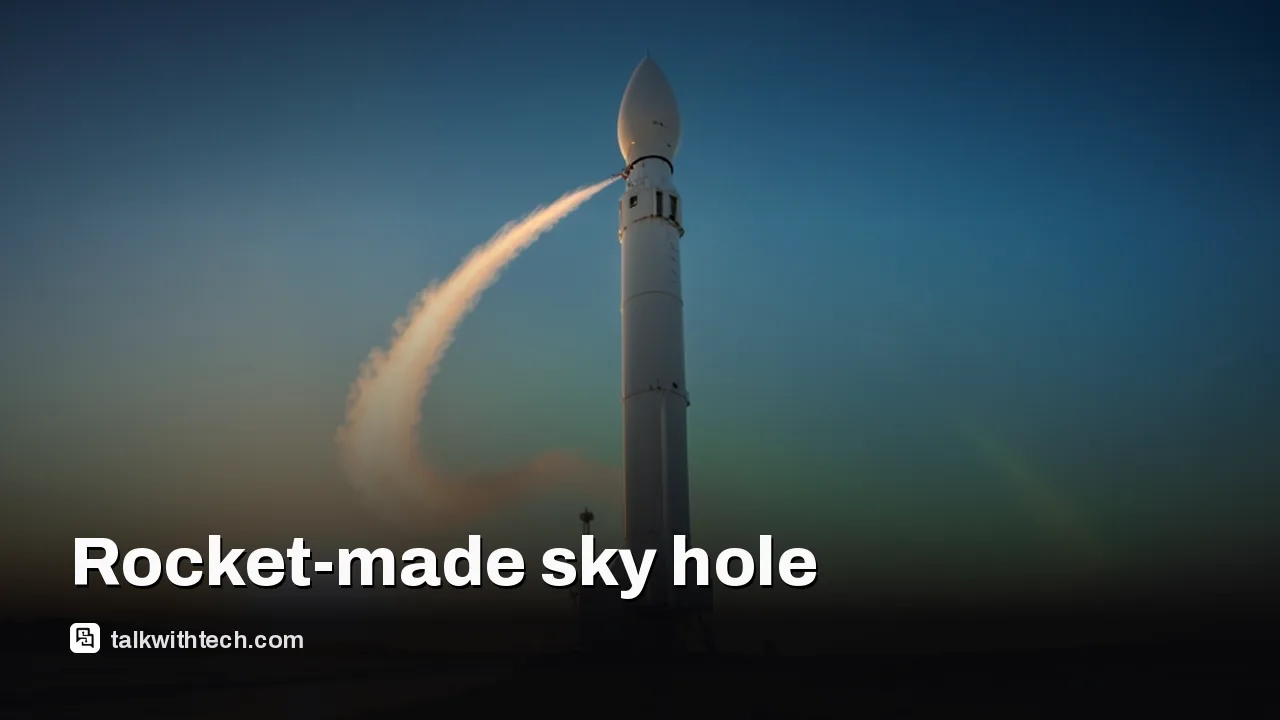
Researchers in Taiwan say the April 1 Artemis II launch disturbed Earth's ionosphere more than any rocket launch measured so far.
Ground GPS stations saw changes in the upper atmosphere equal to positioning errors of several meters, temporary and localized.
Two separate holes formed, one from the SLS core stage and one from upper-stage burns, each stretching about 3,100 miles across North America.
Earlier rocket-made holes in the ionosphere closed within tens of minutes, and no real GPS service failure from Artemis II has been documented.
Quick read · 2 min
A team at National Cheng Kung University in Taiwan says NASA's Artemis II launch on April 1 punched two temporary holes in the ionosphere, the charged layer of the atmosphere that GPS signals must cross. Each stretched about 3,100 miles across North America. The disturbance was up to ten times stronger than those seen after Starship test flights.
Surprisingly, the upper-stage engine burns that sent Orion to the moon left a bigger mark than the launch itself, because they fired inside the ionosphere. Ground stations measured changes equal to GPS errors of several meters, which matters for self-driving cars and drones. No real outage has been documented.
The holes are temporary and not related to the ozone layer.
Past rocket holes closed within tens of minutes.
The researchers expect more of this as moon and Mars missions ramp up.
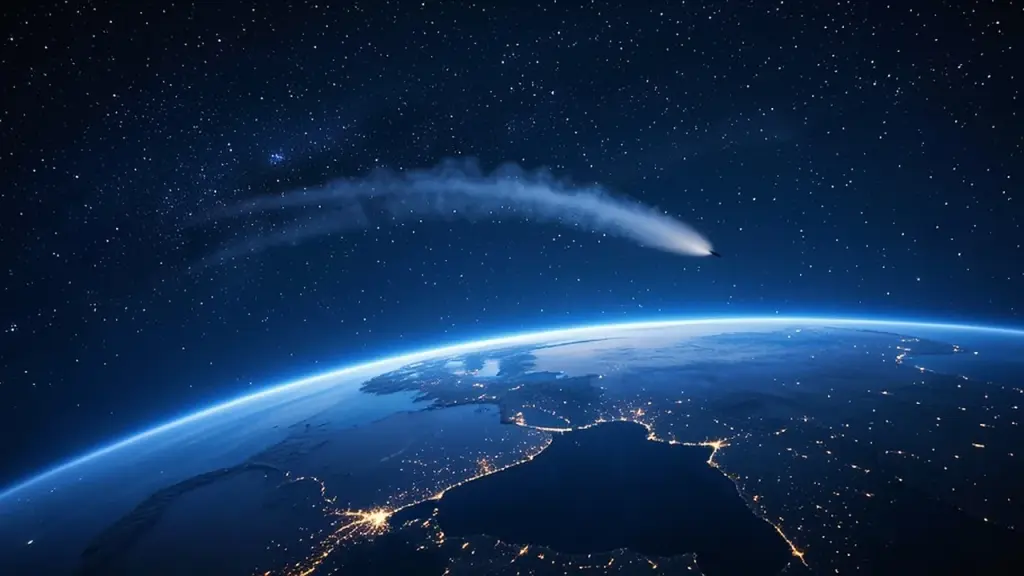
NASA’s Artemis II moon rocket did not just carry four astronauts toward the moon in April. A new study says it also left two gaps in Earth’s electrically charged upper atmosphere, each about 3,100 miles long, stretching across North America from east to west like giant contrails.
That is the Artemis 2 atmosphere hole people are now searching for, and the short answer is reassuring: the hole was real, but it was temporary and localized. Ground stations measured changes equal to GPS positioning errors of several meters. That is not enough to send your car to the wrong town, but it is the scale that matters for self-driving cars, drones and precision surveying, and the researchers think future moon and Mars missions will make it more common.
01
What the Artemis 2 atmosphere hole actually is
The hole is in the ionosphere, not in the air you breathe or the ozone layer. The ionosphere is the layer of Earth’s atmosphere that starts about 30 miles (50 kilometers) up and is full of electrically charged particles. It sits between the ground and the satellites that run GPS, which orbit around 12,550 miles (20,200 kilometers) up, so every navigation signal has to pass through it.
A “hole” here means a patch where the number of free electrons suddenly drops. Rockets cause this in two ways. The rocket’s supersonic climb sends a shock wave upward that pushes the charged gas aside. And when engines fire high up, the exhaust reacts with the charged gas. An earlier modeling study explained the chemistry in plain terms: water, hydrogen and carbon dioxide in the exhaust swap charge with oxygen ions, and the new ions quickly recombine and stop being charged. The result is a dent in the layer, which scientists call an ionospheric depletion.
This is also not the ozone hole. Scientists who studied an earlier rocket-made gap stressed that these ionospheric holes are nowhere near as serious as the ozone problem, though they admit the effects are still poorly understood.
02
How big the Artemis II disturbance was
It was the strongest rocket disturbance measured so far. The team at National Cheng Kung University in Taiwan says the Artemis II effect was up to ten times more intense than the disturbances seen after SpaceX’s Starship test flights, even though Starship produces roughly twice the liftoff thrust of NASA’s Space Launch System (SLS).
The researchers found two separate holes. One trailed the SLS core stage, the 212-foot main body of the rocket. The other came from two burns of the rocket’s upper stage that fired more than an hour after liftoff, around 115 miles (185 kilometers) up, to push the Orion capsule out of Earth orbit and toward the moon.
Here is the surprise. The upper-stage burns left the bigger mark, not the roaring launch itself. That is because they happened inside the ionosphere, where the gas is thin and easy to disturb.
The study counts three distinct disturbance events from the one mission:
the launch itself, which sent shock and gravity waves upward;
the Apogee Raise Maneuver, a burn that stretched Orion’s orbit and spread a disturbance across about 50 degrees of longitude;
the trans-lunar injection burn the next day, which sent Orion on its way to the moon.
The authors say this is the first time one space mission has produced three ionospheric disturbances over the same region during successive orbital maneuvers. Their paper is a preprint in the journal Geophysical Research Letters, so it has not yet gone through final peer review.
03
Did it break GPS for ordinary users?
No real GPS outage has been documented. The study measured how much the ionosphere changed and worked out that the change was equivalent to positioning errors of several meters. That is a calculated effect at the ground stations, not a list of phones or cars that failed.
Why would charged gas move your location at all? A GPS receiver works out where it is by timing signals from four satellites. When the electron count in the ionosphere changes, those signals arrive slightly faster or slower than expected, and the receiver’s position estimate shifts.
Study co-author Charles Lin, an earth science professor at the university, says a couple of meters of error is enough to make an autonomous car think it should change lanes. He also flagged drone positioning as a concern. Those are the systems that need lane-level or better accuracy. The study looked only at fixed ground stations, not at phones or cars.
How scientists spotted it from the ground
The team did not launch any special instrument. It reused about 3,500 fixed GNSS ground stations across the Americas, many of them run by US scientific groups to track the tiny movements of tectonic plates. GNSS covers GPS and the other satellite navigation systems, and the team used GPS, GLONASS and Galileo signals logged every 30 seconds.
By comparing how long signals took to reach thousands of receivers, the researchers built a moving map of the ionosphere and watched the rocket’s dent spread across the continent. One limit: denser station networks give sharper pictures, so the 3,100-mile figure reflects where receivers happen to be.
04
Does the hole close, and has this happened before?
Yes, these holes heal on their own, and fast compared with natural disruptions. Severe solar storms can upset GPS for days. Rocket-made holes are far more short-lived.
There is a track record. After Starship blew up about 93 miles above the Earth on November 18, 2023, a team from Russia and France checked data from some 2,500 ground stations. They found a hole running between Mexico’s Yucatan peninsula and the southeastern US, and it closed after 30 or 40 minutes. In July 2023, a Falcon 9 launch was followed by a “bleeding” aurora that lasted 20 minutes, and a rocket carrying a US Space Force satellite punched a hole that quickly recovered. Modelers have also studied two Falcon 9 launches from Vandenberg, carrying the Jason-3 and FORMOSAT-5 satellites, and found the FORMOSAT-5 hole was far bigger and lasted longer.
The public summaries of the Artemis II study do not give an exact closing time, so we cannot say how many minutes its holes lasted.
Artemis II was a test. NASA is now working toward Artemis IV, which aims to land astronauts on the moon, and a longer-term Moon Base program. Lin says rocket launches have always disturbed the ionosphere, but his team had never seen this kind of effect from the orbital maneuvers of a mission heading beyond Earth. With many more moon and Mars missions planned, he expects these space weather effects to grow.
That matters most for anything that needs to know its position to within a meter or two, like the self-driving cars and drones Lin mentioned.
06
Quick answers
Did Artemis 2 make a hole in the ozone layer?
No. The hole was in the ionosphere, a charged layer that starts about 30 miles up. It is a separate issue from the ozone hole and was temporary.
Is the Artemis 2 atmosphere hole dangerous?
The study found temporary, localized GPS errors of several meters, mainly a concern for self-driving cars and drones. No actual GPS failure has been documented.
When did Artemis II launch?
Artemis II launched on April 1, 2026, and flew four astronauts around the moon. It was the first crewed flight beyond low Earth orbit since Apollo 17 in 1972.
NASA's gamma-ray telescope is coming down after a failed $30 million rescue. Here's the timing window, the tropical debris belt and which parts could survive.
After a bright Halloween show, solar activity is fading fast. Here is where the odds stand tonight, the night to circle instead, and how to get an alert.