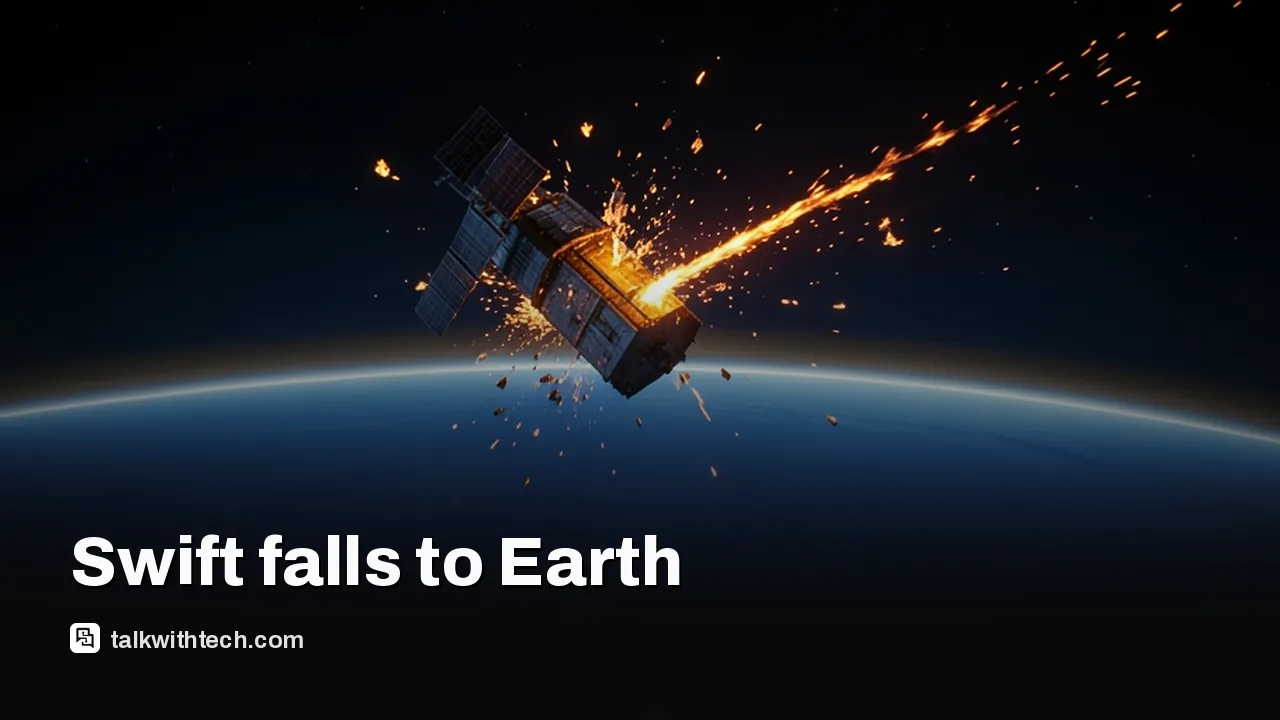
Swift observatory reentry: the debris zone and 1-in-2,100 odds
NASA's gamma-ray telescope is coming down after a failed $30 million rescue. Here's the timing window, the tropical debris belt and which parts could survive.
The Swift observatory reentry is predicted for around 3:30 a.m. Eastern on November 4, with an 11-hour margin either way.
Surviving fragments can only land between 20.6 degrees north and south of the equator, far from the mainland US, the UK and Canada.
NASA puts the chance of anyone being hurt at about 1 in 2,100, and says most of the spacecraft will burn up.
A $30 million rescue by Katalyst's LINK spacecraft failed this summer after the servicer lost attitude control.
Quick read · 2 min
NASA's Neil Gehrels Swift Observatory, a 3,200-pound gamma-ray telescope launched in 2004, is expected to reenter the atmosphere around 3:30 a.m. Eastern on Wednesday, November 4. The Space Force forecast has an 11-hour margin, so the exact time and place are still unknown.
Most of Swift will burn up. A few dense parts, such as tungsten pieces, mirrors and reaction wheels, may survive, but they can only land in a belt between 20.6 degrees north and south of the equator. That rules out the mainland US, the UK and Canada. NASA puts the chance of anyone being hurt at about 1 in 2,100.
Rising solar activity in 2024 thickened the drag on Swift's orbit.
A $30 million rescue by Katalyst's LINK spacecraft failed after it lost attitude control.
Swift studied more than 2,000 gamma-ray bursts and fed about 7,000 papers.
You can follow its last hours on NASA's Swift blog or on trackers using NORAD ID 28485.
A 3,200-pound NASA telescope is about to fall out of the sky, and nobody can yet say exactly where. The Swift observatory reentry is predicted for around 3:30 a.m. Eastern on Wednesday, November 4, based on US Space Force tracking, but that forecast carries an 11-hour margin either way. In plain terms, the Neil Gehrels Swift Observatory could plunge through the atmosphere any time from Tuesday afternoon to Wednesday afternoon, US time.
For readers in the US, UK and Canada, the short answer is reassuring. NASA says any surviving pieces can only come down between 20.6 degrees south and 20.6 degrees north of the equator, a tropical belt that leaves the mainland US, Britain and Canada well outside the zone. Most of the spacecraft will burn up. The bigger loss is scientific: a telescope built for a two-year job that worked for almost 22 years, and a $30 million rescue that came up short.
01
When is the Swift observatory reentry, and can the time change?
The latest official prediction points to the early hours of Wednesday, November 4, Eastern time, and it can still move. NASA and the Space Force say they’ll keep refining the estimate as the spacecraft sinks, and it has shifted already: an earlier Space Force estimate had pointed to around Friday, November 6, before newer tracking pulled the date forward.
Why is the timing so fuzzy? An uncontrolled reentry depends on how hard the thin upper air drags on the spacecraft, and that drag rises and falls with activity on the Sun. Because Swift loops around the planet again and again each day, a small change in timing moves the reentry point a very long way.
Jonathan McDowell, a Durham University astrophysicist who has followed objects in orbit for decades, had read the Space Force data as pointing to a Tuesday-to-Wednesday window, which lines up with NASA’s current forecast.
02
Where could Swift debris land?
Swift’s orbit is tilted only slightly away from the equator, so whatever survives has to come down inside a narrow belt around the middle of the planet. NASA puts the limits at 20.6 degrees south and 20.6 degrees north latitude.
Much of that belt is open ocean, and that’s where experts expect any fragments to end up. But it also crosses land where many people live, including parts of Central and South America, Africa, India, Southeast Asia and northern Australia. The exact spot depends entirely on the moment Swift hits the thicker air, which is why no one can name a country in advance.
The mainland US, the UK and Canada all sit far north of the belt. A few US territories in the tropics, such as Puerto Rico and Guam, do fall inside it.
03
Should you worry about falling Swift debris?
No, not personally. NASA rates the chance of anyone on Earth being hurt at about 1 in 2,100 and calls harm unlikely. That figure covers everyone living under the debris belt combined, so your own odds are vanishingly small.
What will survive? Probably a handful of scorched fragments, and nothing that looks like a telescope. Brad Cenko, Swift’s principal investigator, has pointed to parts made of tungsten and pieces of the mirrors as likely survivors. An outside aerospace engineer asked about the reentry added Swift’s six reaction wheels, heavy spinning wheels that steered the telescope, along with tougher lenses. McDowell’s rule of thumb is that roughly 10% of a satellite this size makes it through, so he wouldn’t be surprised if 100 kilograms (220 pounds) or more reached the surface.
The risk number does stand out, though. NASA’s own orbital debris rules say the casualty risk from a reentering spacecraft shouldn’t exceed 1 in 10,000, and McDowell says detailed calculations usually land near that level. Swift, launched in 2004 with no thrusters able to fix its orbit or steer it down, sits well above that bar.
McDowell’s view is that individuals shouldn’t worry but governments should. About 10,000 objects have come back down since Sputnik, and as orbit gets more crowded, uncontrolled reentries turn into a policy problem. Scientists are also starting to ask what all that melted metal does to the chemistry of the upper atmosphere and the ozone layer.
04
Why NASA couldn’t save Swift
The Sun finished Swift off. Stronger solar activity in 2024 heated and swelled the top of Earth’s atmosphere, which added drag on the satellite and sped up its fall. Swift had no engine that could push it back up. Early this year, its team even paused normal science and used special maneuvers to slow the descent.
NASA then tried a rescue. In September 2025 it picked Katalyst Space Technologies, based in Flagstaff, Arizona, and the $30 million Swift Boost mission launched in July 2026. Katalyst’s robotic LINK spacecraft was meant to dock with Swift and lift it about 150 miles higher, buying years of extra observing time.
It never got to try. LINK ran into attitude control problems, meaning it couldn’t keep itself pointed steadily, and it ended up spinning, which also caused communication trouble. Teams slowed the spin and uploaded new flight software, but NASA and Katalyst then announced LINK would not capture or boost Swift and would test rendezvous technology instead. NASA Administrator Jared Isaacman blamed the control-system trouble when he explained the decision in August.
Swift’s team switched the instruments back on and kept observing as long as it could. The final observation came on October 20, at an altitude of about 171 miles, where the drag was too strong for steady pointing. The operations team at Penn State then ended the mission.
Swift launched on November 20, 2004, on a Delta II rocket, carrying three telescopes and one main job: catching gamma-ray bursts, the most powerful explosions known, which flare and fade within seconds. Earlier telescopes usually couldn’t react in time. Swift could spot a burst, swing toward it within seconds and pass its position to observatories around the world.
More than 2,000 gamma-ray bursts observed
About 1,400 supernovae, plus comets, asteroids and stars torn apart by black holes
Around 1.5 million images from its ultraviolet and optical telescope, and 12 TB of data sent home
Data behind roughly 7,000 research papers
Observing time for more than 1,000 guest scientists
It was renamed in 2018 for Neil Gehrels, the NASA astrophysicist who led the mission and died in 2017. Shawn Domagal-Goldman, who heads NASA’s astrophysics division, noted that it kept working more than 10 times longer than its planned primary mission. Its archive will feed research for years, but astronomers lose a fast-reacting eye on the sky, and NASA says other missions can cover only part of that gap.
06
How to track Swift’s final hours
NASA doesn’t run its own live tracker for Swift, but you can still follow along. The agency posts updates on its Swift mission blog, and NASA and the Space Force will revise the reentry prediction as the hours count down.
For a live map, satellite trackers such as N2YO, KeepTrack and Orbital Radar plot Swift’s position using Space Force tracking data from the military’s public Space-Track portal. Search for the spacecraft’s catalog number, NORAD ID 28485.
Keep the 11-hour margin in mind before you settle in to watch a countdown: until the final day, any reentry time you see is an estimate, not a schedule.
07
Quick answers
When will Swift fall to Earth?
Around 3:30 a.m. Eastern on Wednesday, November 4, give or take 11 hours, based on the latest Space Force prediction.
Can Swift debris hit the US, UK or Canada?
Not the mainland US, the UK or Canada. Surviving pieces can only fall between 20.6 degrees north and south of the equator, although some tropical US territories sit inside that belt.
Why did the Swift rescue mission fail?
Katalyst’s LINK spacecraft developed attitude control problems and couldn’t hold steady, so NASA called off the docking and boost attempt before it could happen.
After a bright Halloween show, solar activity is fading fast. Here is where the odds stand tonight, the night to circle instead, and how to get an alert.