Sunday, 22 November 2026

Is the mini moon visible? No, and its exit date is disputed

Earth's temporary second moon, asteroid 2026 QQ8, is too small and faint for backyard telescopes, and reports give different sizes, distances and leaving dates.

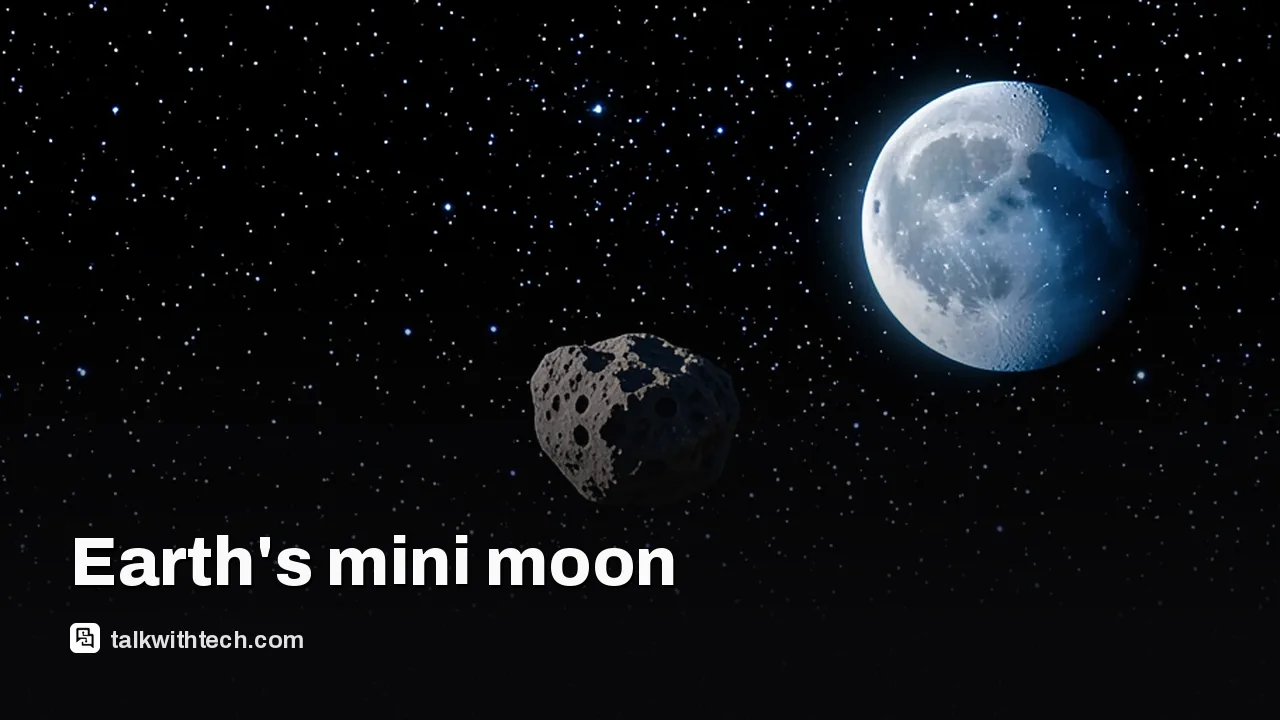
A small asteroid drifting in space with the Moon and Earth in the distance

The short version

  • Asteroid 2026 QQ8 is too small and dim to see with the naked eye or an amateur telescope.
  • The rock was first spotted on August 20 and confirmed as a natural mini-moon on October 29.
  • Reports put its size anywhere from about 3 feet to about 6 feet across.
  • Accounts differ on when it leaves, from mid-December to early 2027, and it poses no danger.
Quick read · 1 min

Earth has a temporary second moon, but you won't be able to see it. Asteroid 2026 QQ8 can't be spotted by eye and is too dim for amateur telescopes. Only large professional instruments can pick it out.

The rock was first seen on August 20 and was briefly suspected of being space junk. On October 29, the Minor Planet Center logged it as a natural object held for now by Earth's gravity.

  • Size: reports range from about 3 feet to about 6 feet across.
  • Distance: about 1.5 times as far as the Moon at its closest.
  • Departure: accounts range from Dec. 13 to January 2027.

Scientists say there is no risk of an impact. The asteroid swings near Earth about once every 10 years, and its next fairly close pass, in 2058, is not expected to end in another capture.

Is the mini moon visible? No. Earth has picked up a temporary second moon, a space rock called 2026 QQ8, but it is far too small and faint to see by eye, and it is beyond the reach of backyard telescopes too.

That is a letdown if you were hoping to step outside and spot it. Still, the story behind this rock is worth a few minutes. It was first taken for a possible piece of space junk, the published figures for its size and distance don’t match, and nobody seems to agree on the day it says goodbye. Here is what is known, and where the accounts differ.

01

Is the mini moon visible from your backyard?

The mini moon is not visible without professional equipment. It can’t be seen with the naked eye, and it is described as too dim for amateur telescopes, so a large telescope is needed to pick it out.

Two things work against you. The first is size: the reports put the rock at a few feet across at most. The second is distance. 2026 QQ8 sits farther away than the real Moon, at roughly 1.5 times the Earth-Moon distance at its nearest.

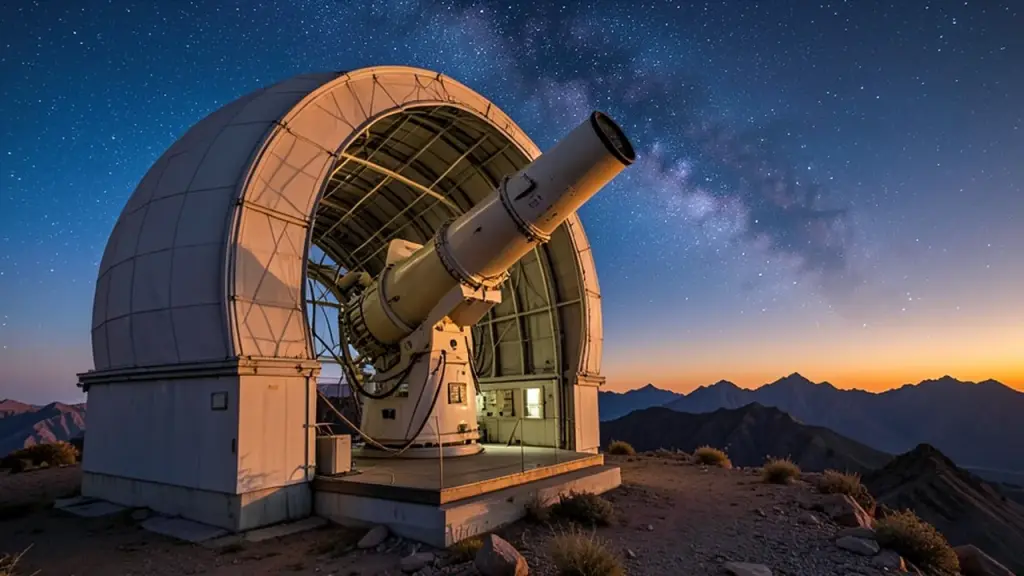
The follow-up observations that confirmed what it is came from the Lowell Discovery Telescope in Arizona and the University of Hawaii’s 2.2-meter telescope.

An observatory dome open at dusk with a large telescope aimed at the sky
02

What 2026 QQ8 is, and why it was mistaken for space junk

2026 QQ8 is a small asteroid that Earth’s gravity has captured for a short while. Mini-moons are asteroids or comets that get pulled in, make one or more loops around a planet, and are then thrown back out. They are sometimes called temporary satellites.

Krisztián Sárneczky, an astronomer from Hungary, first spotted it on August 20. At that point its path left two possibilities open: a natural mini-moon, or debris left behind by a human space mission. Harvard astrophysicist Avi Loeb speculated it could be a panel from Apollo 13.

The later telescope work settled it. On October 29, the International Astronomical Union’s Minor Planet Center logged the object as a natural mini-moon. Its circular said the object is “temporarily bound” to Earth and that no match with a known artificial object had turned up.

The capture itself dates back to spring. The rock approached Earth in April 2026 and crossed into the Hill sphere, the zone where Earth’s pull beats the Sun’s. It normally stays outside that zone.

03

How big is the mini moon? The numbers don’t match

The mini moon is somewhere between about 3 feet and about 6 feet wide, depending on which report you read. One account calls it a 1-meter (3-foot) rock. Another says around 6 feet in diameter. A third describes it as the size of an adult human, at 1 to 2 metres.

For scale, the average mini-moon is put at 29.5 inches across, and at 6 feet this one is described as bigger than average. It is still far from the record. The biggest mini-moon Earth has hosted was 2024 PT5, at roughly 16 to 36 feet across. The first one ever confirmed, 1991 VG, was found in November 1991 and measured about 30 feet.

The closest-approach figures differ as well. One report says it came as near as 537,000 kilometers (334,000 miles) on August 18 and will get no closer. Others give a closest distance of about 353,000 miles (568,000 km). Both versions work out to the same plain comparison: about 1.5 times as far as the Moon.

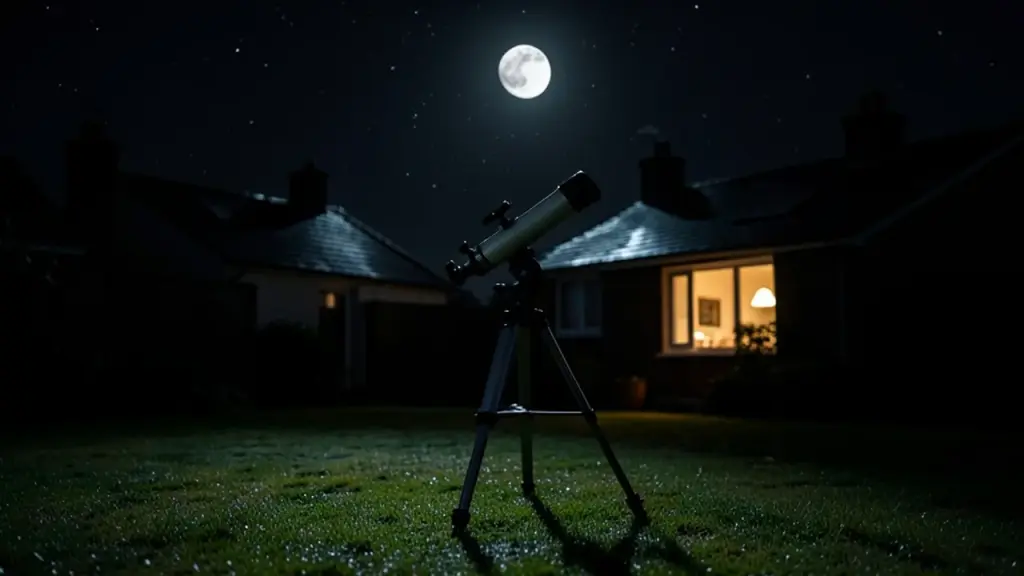
A small backyard telescope pointed at the Moon above suburban rooftops at night
04

When does the mini moon leave Earth?

The mini moon leaves sometime between mid-December and early 2027, and the reports disagree on which. One account gives a final goodbye on Dec. 13, when the rock will be 1,352,000 kilometers (840,000 miles) away. Another says it should stick around through December before leaving in 2027. A third says astronomers expect it to stay in Earth’s orbit until January 2027.

How it leaves is better understood. A mini-moon breaks free through a gravitational tug-of-war with the Sun. As the rock gains speed and energy, the Sun’s stronger pull gradually drags it away and it goes back to its usual path around the Sun.

That usual path takes 359 days to complete, and it brings 2026 QQ8 close to Earth about once every 10 years. Astronomers have traced its history: in 1965 it came pretty close, but not close enough to be captured. The next fairly close pass comes in 2058, and that one is not expected to be close enough for capture either.

05

Is the mini moon dangerous to people on Earth?

The mini moon is not a danger to anyone. Scientists say there is no threat of an impact, and a rock this size would burn up in the atmosphere before reaching the ground if it ever did come in.

There is one detail that sounds alarming. 2026 QQ8 is classed as an Aten asteroid, a type whose orbit crosses Earth’s path while staying mostly close to the Sun. Larger Atens can be a serious hazard because the Sun’s glare can hide them. This one is far too small to do any harm.

So for everyday life, nothing changes. The interest is scientific: researchers around the world are tracking its orbit to learn how Earth captures temporary moons, and the Minor Planet Center’s circular encouraged further observations.

06

How often does Earth get a second moon?

Earth probably has a mini-moon most of the time. Scientists estimate at least one temporary mini-moon is usually present, and one model suggests there may be as many as six tiny ones, made of fragments of the Moon, in orbit at any given time. In August 2024, Earth had two known ones at once.

The average stay is around nine months, and most drift off within a year. Some come back. A rock called 2022 NX1 was a mini-moon in 1981 and again in 2022. And 2024 PT5 may have been a piece of the Moon itself, since it had the same chemical makeup.

Don’t confuse these with quasi-moons. A quasi-moon is not held by Earth’s gravity. It circles the Sun on a path so similar to ours that it only looks like it is going around us. Earth has eight of those, including Kamoʻoalewa and Cardea.

More finds are expected. The Vera C. Rubin Observatory in Chile scans the whole southern sky every few days, and over its 10-year mission it is projected to discover millions of moving objects that nobody has cataloged before.
07

Quick answers

Can you see the mini moon with binoculars?

No. 2026 QQ8 can’t be seen with the naked eye and is too dim for amateur telescopes. It takes a large professional telescope.

How long is a mini moon around for?

The average mini-moon stays about nine months. 2026 QQ8 was captured in April 2026 and is expected to leave between mid-December and early 2027, depending on the report.

Will 2026 QQ8 hit Earth?

No. Scientists say there is no impact threat, and its closest distance is about 1.5 times as far as the Moon.

You're reading the quick version.