Friday, 27 November 2026

Cambridge Audio Spira turntable plays records right away

The $499 Spira ships with its cartridge fitted and aligned, a switchable phono stage and Bluetooth, and it is now the cheapest way into Cambridge Audio vinyl.

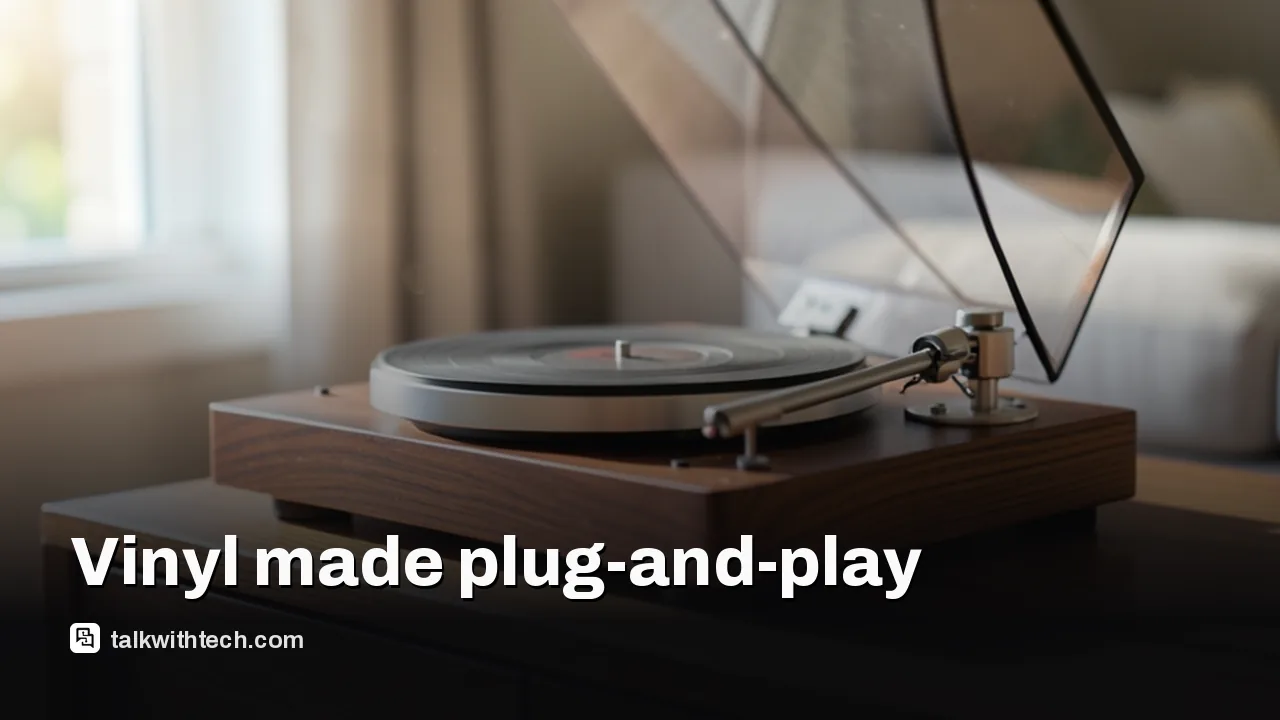
Turntable with pre-mounted cartridge on wooden plinth, dust cover raised, natural light.

The short version

  • Cambridge Audio's Spira turntable launched October 14 at $499 in the US, £329 in the UK and €349 in Europe.
  • It arrives with an Audio-Technica cartridge already fitted and aligned, a built-in phono stage you can bypass, and a Bluetooth transmitter.
  • A 1.8kg steel platter, removable headshell and adjustable tonearm leave room for upgrades later.
  • It comes in five colors that match Cambridge's L/R active speakers, though it works with any powered speakers or amplifier.
Quick read · 1 min

Cambridge Audio's Spira is a $499 turntable (£329 in the UK) built for people who want to play records without a setup headache. It launched October 14.

The deck arrives with an Audio-Technica cartridge already fitted and aligned, a built-in phono stage so it plugs straight into powered speakers, and a Bluetooth transmitter for wireless headphones or speakers.

  • A heavy 1.8kg steel platter helps keep speed steady.
  • The headshell comes off, and the preamp can be bypassed, so you can upgrade later.
  • Five colors match Cambridge's L/R active speakers.

It is fully manual, with no USB port, and Cambridge hasn't said which Bluetooth codecs it supports, so serious listeners should plan on a wired connection. You'll still need speakers or headphones. For newcomers who want a deck that won't be outgrown in a year, it is one of the simpler ways to start.

Most first turntables come with homework: fit the cartridge, line it up, then figure out why the music sounds thin and quiet. Cambridge Audio’s Spira skips most of that. The cartridge comes already fitted and aligned, the preamp is built in, and Bluetooth lets you send your records to wireless headphones on day one.

That matters because the hidden costs of vinyl usually show up after you buy the deck. A separate phono preamp, a new amplifier or a cartridge you have to install yourself can push a starter setup well past the sticker price. The Spira bundles the essentials into one box for $499 in the US, £329 in the UK and €349 in Europe, and it went on sale on October 14.

01

What makes the Cambridge Audio Spira turntable easy to set up

The Spira is built so a newcomer can unbox it and play a record with very little fuss. Three features do the heavy lifting.

  • A pre-fitted cartridge. An Audio-Technica AT3600L cartridge is installed and aligned at the factory. The cartridge holds the stylus, the tiny needle that reads the groove, and setting it up badly is one of the easiest ways to ruin the sound.
  • A built-in phono stage. Records play back a very weak signal that needs special boosting and tone correction before speakers can use it. The Spira does that inside the deck, so it can plug straight into powered speakers or an amplifier’s normal input.
  • Bluetooth out. A transmitter sends the sound to wireless speakers or headphones. It only sends audio, so you can’t stream music from your phone to the turntable.

You still have a few small jobs, such as balancing the tonearm and setting the tracking force, the downward pressure of the stylus. Cambridge gives guidance on the right weight for the supplied cartridge.

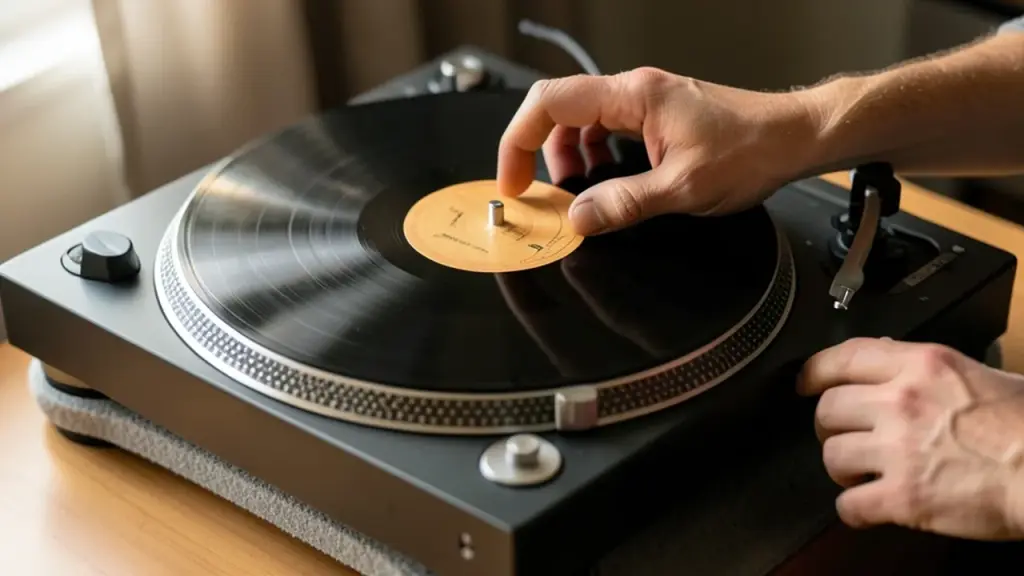
Hands placing a record onto the turntable, showing fitted cartridge and tonearm details.
02

What’s in the box, and what isn’t

Cambridge includes the pieces most people forget to buy: an RCA cable, a power supply, a hinged smoked dust cover, a felt platter mat, a cartridge alignment protractor and an adapter for seven-inch singles.

What you don’t get is something to play the music through. You will need powered speakers, an amplifier with speakers, or a Bluetooth speaker or headphones. The deck measures 41.8 by 34.3 by 12.2cm and weighs about 5.95kg, so plan for a sturdy shelf with room to lift the lid.

It is also a fully manual turntable. You place the tonearm on the record and lift it off at the end yourself. There is no automatic return and no USB port for copying records to a computer.

03

Built to grow with your record collection

The Spira is aimed at beginners, but it is not a throwaway record player. Underneath the colored plinth, a belt drive turns a 1.8kg steel platter. Cambridge says the extra weight helps the record spin at a steady speed and cuts down vibration, and it quotes wow and flutter, the slight wobble in pitch you can hear on long piano or string notes, at under 0.15%.

Switching between 33 and 45 RPM is done with an electronic dial, so you never move the belt by hand. The aluminum tonearm has adjustable tracking force and anti-skate, a setting that stops the arm drifting toward the center of the record.

The upgrade path is clear:

  • Better stylus. The headshell comes off, which makes cartridge swaps easier, and Cambridge points owners to Audio-Technica’s ATN3600LE elliptical stylus for cleaner tracking.
  • Better preamp. The internal phono stage can be switched off, so you can add an external one later. Cambridge says you need the ground wire connected in that mode to avoid hum, and you shouldn’t flip the switch while the deck is on.
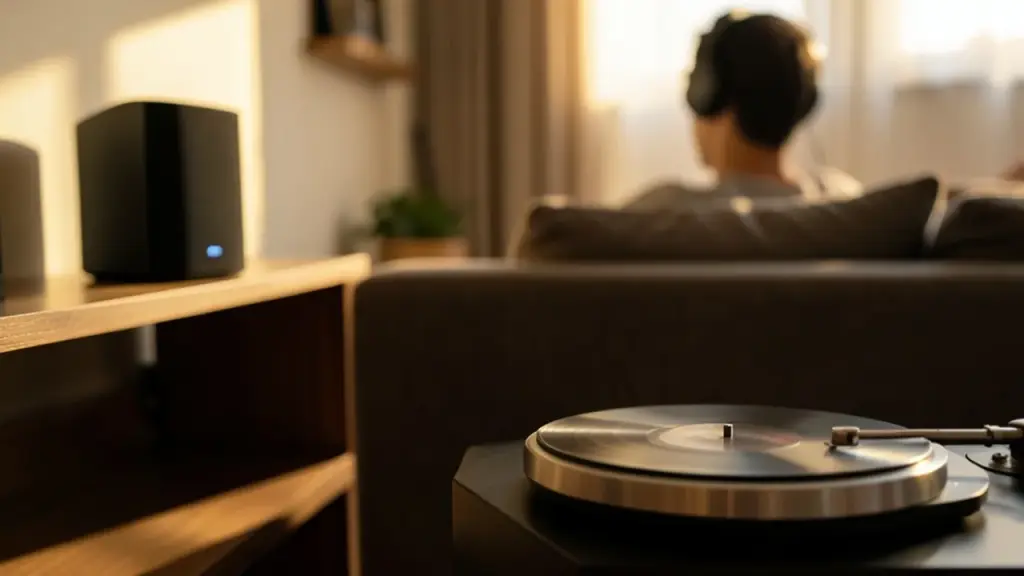
Turntable on media console with blurred listener on sofa wearing headphones, warm light.
04

Why it matches Cambridge’s L/R speakers

The five colors are black, white, blue, green and orange, the same finishes as Cambridge’s L/R active speakers shown at CES in January. The pairing is deliberate. The smallest pair, the L/R S at $549, has no phono input, so the Spira’s built-in preamp lets you connect it with a single cable. The larger L/R M and L/R X already have phono inputs, so owners can bypass the Spira’s preamp and use the speakers’ own.

You don’t need Cambridge speakers, though. Any powered speakers with an analog input, any amplifier, or any Bluetooth speaker will work.

The Spira is also now Cambridge’s entry point for vinyl, and its most affordable turntable. The direct-drive Alva TT V2 appears to have been discontinued. Reports disagree on whether the $699 Alva ST is still on sale.

05

What this means for new vinyl listeners

If you have been put off by the setup side of vinyl, the Spira removes the scariest steps. You don’t have to mount a cartridge or buy a preamp, and you can start with the headphones or Bluetooth speaker you already own.

There are trade-offs. Cambridge hasn’t said which Bluetooth codecs, the formats used to compress wireless audio, the Spira supports. Its pricier Alva decks offered aptX HD, so don’t assume the same here. Bluetooth also turns the analog signal into digital data before sending it, so a wired connection remains the better choice for the best sound.

At $499 it also faces strong rivals. Sony’s PS-LX5BT and Audio-Technica’s AT-LP3XBT both offer automatic playback, which suits people who never want to touch the tonearm. The Spira’s case is the heavier platter, the removable headshell and the room to upgrade.
06

Quick answers

Do I need a separate preamp for the Cambridge Audio Spira?

No. It has a built-in phono stage, so it connects directly to powered speakers or an amplifier’s line input. You can switch it off later if you add an external preamp.

Can the Spira play through Bluetooth headphones?

Yes. Its Bluetooth transmitter sends audio to wireless headphones or speakers, but it can’t receive music from your phone.

How much is the Spira in the UK and Canada?

It costs £329 in the UK and $499 in the US. Cambridge hasn’t published a Canadian price, and stock and colors vary by region.

You're reading the quick version.