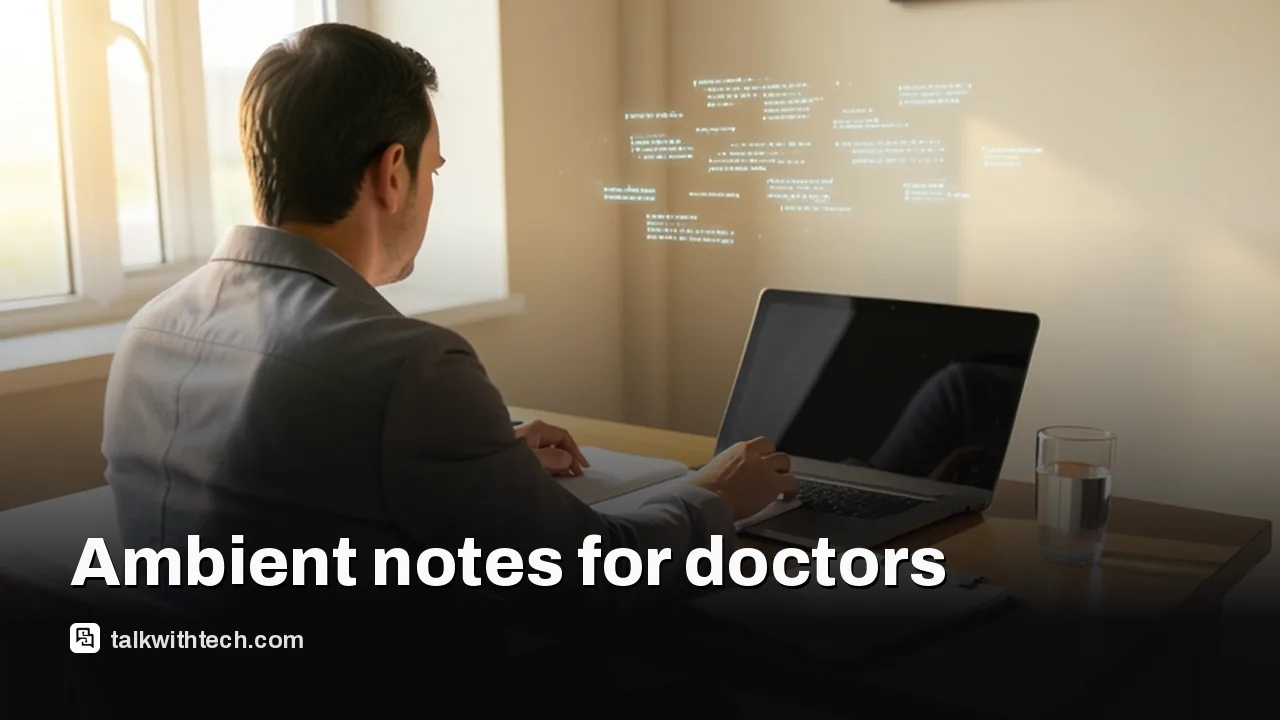
Google’s Dialogues episode features Dr. Eric Topol and Josh Woodward discussing how ambient AI notes can save clinicians time.
The conversation centers on generative tools and the Gemini ecosystem, including Gemini Notebook, used for medical research and clinical practice.
Experts describe how ambient note-taking could refocus clinician time toward prevention and patient care.
The discussion ties practical uses of AI to workflows in medicine without overhyping capabilities.
Quick read · 1 min
Google’s Dialogues episode with Dr. Eric Topol and Josh Woodward explores how ambient AI notes could save doctors time and boost preventive care. They highlight Gemini Notebook as a key tool for organizing medical data and drafting notes without taking clinicians away from patient care.
The idea is to reduce the administrative burden and let physicians focus on prevention and patient conversations. Real-world use will require strong privacy protections and careful testing to avoid errors.
What happens next: Google says Gemini Notebook and related features are under ongoing development and validation before wider rollout.
Ambient AI notes aim to speed up documentation
Focus remains on prevention and patient care
Privacy and accuracy are central to any rollout
Google is painting a picture of a practice where artificial intelligence lightens the load on clinicians’ administrative chores. In a recent Dialogues episode, Josh Woodward, VP of Google Labs and Gemini, sits down with Dr. Eric Topol, a cardiologist and leader in translational medicine, to discuss how ambient note-taking and generative tools could reshape everyday medical care.
The core idea is straightforward: AI observes a patient encounter and, with consent, surfaces notes and context that a doctor would otherwise have to write down during or after the visit. The discussion centers on Gemini Notebook, a tool speakers say helps organize and analyze complex medical information. In practical terms, ambient AI could help clinicians capture details from conversations, lab results, and imaging, then turn that material into structured notes and relevant follow-up tasks.
01
What Gemini Notebook would actually do for a doctor
According to the participants, the notebook is meant to streamline the cognitive load of medical care. Clinicians could rely on AI to draft initial notes, summarize key findings, and organize decisions about preventive care based on the patient’s history. The aim isn’t to replace physicians but to give them more reliable, consistent support so they can focus more on patient interaction and preventive strategies rather than paperwork.
02
The link between AI, data, and preventive care
The episode ties AI capabilities to a broader goal: shift preventive care from reactive treatment to proactive management. Dr. Topol emphasizes how such tools could help with early detection and more timely interventions. The conversation also touches on how AI must handle medical data responsibly and with appropriate safeguards to protect patient privacy.
03
What this means for daily life in clinics
For patients, the practical takeaway is that doctor visits might feel smoother and more focused on the discussion itself, not the admin. For clinicians, the real benefit is time saved on note-taking, documentation, and data synthesis. The speakers also acknowledge that AI tools are evolving and that real-world use will require careful validation and clear workflows to ensure accuracy and safety.
04
What happens next
Google describes Gemini Notebook and related ambient AI features as part of ongoing work across the Gemini family. The path forward involves refining how AI reads and summarizes clinical information, implementing strong privacy protections, and validating usefulness in real-world medical settings before broader deployment.
It’s described as a tool to organize and analyze medical information, helping create notes and support preventive care decisions during patient encounters.
Will AI replace doctors?
No. The discussion frames AI as a helper to save time on routine tasks, so clinicians can spend more time with patients.
Elon Musk’s Grok Bot, the AI agent from SpaceXSI, can sign into sites and place orders. SpaceX promises to fix mistakes or leaked card data, but details are murky.
4 min read
We use cookies to understand how readers use Talk With Tech, so we can make it better. Is that OK? Privacy policy
The Daily Brief
Today's biggest tech stories, in 5 minutes
Every morning, the news that matters from AI, phones, apps and the people shaping tech. Explained in plain English. Free.
One email a day. No spam, unsubscribe anytime. Privacy policy