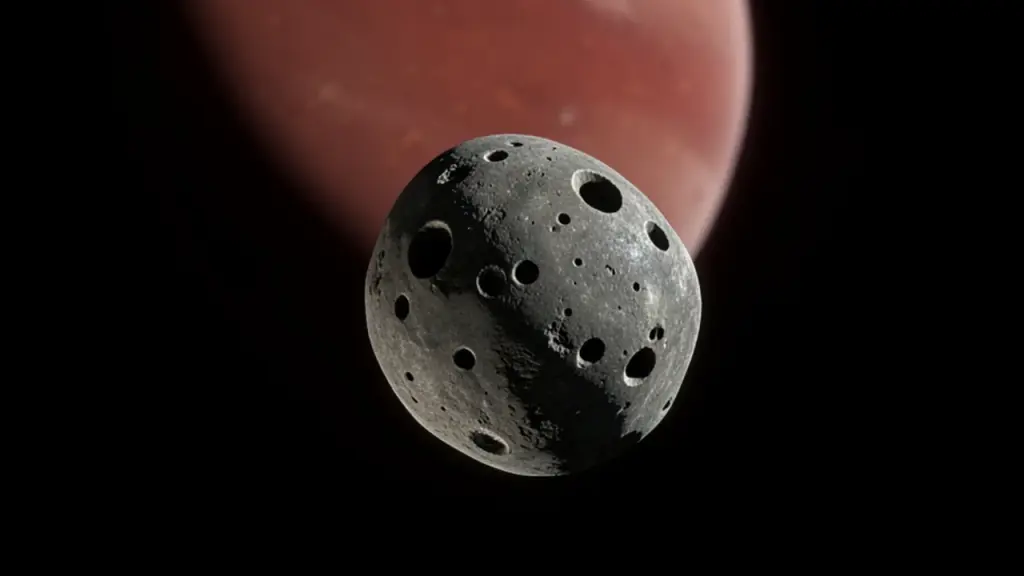
Japan launched the $578 million MMX mission to Mars' largest moon, Phobos, on an H3 rocket from Tanegashima Space Center.
The spacecraft should reach Mars in August 2027, release a small rover in early 2029 and land on Phobos in 2030.
It aims to bring more than 10 grams of Phobos material to Australia in 2031.
NASA, France, Germany and Europe are partners, and NASA's Johnson Space Center will get 15 percent of the sample.
Quick read · 1 min
Japan has launched MMX, a $578 million mission to bring back the first ever sample from a moon of Mars. The spacecraft lifted off on an H3 rocket from Tanegashima Space Center at 3:41pm EDT on Monday, October 19, and separated from the rocket about 71 minutes later in stable condition.
MMX should reach Mars in August 2027, send a small rover to Phobos in early 2029 and land twice in 2030 to collect at least 10 grams of material. A capsule is due to land in Australia in 2031. Scientists hope the sample shows whether Phobos is a captured asteroid or a chunk of Mars.
NASA is a partner and will receive 15 percent of the sample.
NASA's own Mars sample return plan is stalled.
It was the H3 rocket's third straight success.
A spacecraft that weighs about 9,900 pounds, two-thirds of it fuel, is now racing toward Mars at more than 24,000 mph with one job: land on a tiny, dark moon, scoop up some dirt and fly it home. Japan’s space agency, JAXA, launched the MMX Phobos mission from Tanegashima Space Center on Monday, October 19, US time.
Why should you care about a lump of rock smaller than many cities? Because nobody has ever brought back a sample from a moon of Mars, and with NASA’s own plan to return Mars rocks stalled, this $578 million Japanese mission may be the closest scientists get to Martian material in the next decade.
01
How the MMX Phobos mission launched
The MMX Phobos mission lifted off at 3:41pm EDT on Monday, which was 4:41am on Tuesday, October 20, in Japan. It rode a 207-foot H3 rocket, Japan’s main launch vehicle, flying in a new heavy-lift setup with four solid rocket boosters to carry the country’s heaviest interplanetary probe so far.
About 71 minutes after liftoff, the spacecraft separated from the rocket, contacted mission control and opened its solar panels. JAXA president Hiroshi Yamakawa declared the launch a success, saying a five-year journey had just begun. Project manager Yasuhiro Kawakatsu reported the probe was in a very stable condition.
It was also a confidence boost for the H3. The rocket failed on its first flight in March 2023 and again on flight No. 8 in December 2025, when a second-stage engine shut down early. MMX marked its third success in a row, and the first time an H3 has sent anything beyond Earth orbit.
02
The timeline: Mars in 2027, Phobos sample home in 2031
MMX stands for Martian Moons eXploration, and the trip is long. Here’s the schedule JAXA and its partners have laid out:
August 2027: MMX enters orbit around Mars after a cruise of roughly 10 months.
September 2027: It starts circling alongside Phobos, the larger of Mars’ two moons, and studies both Phobos and the smaller moon, Deimos, from a distance.
Early 2029: It drops Idefix, a 55-pound rover built by France’s CNES and Germany’s DLR space agencies, to scout landing spots.
2030: The main spacecraft lands on Phobos twice to collect at least 10 grams of material.
2031: A capsule lands in the Australian outback, where scientists will recover it.
Ten grams is about the weight of four US pennies. That sounds tiny, but one NASA scientist called a few grams a real bonanza for researchers. MMX will gather it two ways: one tool drills about two centimeters into the surface, while another blasts pressurized gas at the ground to catch loose grains.
03
The Phobos mystery scientists want solved
Phobos and Deimos are odd. They are small, very dark and shaped like potatoes, which makes them look like asteroids that drifted too close to Mars and got caught. But their neat, circular orbits suggest something else: that they formed from debris blasted off Mars by a giant impact.
Photos and remote measurements haven’t settled the question, so scientists want the real thing in their labs, where they can use equipment far too big or delicate to send into space. The answer would also help scientists date collisions around Mars, which they currently estimate using a timeline borrowed from our own Moon.
There’s a bonus. Space rocks regularly smash into Mars and spray debris outward, so the Phobos surface may hold stray grains of Mars itself. Spotting them won’t be easy, since they would be microscopic and battered by radiation, but they could come from deeper in the Martian crust than any meteorite found on Earth.
The mission also carries hardware from its partners. Europe supplied the probe’s deep-space radio equipment, and the spacecraft is built in three parts: a propulsion module to reach Mars, an exploration module for the work at Phobos and a return module that will carry the capsule home.
04
What this means for NASA and the US
This is a Japanese-led mission, but it has a strong American connection. NASA is a partner alongside France’s CNES, Germany’s DLR and the European Space Agency, which supplied deep-space radio gear and its ground station network. After JAXA catalogs the samples, it will share portions, and 15 percent will end up at NASA’s Johnson Space Center in Houston.
That matters because NASA’s Mars Sample Return plan, meant to fly home the rock cores collected by the Perseverance rover, is in limbo after Congress cut funding for the follow-up mission over rising costs and doubts about launching a rocket off Mars. For now, MMX is the most realistic route for scientists to study material linked to Mars in Earth labs.
Japan has done this before. Its Hayabusa and Hayabusa2 probes were the first two missions to return pristine samples from asteroids, and Hayabusa2’s dust from the asteroid Ryugu turned out to contain building blocks of life. If MMX succeeds, it will also be the first spacecraft to reach Phobos at all. Three earlier Russian attempts failed.
The return capsule is scheduled to land in Australia in 2031, after the spacecraft collects its sample on Phobos in 2030.
Can I watch MMX arrive at Mars?
MMX should enter Mars orbit in August 2027. JAXA usually shares mission updates and images online at major milestones, so that is the next big date to watch.
How much does the MMX mission cost?
The mission costs about $578 million, making it one of Japan’s most ambitious planetary projects to date.