Saturday, 31 October 2026

What is vibe coding? How it works, and why your TV is involved

You describe what you want in everyday words and an AI writes the code. It's now stripping ads from TVs and building Unreal Engine. Here's where it breaks.

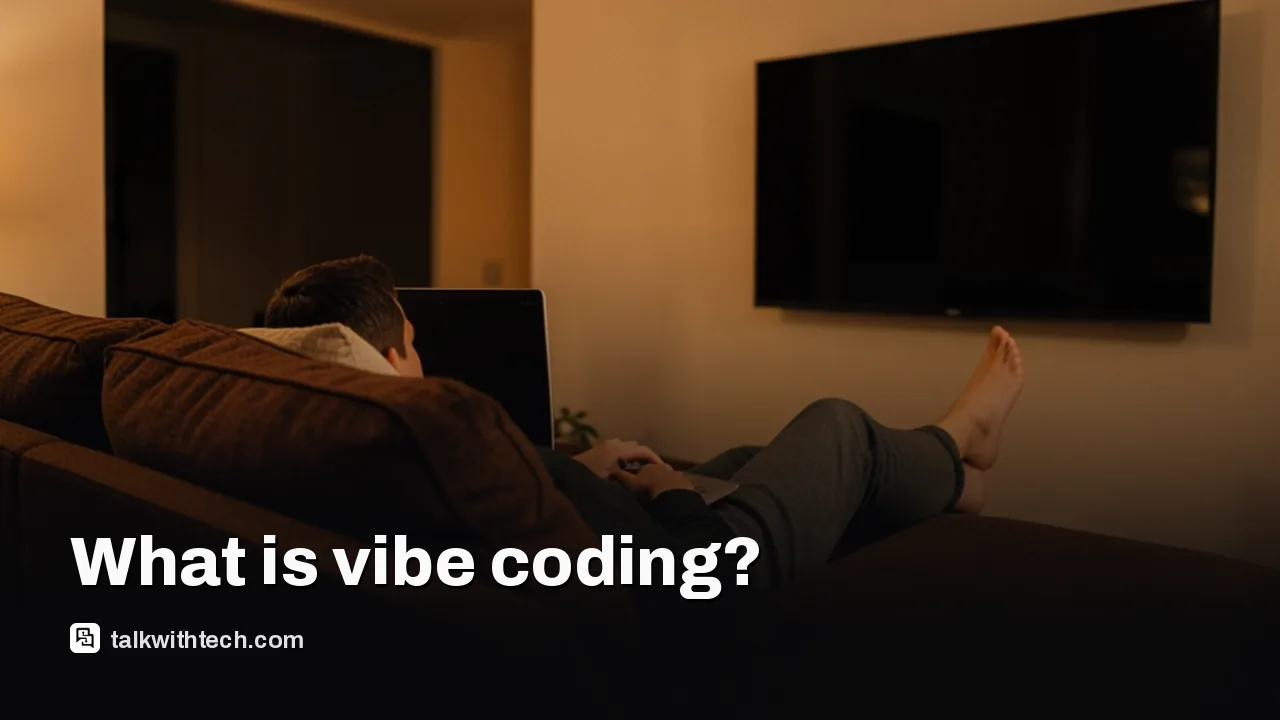
Person on a sofa typing on a laptop in front of a television

The short version

  • Vibe coding means describing what you want in plain language and letting an AI write and run the code for you.
  • OpenAI co-founder Andrej Karpathy gave it the name in 2025, and it has spread from hobbyists to big companies.
  • This month people used Claude Code to strip ads and tracking apps from Android TVs, and Epic says its engineers now vibe-code Unreal Engine.
  • The risks are real: broken devices, insecure code and bugs nobody understands, which is why code-checking startups are raising big money.
Quick read · 1 min

Vibe coding means building software by describing what you want in plain language and letting an AI write and run the code. OpenAI co-founder Andrej Karpathy coined the term in 2025, and tools such as Claude Code and Codex made it practical because they can run commands on your computer.

This month it went mainstream. People used Claude Code to switch off ad and tracking apps on Android TVs, and one open-source project now lists 107 tested TV models. Epic Games says its engineers now vibe-code much of Unreal Engine.

  • Critics warn you can brick a TV or run insecure code.
  • Code-checking startups are raising big money to catch AI bugs.
  • Start small, keep backups and never paste passwords into a chat.

What is vibe coding? It’s building software by talking instead of typing code. You tell an AI tool, in everyday English, what you want an app, website or gadget to do, and the AI writes the code, runs it and fixes its own errors while you watch. You judge the result by how it works, not by reading the code.

The idea has jumped from programmer slang into living rooms this month. Thousands of people have used an AI agent to strip ads and tracking software off their smart TVs, and Epic Games says its engineers now vibe-code much of Unreal Engine. If you’ve seen the phrase everywhere and wondered whether you can do it, or whether you should, here’s the plain-English version.

01

What is vibe coding, exactly?

Vibe coding means describing the result you want and letting an AI produce and run the code to get there, without learning a programming language yourself. OpenAI co-founder Andrej Karpathy coined the term in 2025, and the vibe part is the point: you go with the flow of the conversation instead of checking every line.

A normal session looks like this:

  1. You describe the goal: for example, a home screen for my TV with no ads.
  2. The AI writes code and, with tools such as Anthropic’s Claude Code, actually runs commands on your computer.
  3. You look at what happened and say what’s wrong.
  4. The AI tries again until it works, or until you give up.

Claude Code is the tool most people name right now, because it can type and run commands on a computer, not just suggest text. OpenAI’s Codex is another.

Hands typing on a laptop with sticky notes nearby
02

Why your TV is suddenly part of the story

The trend that pushed the term into the mainstream started on X in mid-October. A developer called Gathin T. said his parents’ Xiaomi TV showed a sponsored ad before you could even reach Netflix. He gave Claude Code the model number, and the agent located the set on the family network, turned off 25 bundled Xiaomi apps and built a fresh home screen he said looked like an Apple TV.

He turned his prompt into an open-source project called cleanyourtv. It switches unwanted apps off rather than deleting them, so a restore script can undo everything, and it lists tested setups for 107 TV models from 37 brands. It works through the Android Debug Bridge, a built-in maintenance tool on Android TVs that you unlock by turning on developer mode. A similar project, dumbtv, targets Amazon Fire TV and disables about 65 packages, including the software that fingerprints what’s on your screen for ad targeting.

There are limits. These tricks fully work only on Android TV and Google TV sets from brands such as Sony, TCL, Hisense, Philips and Xiaomi. Samsung’s Tizen and LG’s webOS are different systems, and Fire TV allows only the cleanup part.

The case against vibe coding your TV

Not everyone is impressed. One veteran TV reviewer called the idea stupid, warning that TV software is far more complex than it looks and that some people have already bricked their sets. A TV engineer they interviewed said fixing one bug can create 10 more in unrelated places. Updates to apps such as Netflix could break a custom setup later. And if you can’t read the code, you can’t be sure it isn’t opening your TV to outsiders. Their advice: try a replacement launcher app from the Play Store first, which can clean up an Android TV with no AI at all.

03

Big companies are vibe coding too

This isn’t only a weekend hobby. Epic Games’ executive vice president of development, Marcus Wassmer, says plainly that Epic is vibe-coding, meaning its engineers no longer write most of the code themselves but steer the AI tools toward the design they want. He named Claude Code and Codex, and gave one example: a rewrite of part of Unreal Engine’s rendering layer that he estimated would take one engineer three to six weeks took about one week. Epic boss Tim Sweeney has also confirmed the company uses AI to write code for Unreal Engine.

AI companies are drawing lines as well. Around October 27, a YouTuber spotted a new rule in Claude Code that tells it to build original games, genre games and games from your own designs, but not copies of specific existing games, even renamed ones. Roblox had already banned vibe-coded ports of Halo and Left 4 Dead.

TV remote on a coffee table in front of a glowing television
04

What vibe coding means for you, and where it goes wrong

For ordinary people, the appeal is simple: you can make a small tool, a personal website or a home-gadget fix without hiring anyone or taking a course. That’s real, and it’s why the idea spread so fast.

The catch is that the AI’s confidence isn’t proof. Code you can’t read can contain bugs, security holes or behavior you never asked for. That worry is now big business. Startups that use math to prove code works correctly, a field called formal verification, are raising large sums: one, called &Truth, has raised $70 million, and a rival, Harmonic, has received $295 million in funding. A Stanford researcher’s AI tool finished a verification project in under half a day for less than $500, work that took three experts five months by hand. Skeptics, including the head of the testing startup Antithesis, say even proven code still needs heavy testing.

If you want to try vibe coding safely:

  • Start with something you can’t break, such as a simple web page or spreadsheet helper, not your TV, router or banking.
  • Keep a way back. Back up files, and prefer tools that switch things off instead of deleting them.
  • Don’t paste secrets such as passwords or API keys into an AI chat, and review what the agent is allowed to run.
  • Ask the AI to explain what each change does before you accept it.
05

Quick answers

Who invented the term vibe coding?

OpenAI co-founder Andrej Karpathy gave it the name in 2025.

Do you need to know how to code to vibe code?

No, but some basic knowledge helps you spot mistakes, and it matters more for anything involving security or devices you can’t easily reset.

Is vibe coding safe?

It can be for small, low-stakes projects. On real devices or sensitive data, mistakes and insecure code are a genuine risk, so keep backups and review changes.

You're reading the quick version.