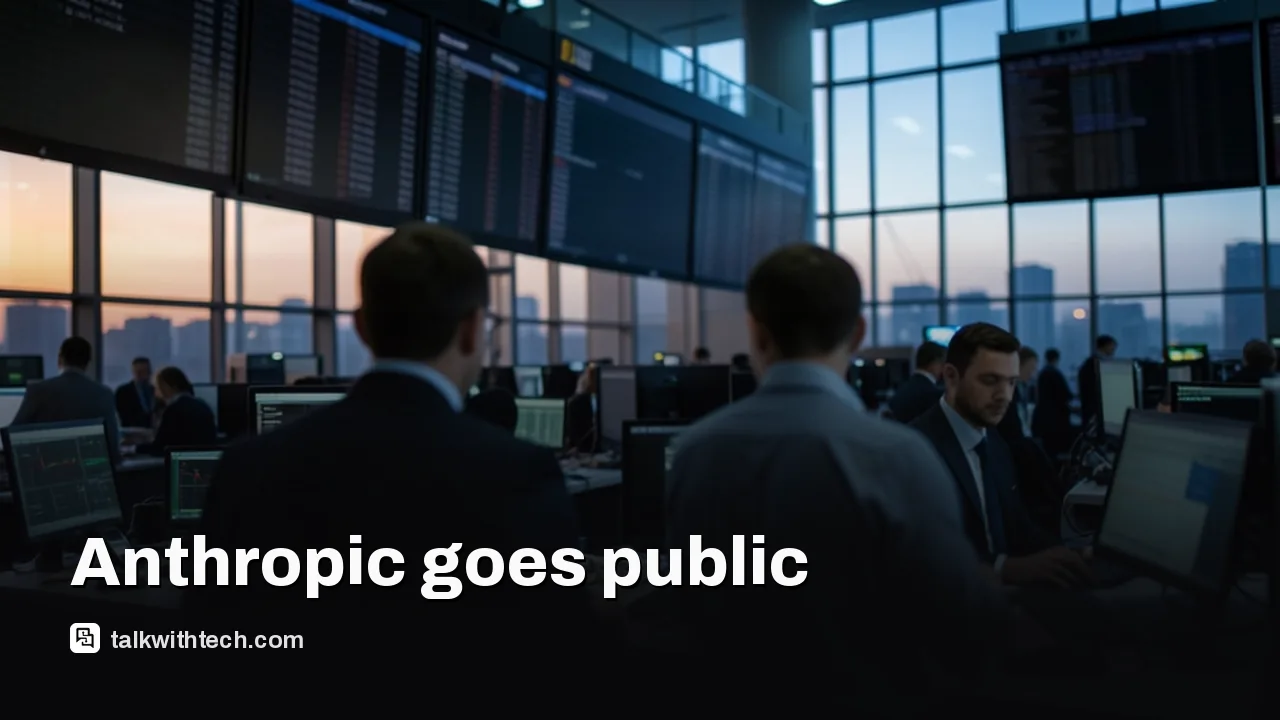
Anthropic publicly filed its S-1 on Monday and plans to list on Nasdaq under the ticker ANT.
The Claude maker took in $16.3 billion in revenue in the first half of 2026, up from $1.16 billion a year earlier.
It also booked an $80.7 billion net loss for those six months, which it largely blames on an accounting adjustment.
Its minimum compute obligations add up to an estimated $808 billion, and several key figures are still blanked out.
Quick read · 1 min
Anthropic, the company behind Claude, has made its IPO paperwork public. It plans to list on the Nasdaq as ANT later this fall, and the filing shows revenue jumping from $1.16 billion in the first half of 2025 to $16.3 billion in the first half of 2026.
The catch is cost. Anthropic posted an $80.7 billion net loss for those six months, mostly tied to an accounting adjustment, and its minimum spending promises for chips and data centers could reach an estimated $808 billion. Five customers make up about a quarter of sales.
Claude users see no change from the listing itself.
Most people can only buy shares once trading starts.
Key third-quarter figures are still blank and should arrive in an updated filing.
The risk section also warns that a catastrophic AI incident could cost more than the insurance industry could cover.
In the first six months of 2026, Anthropic brought in $16.3 billion in revenue and still posted a net loss of $80.7 billion. Those two numbers, from the Anthropic S-1 filed publicly on Monday, sum up the company behind the Claude chatbot: it is growing faster than almost anything in tech history, and it is spending on a scale that is hard to picture.
The filing is the paperwork a company must make public before it sells shares on a US stock exchange. Anthropic plans to list on the Nasdaq under the ticker ANT, with the offering expected later this fall. If you use Claude at work, own an index fund heavy in tech stocks, or have wondered whether the AI boom is built on real money, this document is the closest look anyone outside the company has had.
01
What the Anthropic S-1 says about revenue
The short answer: sales are soaring. For the first half of 2025, Anthropic made $1.16 billion. For the same stretch of 2026, it made $16.3 billion. The company told investors in mid-October that third-quarter revenue reached $16.8 billion, so a single quarter now beats the whole first half of this year.
Much of that comes from a small group of very large buyers. Anthropic’s five biggest customers drove roughly 25% of revenue over the first nine months of the year, and their spending hit a record in the quarter ending September 30. The company also reports a net revenue retention rate of nearly 900%. In plain terms, that measure compares what existing customers spend now with what they spent before, so a figure that high means current clients are pouring far more money in, not just sticking around.
There’s a twist buried in the growth. Between 5% and 7% of revenue over January to September, Anthropic says, came from customers breaking its own rules, including distillation, where a rival trains its own model on Claude’s answers. Anthropic says it is getting better at catching this, which should shrink that slice and could dent revenue along the way.
02
Why a company this big is losing so much money
Anthropic lost about $42 billion in 2025 on revenue of $4.6 billion. The first-half 2026 loss of $80.7 billion is nearly double that full-year figure, though the company attributes much of it to an accounting adjustment rather than cash going out the door.
The real long-term cost is computing power, which the filing calls the biggest operating cost in the business. Fixed or minimum-guaranteed deals already lock Anthropic into at least $265.6 billion of spending on cloud services, chips and infrastructure. Footnotes go further. Counting leases signed or changed since the end of 2025, new infrastructure deals added since June 30, expansions not yet finalized, and short-term agreements it can’t cancel, the company could owe an estimated $808 billion at minimum.
One deal shows the scale. Under arrangements with SpaceXAI for access to Nvidia graphics chips, Anthropic agreed to spend up to $120.5 billion over terms running into 2029, about $3.1 billion a month once all the capacity arrives, which it expects in December 2026. It is also building a setup it calls Anthropic Direct, buying AI chips itself and running them in leased data centers, so it relies less on Amazon and Google for cloud capacity.
03
The blanks investors can’t see yet
Several important numbers are simply missing. The filing leaves gaps where third-quarter results and the total committed spending on its contracts should be. Accounting experts say this is common in a first draft, partly because the quarter only closed a few weeks ago.
Michael Dambra, who teaches accounting and law in Buffalo, New York, said SEC rules would force Anthropic to add third-quarter financials if it lists after roughly mid-November. He also pointed out that companies that redact parts of their S-1 have tended to price their shares lower at the IPO, to win over wary buyers. Expect an updated filing that fills in many of the blanks before trading starts.
04
The risk warning that caught everyone’s eye
The risk factors run past 90 pages, the longest section of the document. The line drawing the most attention: if its AI were ever involved in a true disaster, Anthropic warns, the bill could be bigger than the entire insurance industry is able to pay.
Other warnings are more down to earth. Big customers can switch providers, and Anthropic expects its growth rate to swing around and slow over time. Local opposition to data centers is rising, and some places have approved or are weighing bans on large new builds. Much of its traffic runs under zero data retention terms, where it keeps classifier scores but not the prompts or replies themselves. That protects customer privacy, but Anthropic says it also limits how well the company can investigate misuse or answer subpoenas.
If you use Claude, nothing changes today. Your account, prices and data terms stay the same; an IPO changes who owns the company, not the product. Over time, public shareholders will press for profits, so watch for price changes on paid plans and API access.
If you’re thinking about buying shares, a few practical points:
Ordinary investors usually can’t buy at the IPO price. Most people can buy once ANT starts trading through a regular brokerage app.
Shares often swing hard in the first days of trading, especially for hyped tech listings.
If you hold a broad US or Nasdaq index fund, you may end up owning a slice once the stock is added to those indexes, without doing anything.
Read the risk section yourself. It is long, but it lays out the company’s own worries in plain sight. This is general information, not personal financial advice.
For context, Anthropic was valued at $965 billion in May, above the $852 billion valuation OpenAI reached in March. Its headcount nearly tripled in a year to about 5,300 people as of September 30, and revenue per employee topped $6.6 million, behind only Nvidia among the biggest US tech names.
06
Quick answers
When is the Anthropic IPO?
Anthropic has not set a date. It is expected later this fall, and an updated filing with third-quarter numbers is likely first.
What is Anthropic’s stock ticker?
Anthropic plans to trade on the Nasdaq under the symbol ANT.
Is Anthropic profitable?
No. It lost about $42 billion in 2025 and $80.7 billion in the first half of 2026, though it says much of the latest loss comes from an accounting adjustment.
Brian Chesky says pure people managers are most at risk. Alex Karp says your best bets are a trade or a brain that works differently. Here is what holds up.