Poor ventilation raises health risks for home 3D printing sessions
New safety guidance warns that common PLA and resin printers can release airborne particles and gases in small spaces. Here’s what to know before you print at home.
3D printers emit ultrafine particles and VOCs when heated, even with PLA filament.
Small spaces like bedrooms or compact home offices are not ideal without ventilation.
Ventilation, enclosures, and distance from the printer reduce exposure during longer prints.
For occasional prints, consider off-site services or dedicated workshop spaces to limit risk.
Quick read · 1 min
Home 3D printing can emit ultrafine particles and VOCs, even with PLA. In a small bedroom or cramped home office, exposure can rise during longer prints. The safer move is a well-ventilated room or a dedicated workshop with outside exhaust. If that isn’t possible, limit time near the printer and consider using a local print service for big projects.
What to do next: 1) Ventilate properly or relocate the printer. 2) Use an enclosure and outdoor exhaust if you print at home. 3) Choose safer filaments and keep temperatures lower when feasible.
Ventilation and enclosure
Safer filament choices
Consider local services
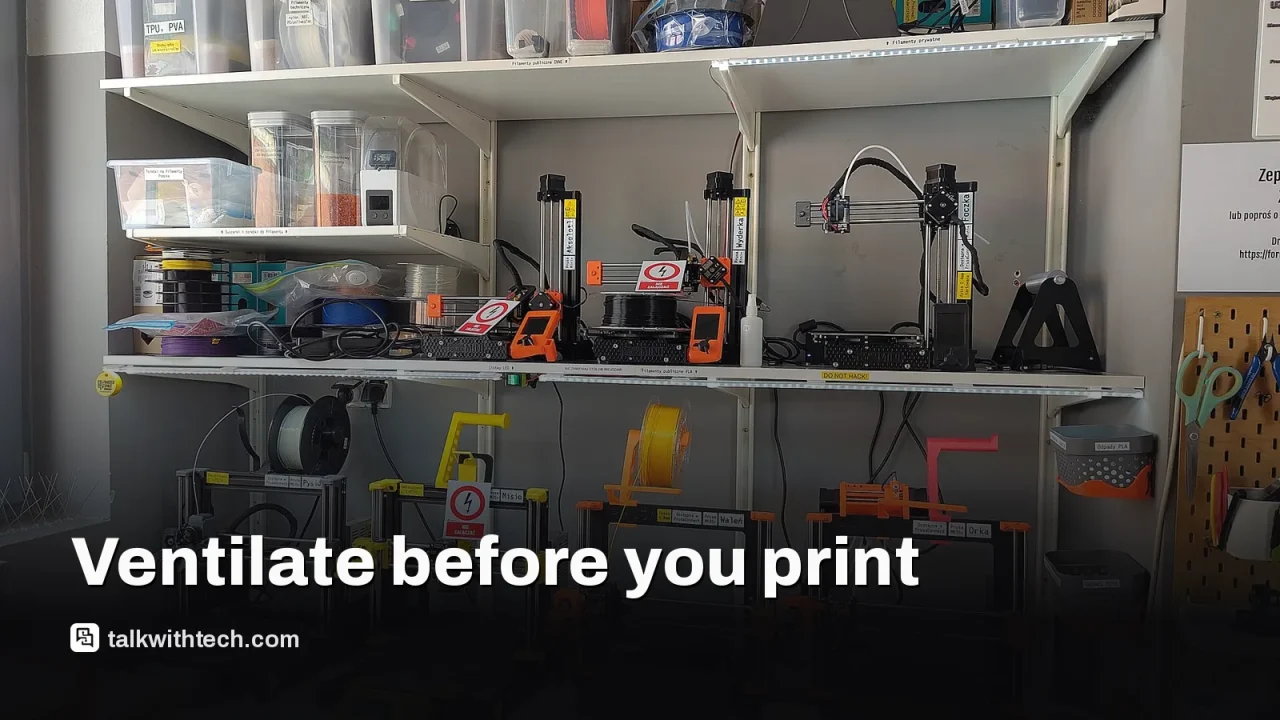
A new look at home 3D printing safety emphasizes that where you print can matter as much as what you print. Even popular PLA filament cans emit ultrafine particles and volatile organic compounds when heated. In a cramped bedroom or tight home office, those emissions can build up over long prints, making little spaces less safe than people assume.
If you’re planning to print at home, think about the space first. The safest approach is a well-ventilated area or a separate workspace, rather than a bedroom desk or corner of a living room. Opening a window alone isn’t enough to reliably remove airborne particles, and a proper enclosure or dedicated venting helps capture emissions close to the source.
01
What exactly is released during a print?
Ultrafine particles can travel deep into the lungs, and VOCs are stray gases released when plastic heats up. The long-term effects of breathing these in at home aren’t fully known, but experts say ventilation and filtration matter. Filament choice influences risk: PLA generally emits fewer particles than ABS, but emissions still occur and vary by brand, temperature, and additives. Resin printers bring their own hazards, especially uncured resin, which can irritate skin and trigger asthma in some people. Cleaning and curing resin also carry exposure risks.
02
Where should you print to stay safer?
Best practices point to a separate room or workshop with outdoor exhaust. A garage can work if it’s properly vented and climate-controlled. The goal is to exhaust air outdoors and keep the printer away from primary living or working spaces. Relying on a window to vent is not enough to reliably remove emissions from repetitive prints.
03
Practical steps to cut your exposure
Ventilate well: Use an enclosure with external exhaust or print in a room that can be vented outside. Keep doors closed to limit spread.
Reduce time near the device: If you must print in a shared space, limit the amount of time you spend nearby while the printer runs.
Choose safer materials and lower temps: PLA is often viewed as safer than ABS, but it isn’t emission-free. Look for low-emission filaments and run at cooler temperatures when possible.
Consider off-site services for big jobs: For large or frequent prints, sending designs to a local print service can be a practical option.
Protect yourself when handling resins: Wear gloves and ensure good ventilation if you work with uncured resin, following the manufacturer’s safety guidance.
04
What this means for everyday makers
For hobbyists building parts, toys, or cosplay pieces at home, treat your printer like a power tool. Don’t run it unattended in a closed room. Plan for a safe setup you can monitor, and weigh the convenience of at-home printing against the health considerations for you and anyone sharing the space.
As home 3D printing grows, expect more guidance on safe setups. In the meantime, assess your space for ventilation, consider moving the printer to a dedicated area, and decide whether occasional at-home printing or a local service makes more sense for your projects.
06
Quick answers
Is it safe to print in a bedroom?
Not ideal. Emissions can accumulate in small spaces, so ventilation and an enclosure are important if you print there.
Which filament is safest?
PLA is generally considered safer than ABS, but neither is emission-free. Emissions depend on temperature and additives.
What should I do right away?
Check your space for ventilation, consider moving the printer to a better spot, and avoid unattended printing in a cramped room.
A practical guide to wireless backup cameras for older vehicles: how they transmit video, power them, and what features you’ll miss compared with factory kits.