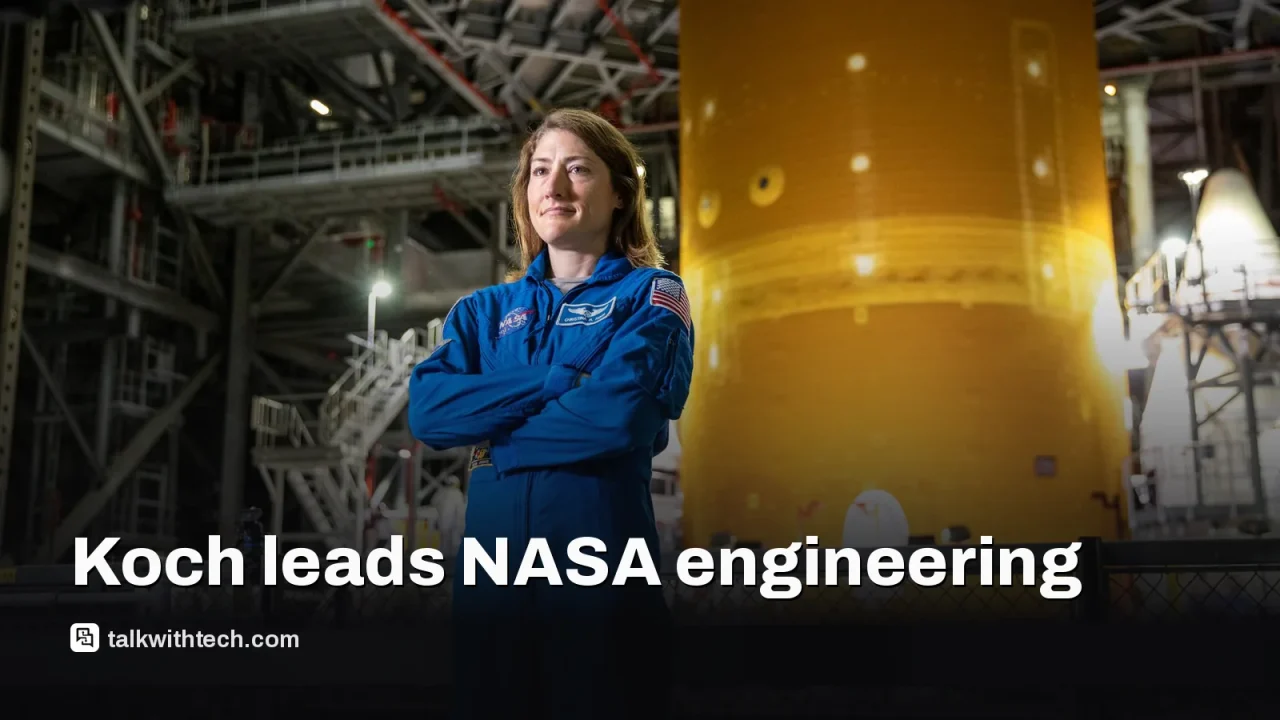
NASA taps Christina Koch to lead engineering as retirement reshapes leadership
The Artemis II astronaut gives up future spaceflights to become NASA's acting deputy chief engineer, replacing a propulsion veteran who retired after more than 35 years.
NASA named astronaut Christina Koch acting deputy chief engineer, starting Sunday, Nov. 1, 2026.
She replaces Katherine Van Hooser, who retired on Oct. 21 after more than 35 years at NASA.
Taking the job makes Koch a management astronaut, so she can no longer be assigned to future spaceflights.
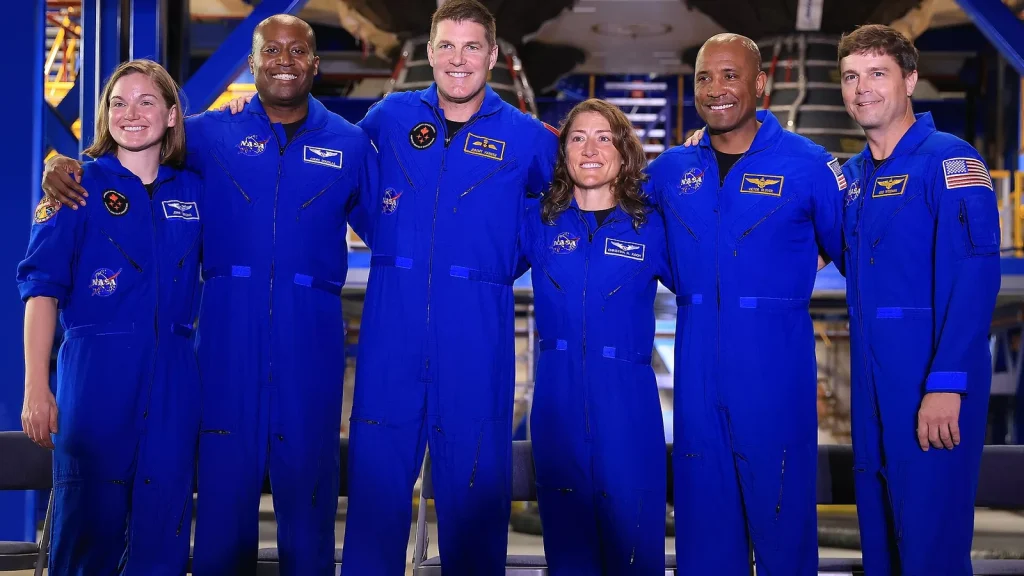
Koch flew around the Moon on Artemis II in April and holds the record for the longest single spaceflight by a woman.
Quick read · 1 min
NASA has made astronaut Christina Koch its acting deputy chief engineer, starting Nov. 1, 2026. She takes over from Katherine Van Hooser, a rocket engine specialist who retired on Oct. 21 after more than 35 years at the agency.
The job means helping lead NASA's engineers and checking that its programs are technically sound and ready to fly. It also comes at a price: Koch becomes a management astronaut and can no longer be picked for spaceflights.
She flew around the Moon on Artemis II in April
She spent 328 days in a row on the space station
She started at NASA as an electrical engineer at Goddard
She will report to chief engineer Amit Kshatriya as NASA works toward a crewed Moon landing, a Moon base and nuclear power in space.
Christina Koch flew around the Moon in April. Now she has given up any chance of flying again. NASA has named the Artemis II astronaut its acting deputy chief engineer, a senior desk job that comes with one big condition: she is off the list for future spaceflights.
Why does a staffing change at NASA matter to you? The deputy chief engineer helps decide whether rockets, capsules and Moon hardware are safe and ready to fly. NASA is planning to land Americans back on the lunar surface, build a Moon base and start work on nuclear power in space, all programs paid for by US taxpayers. Putting someone who has trusted that hardware with her own life into that seat is a deliberate choice.
01
What is Christina Koch’s new job at NASA?
Christina Koch is NASA’s acting deputy chief engineer, starting on Sunday, Nov. 1, 2026. In the role she helps lead the agency’s engineering community, with a focus on technical oversight, mission readiness and the quality of engineering work across NASA’s programs and projects.
“Acting” means she holds the post on an interim basis rather than as a permanent appointment. “Deputy” means she works under NASA’s chief engineer, Amit Kshatriya, who is also the agency’s associate administrator. So while she now helps steer engineering across the whole agency, she is the number two in that chain, not the top engineer.
In practice, the chief engineer’s office is where tough technical calls get checked: whether a design holds up, whether testing was good enough and whether a mission is truly ready. It is less glamorous than a launch, and arguably more important.
With this appointment, Koch moves to what NASA calls management astronaut status. She keeps the astronaut title, but she will no longer be eligible for spaceflight assignments.
That is a real trade. Koch has been one of NASA’s most experienced flyers. She spent 328 days in a row aboard the International Space Station, a record for the longest single trip to space by a woman, and she took part in the first spacewalks carried out only by women. In April 2026 she was a mission specialist on Artemis II, the first time astronauts had flown around the Moon in more than half a century.
NASA Administrator Jared Isaacman said Koch has seen engineering from both sides, building complex systems on the ground and then relying on them to keep her alive in space. He pointed to her near-year on the space station and her Artemis II flight as the reasons she brings rare technical and operational judgment to the job.
03
Who is Christina Koch? An engineer before an astronaut
Koch’s background explains why NASA picked her for an engineering post rather than a ceremonial one. She started at NASA as an electrical engineer at Goddard Space Flight Center in Greenbelt, Maryland, where she built scientific instruments for space missions.
Before NASA selected her as an astronaut in 2013, she also worked as a scientific field engineer in Antarctica and the Arctic, some of the harshest places people work on Earth. Since then she has held leadership roles in NASA’s Astronaut Office and at Johnson Space Center in Houston.
That mix of lab work, field work and flight experience is the point. Engineers who design hardware and astronauts who ride it don’t always see risk the same way. Koch has done both.
Kshatriya made the same point when announcing the move, praising her engineering skill, her operational experience and the leadership she has shown both on the ground and in orbit. He said he was confident she would carry on the high technical standards NASA depends on.
04
Katherine Van Hooser: the propulsion veteran she replaces
Koch fills the seat left by Katherine Van Hooser, who retired on Wednesday, Oct. 21, after more than 35 years at NASA. Van Hooser had been the agency’s deputy chief engineer since 2023.
Her career ran through some of NASA’s biggest rocket engines. She joined the agency in 1991 at Marshall Space Flight Center in Huntsville, Alabama, working first on the turbomachinery (the high-speed pumps) inside liquid rocket engines. She went on to become chief engineer for the space shuttle main engine, leading that work through the final 21 shuttle flights.
Later she was the first chief engineer for the Liquid Engines Element of the Space Launch System, the giant rocket behind the Artemis missions, and then Marshall’s chief engineer. Kshatriya credited her with guiding the agency through key milestones and periods of change.
What this means for Artemis and NASA’s next missions
For most people, the effect is indirect but real. Engineering leaders are the ones who raise a hand when something isn’t ready, and the cost of getting that wrong on a crewed Moon mission is enormous, in money and in lives.
Isaacman tied the appointment to a busy agenda: returning Americans to the Moon’s surface, building the Moon Base, getting nuclear power in space under way and developing the tools that will eventually take astronauts to Mars. Each of those needs hardware that has never flown before, and Koch’s new office is part of how NASA decides it is safe.
There is also a signal here for the astronaut corps. Moving a recent Artemis flyer into engineering management suggests NASA wants first-hand flight experience feeding directly into technical decisions, rather than sitting only in the Astronaut Office.
06
Quick answers
When did Christina Koch become acting deputy chief engineer?
Her appointment began on Sunday, Nov. 1, 2026, after Katherine Van Hooser retired on Oct. 21.
Will Christina Koch go to space again?
No. The new role makes her a management astronaut, and NASA says she is no longer eligible for future spaceflight assignments.
Is Christina Koch NASA’s chief engineer?
No. She is the acting deputy. NASA’s chief engineer is Amit Kshatriya, who is also the agency’s associate administrator.
A Brooklyn jury found Huawei guilty of bank fraud, sanctions breaches and plotting to take US trade secrets, but cleared it of racketeering. Here is what happens next.
Brussels wants its quantum labs to become quantum companies. The plan favors EU-controlled suppliers, tackles code-breaking risk and still faces years of debate.