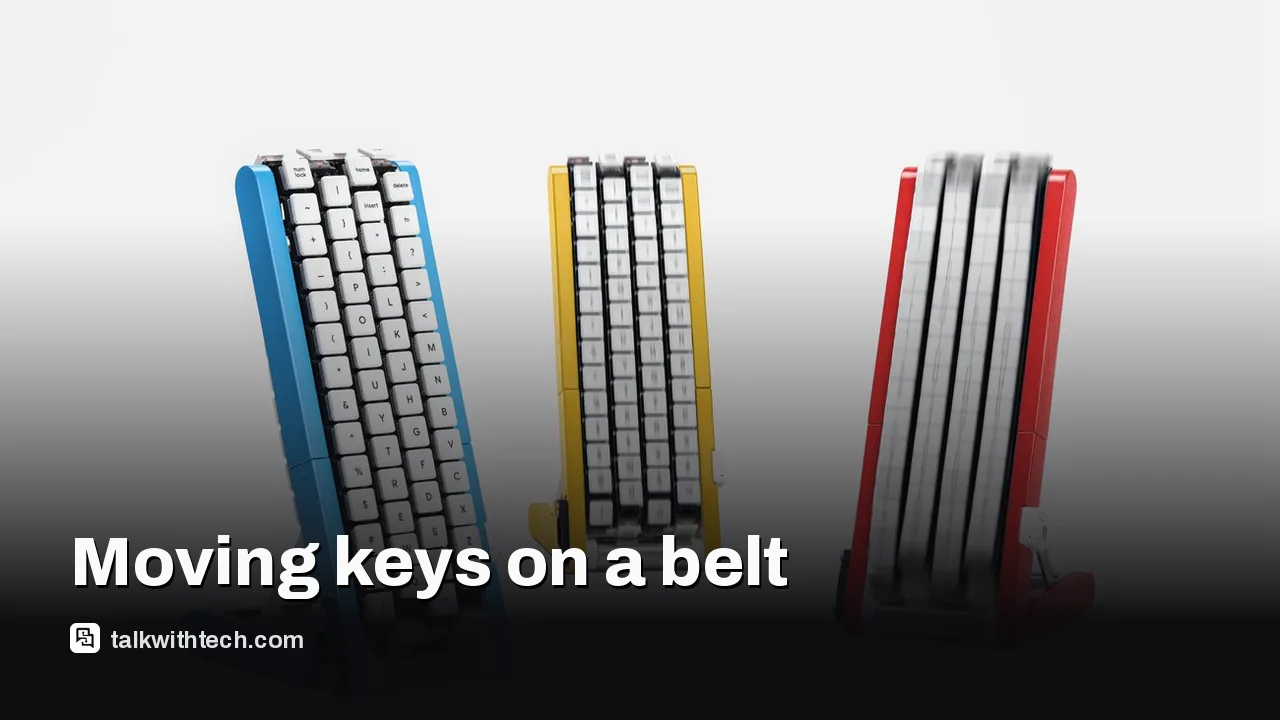
Google Japan built a conveyor belt keyboard and shared the plans
A quirky Gboard concept from Google Japan comes with DIY plans on GitHub, but it isn’t a consumer product, yet it proves keyboard humor still has legs.
Google Japan unveiled a conveyor-belt keyboard as part of its annual April Fools tradition.
The device is a joke and not available to buy, but Google published DIY plans on GitHub.
The concept frames one-handed use by letting keys move to the user, a playful nod to kanji input and keyboard limits.
Quick read · 1 min
Google Japan just teased a conveyor-belt keyboard as part of its annual Gboard April Fools joke. It’s not for sale, but DIY plans are on GitHub for curious builders. It’s a playful look at input methods and one-handed use, not a real product. If you’re intrigued, you can check out the plans and imagine how such ideas test the edges of keyboard design.
What does it mean for you? Mostly curiosity and a bit of nostalgia for quirky tech stunts. For serious typing needs, stick with proven keyboards and software input options. What happens next is simple to watch: another year, another oddball idea from Google Japan, and perhaps more DIY experiments for enthusiasts.
Google Japan rolled out one of its most outlandish keyboard ideas yet, a conveyor-belt keyboard that looks like a cross between a traditional office board and a tiny factory line. It’s not a product you can buy. It’s part of Google’s long-running April Fools tradition for the Gboard team, a playful way to spotlight input quirks rather than hardware reality.
In the past, Google Japan has teased an array of unusual input methods to poke fun at the limits of typing on a smartphone. This year’s entry channels the humor into a one-handed typing scenario where keys drift toward your fingers on a rotating belt. The gag is that rather than moving your hand to reach keys, the keys move to you. It’s a reminder that Japanese script and diverse input styles often push keyboards to stretch beyond a standard layout.
Crucially, Google isn’t selling this thing. Instead, the company has published the build plans on GitHub so curious hobbyists can try to assemble a DIY version themselves. The page describes the concept and walking-through steps, inviting creative tinkers to experiment with the idea. It’s the kind of project that’s more about curiosity and engineering play than a realistic path to a consumer device.
So why does this matter to everyday readers? It’s a peek into how one of the world’s most-used mobile keyboards toys with ideas about input speed, fatigue, and one-handed use. Even as a joke, it highlights how flexible software keyboards can be in theory, and how hardware experiments can still spark conversation about usability.”
01
What is the conveyor-belt keyboard, exactly?
It’s described as a keyboard where the keys are arranged so they flow toward the user on a rotating conveyor. The idea is to reduce the need to move your hands around the keyboard by letting the keys arrive at your fingertips. In practice, it’s a playful, visual gag that emphasizes the friction of real-world typing and the lengths engineers will go to test ideas in a joking format.
02
Is this a real product I can buy?
No. This is an April Fools joke from Google Japan, not a commercial device. Google says the project is meant to entertain and inspire discussion about input methods, not to become a physical store item.
03
How can I see or try it myself?
The DIY plans are available on GitHub, so technically skilled readers can build a version of the conveyor-belt keyboard at home. The GitHub release is there for enthusiasts who want to experiment with the idea, but Google isn’t offering a ready-made kit or official instructions for a mass-produced version.
04
What this means for ordinary people
For most of us, the takeaway isn’t a new gadget you should rush to buy. It’s a reminder that keyboards and input can be fun, flexible, and sometimes a little silly. If you’re curious about your own typing comfort, you can explore simpler, publicly available accessibility and input options in Gboard and other keyboard apps. And if you’re technically inclined, the DIY approach on GitHub shows how far people will go to prototype ideas that blur the line between hardware and software experiments.
This is a playful tradition, and Google tends to push the envelope with new gimmicks each year. Whether the conveyor-belt concept influences future features or simply fuels hobbyist projects remains to be seen. If you’re curious, keep an eye on future Gboard antics around April Fools, each year brings a new twist.
06
Quick answers
Is the conveyor-belt keyboard real?
No, it’s a joke and a DIY project, not a consumer product.
Where can I see the plans?
Plans are published on GitHub for interested hobbyists and builders.
Should I expect this to appear in stores?
There’s no indication Google plans to market this as a product; it’s meant as a playful showcase and a DIY invitation.
Switching to T-Mobile can drop the cost of the iPhone 17e to zero this weekend, but you’ll pay over three years through monthly credits and face a few caveats.
3 min read
We use cookies to understand how readers use Talk With Tech, so we can make it better. Is that OK? Privacy policy
The Daily Brief
Today's biggest tech stories, in 5 minutes
Every morning, the news that matters from AI, phones, apps and the people shaping tech. Explained in plain English. Free.
One email a day. No spam, unsubscribe anytime. Privacy policy