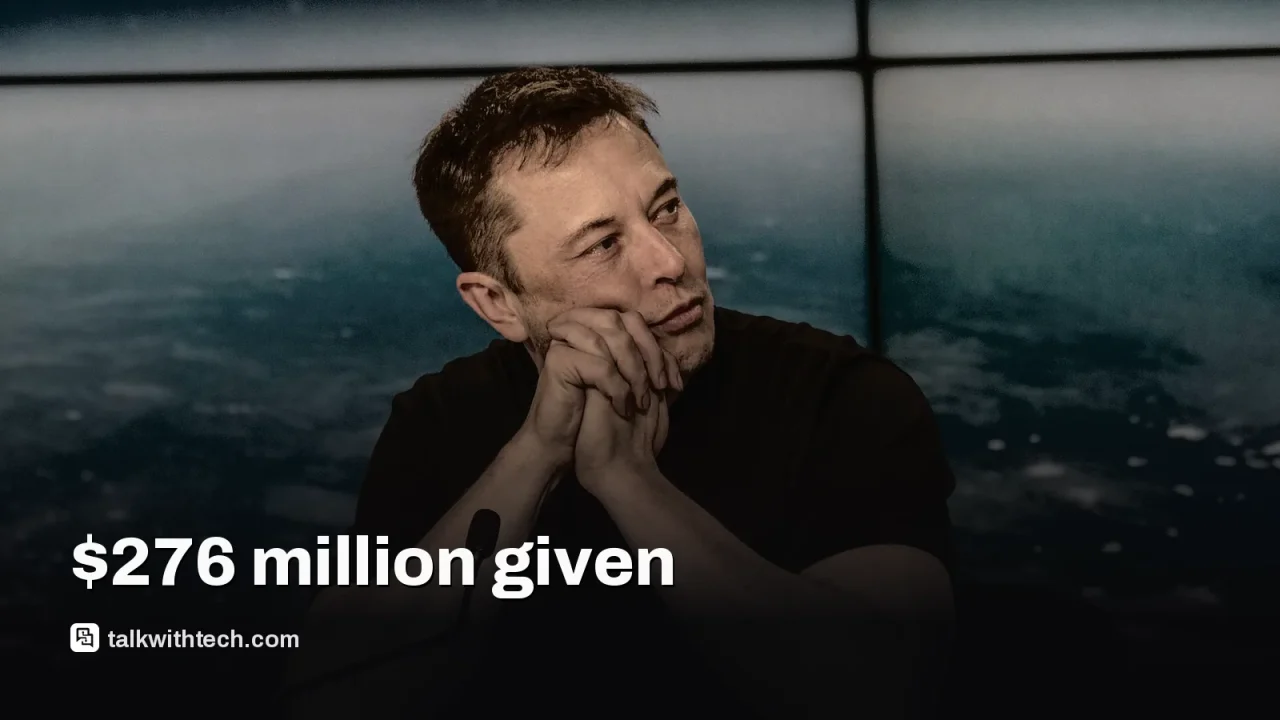
Elon Musk has donated at least $276 million to Republican midterm groups since July, becoming the largest known midterm donor.
A large portion, about $158 million, went to the Senate Leadership Fund, a super PAC backing Republican Senate candidates.
Other notable gifts include funds to America PAC, the Congressional Leadership Fund, and several state-focused or issue-specific groups.
The total federal-level giving in 2025-26 is higher than the $290 million Musk spent in 2024, despite promises to scale back political spending.
Quick read · 1 min
Elon Musk has donated over $276 million to Republican midterm efforts since July, making him the largest known midterm donor. The largest recipient was the Senate Leadership Fund, which got about $158 million.
The total federal-level giving in 2025-26 is around $366 million, higher than 2024. This matters because donor money can influence policy directions that affect how tech platforms work, how data is used, and how regulations evolve.
What readers should watch for: more advertising and messaging tied to tech policy, and questions about transparency and influence as elections approach.
Watch for policy debates on data privacy and platform rules
Follow any shifts in tech funding or R&D incentives
Consider how political spending might affect your online life
The main takeaway: Elon Musk has poured more than $276 million into Republican midterm efforts since July, making him the biggest known donor in this cycle. The figure comes from reports that compile political contributions and donor activity, and it places Musk at the center of fund-raising battles shaping which party controls Congress.
Among the recipients, the Senate Leadership Fund received the largest slice, about $158 million. That group is focused on keeping a Republican majority in the Senate. Smaller, but still substantial, gifts went to America PAC and the Congressional Leadership Fund, with other sizeable contributions to groups tied to specific races or conservative causes. The total federal-level spending by Musk in the 2025-26 cycle is estimated to be around $366 million, which dwarfs the roughly $290 million he spent in 2024 during the previous cycle.
What this means for readers is less about a single election moment and more about the influence a tech billionaire can have on political advertising, messaging and turnout. Musk’s donations align with a broader pattern of tech leaders backing political committees that support certain policy outcomes, which can influence regulatory debates, tech funding, and even what kinds of products get attention in Washington.
01
What Musk’s donations cover
Reportedly, the money has flowed to a mix of large national groups and smaller state or issue-focused committees. The Senate Leadership Fund received the largest share, while other funds supported House and Senate races and a cluster of GOP-aligned groups. The pattern suggests a strategy aimed at shaping both the legislative agenda and the size and scope of federal competition and regulation that could touch tech, data use, and online platforms.
02
Why this matters to everyday tech users
Political spending by tech executives can influence policy questions that touch your online life, things like how data is collected, how tech chips and gadgets are regulated, or how antitrust and competition rules evolve. If donor influence sways policy toward certain business models or regulatory approaches, you might see changes in how platforms operate, what kind of innovations get priority, or how government contracts and subsidies flow to tech projects.
03
What this says about tech and money in politics
Large, high-profile donations aren’t unusual among wealthy tech founders, but they do raise questions about transparency and influence. In this cycle, Musk’s giving stands out for its scale, underscoring how money from a single individual can become a prominent factor in national campaigns and policy debates. Readers should watch for how donors and political groups frame their messaging as elections approach.
04
What happens next
The midterm season will ramp up with more advertising and candidate spending. If you’re trying to understand what this means for your tech choices, keep an eye on how policy discussions around data privacy, platform accountability, and innovation funding evolve as committees gain or lose leverage in Congress.
Election-denial groups push unverified claims of voting fraud in nursing facilities as the midterms approach, urging supporters to contact facilities and share the message.