How IceCube’s South Pole sensors catch ghostly cosmic neutrinos
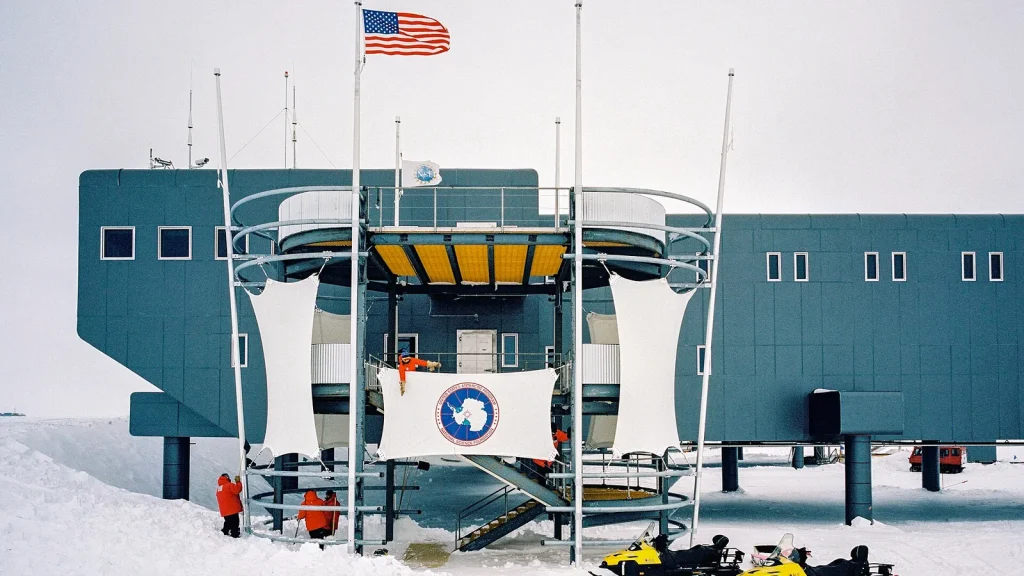
The IceCube Neutrino Observatory at the South Pole helps scientists study high‑energy neutrinos from space, a prize‑winning technology that relies on buried sensors in ice.
Francis Halzen won the Nobel Prize in Physics for work related to the IceCube Neutrino Observatory.
IceCube sits in ice at the South Pole and uses thousands of sensors to catch faint light from neutrinos.
The project draws on an international team spanning many institutions and countries.
Detecting neutrinos helps scientists study distant cosmic phenomena like supernova remnants and black holes.
Quick read · 1 min
The IceCube Neutrino Observatory at the South Pole is behind Nobel Prize–winning physics work. It detects high‑energy neutrinos by listening for faint flashes of light in a cubic kilometer of ice using thousands of sensors.
So why does this matter to you? Neutrinos help scientists study extreme cosmic events and the fundamental laws governing our universe. The project is a testament to international collaboration in science and the power of large, distributed computing to turn tiny signals into big discoveries.
What happens next? Researchers continue refining models of cosmic ray sources and the behavior of neutrinos, while the IceCube collaboration grows with more institutions and researchers around the world.
The IceCube Neutrino Observatory, a science project centered at the South Pole, played a crucial role in Nobel Prize–winning physics. The lab’s work centers on detecting high-energy neutrinos, tiny particles that stream through space and matter with almost no interaction. A Wisconsin‑based team member explains how this complex setup works and why it matters beyond the science lab.
Neutrinos are incredibly light and hardly interact with anything, so catching them requires a clever approach. IceCube hides an array of light sensors deep in the Antarctic ice. When a neutrino collides with ice atoms, it creates tiny flashes of light that the sensors pick up. In total, IceCube covers about a cubic kilometer of ice, dotted with 5,160 optical sensors. Those sensors are the eyes of the detector, watching for faint signals that reveal a neutrino’s energy and direction.
Francis Halzen, who led the project, shares credit with a broad, international collaboration. The IceCube team includes roughly 450 people at 58 institutions across 14 countries. While Halzen’s name appears on the Nobel Prize, the work rests on the effort of dozens of researchers, students, and engineers who helped design, build, and run the detector over many years.
To put IceCube in perspective: every second, a billion neutrinos pass through a typical thumb. Most go unnoticed, but the detector’s sensors capture the rare few that interact, allowing scientists to trace them back to cosmic sources. These particles are messengers from the universe’s most energetic events, like active galactic nuclei or remnants of supernovae, shedding light on the extreme physics at those distant locations.
IceCube’s design also relies on smart data processing. The sensors generate a flood of information, which researchers filter and simulate to understand the particles’ paths and energies. The project combines physics insight with high‑performance computing to turn raw light signals into meaningful cosmic clues.
In short, IceCube is more than a lab instrument. It’s a global collaboration that turns tiny flashes of light in a frozen ocean into evidence about how the universe works on the biggest scales. The Nobel Prize highlights a technology built on ice, sensors, and global teamwork.
A UPS shipment carrying sensitive F-35 cockpit canopy and weapons-bay door components was allegedly rerouted through Hong Kong after an employee missed an ITAR alert, raising questions about secure handling of military tech.
4 min read
We use cookies to understand how readers use Talk With Tech, so we can make it better. Is that OK? Privacy policy