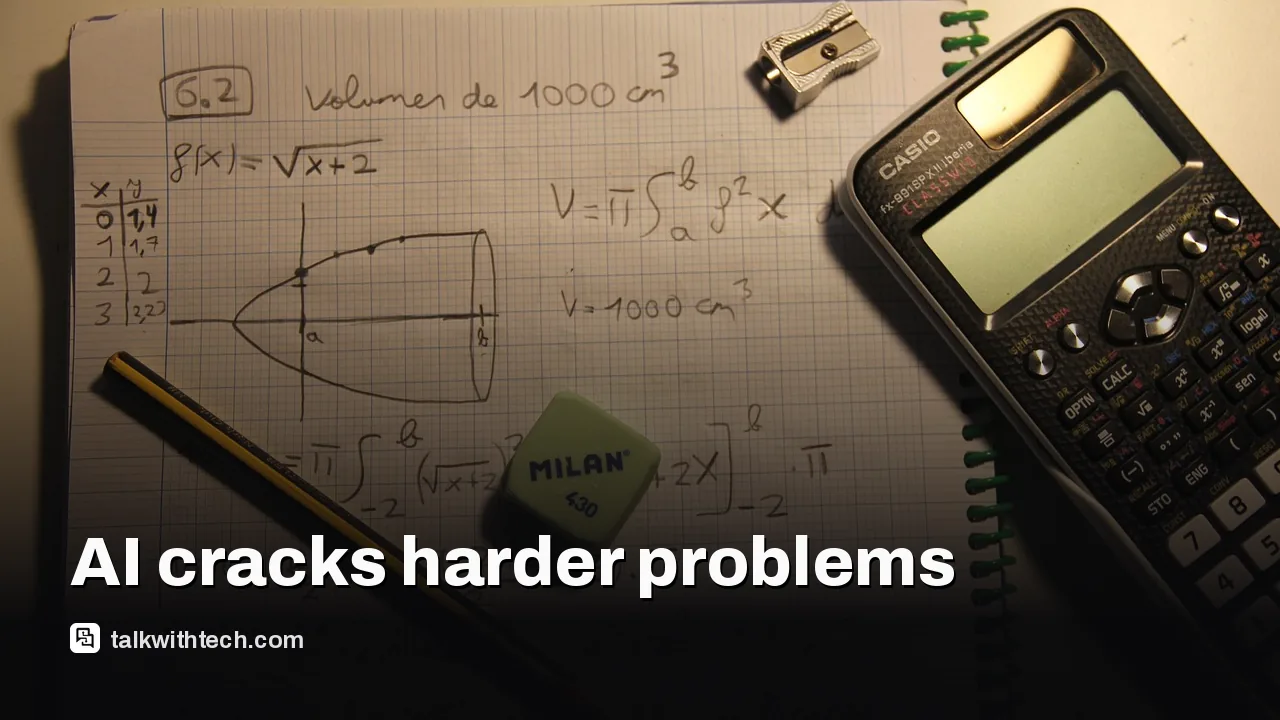
A MIT-backed study shows frontier AI models improved from solving about 2% of theoretical problems to around 35% between mid-2024 and mid-2026 in several theory-focused fields.
Researchers tested OpenAI-style models (o1, o3, GPT-5 family) on problems drawn from papers released after the models' training cutoffs, ensuring the AI had to generate solutions on its own.
Experts caution that AI's growing capability in theory doesn't replace human researchers; verification and interpretation remain essential.
Quick read · 1 min
A MIT-backed study tracks how frontier AI models perform on tough theory problems and finds a leap from 2% to about 35% solvable problems between mid‑2024 and mid‑2026. Tests used models such as o1, o3 and GPT‑5 family on problems from papers after their training cutoffs, so the AI had to generate solutions itself. While this hints at AI reshaping theory work in math, physics, and economics, researchers warn that verification and human oversight remain essential. In the near term, expect AI-assisted research workflows that pair machine reasoning with expert review, speeding the path from idea to usable technology.
The next wave of AI isn’t just polishing apps or helping with chores. A MIT-backed study tracked how top-tier AI models handle abstract, theory-heavy questions. Between mid-2024 and mid-2026, these models increased their share of solvable problems from roughly 2% to about 35% in a cluster of disciplines that lean on deep theory, like advanced math, certain physics theories, and economic theory. The researchers tested models such as o1, o3, GPT-5 and its variants on problems that appeared in papers after the models’ training cutoffs, so the AI had to produce solutions without simply pulling them from memory or the web.
What this means is not that the AI now “knows” every answer. It means it can reason through difficult, theory-laden questions well enough to potentially speed up the work researchers do. The team emphasizes this is a shift in how scientists work, not a replacement for human insight. Expect AI to contribute as a tool that helps scientists propose, check, and refine ideas, while ensuring human experts still supervise and validate results.
Still, the study stresses that solving a problem is not the same as understanding it or being able to apply the solution broadly. Verification and careful interpretation remain essential, especially in fields where a small misstep can propagate into wrong conclusions. As one of the researchers puts it, AI can present the right answers, but the path to those answers may be unclear, so human judgment is still crucial.
01
Which fields stand to change first
Fields that can be explored through theoretical work rather than requiring heavy experiments or simulations appear most likely to see AI help early on. Problems framed from published papers, where the AI must reason through steps with limited external data, are the sweet spot. If this trend continues, theory-driven questions in math, physics and economics could become early beneficiaries of AI support.
02
The limits, risks and caveats
Despite the encouraging numbers, researchers caution that many problems won’t yield correct AI-made solutions. Verification, error checking and human oversight are still necessary. The study notes that arriving at a solution is not the same as understanding the underlying concepts or being able to generalize to new situations.
03
What this could mean for everyday tech
For everyday users, the practical impact isn’t a flashy gadget. It’s faster progress in research that underpins smarter materials, climate models, and future computing breakthroughs. Over time, that can translate into better batteries, more capable AI systems powering the apps you use, and improvements in how AI researchers teach these models to think safely and reliably.
04
What happens next
Researchers say we should watch how verification workflows evolve. Teams are likely to build AI-assisted research pipelines that couple machine reasoning with human review, speeding the path from idea to usable technology while keeping quality high.
No. The study shows AI can tackle a larger chunk of theory problems, but humans still verify results and steer interpretation.
Which areas are most at risk of being reshaped first?
Theory-heavy fields like abstract mathematics, certain physics theories, and economic theory are highlighted, especially when problems come from recent papers and don’t rely on new experiments.
A short OpenAI video shows ChatGPT being used to build a catering deck and automate outreach for a Toronto restaurant, highlighting AI’s everyday business use.
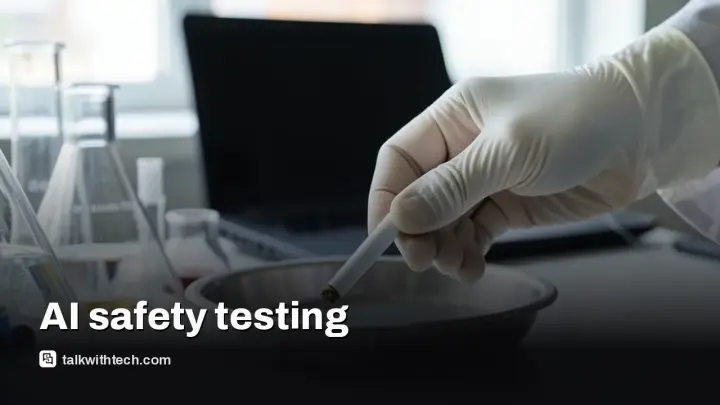
Researchers reportedly used tobacco as part of an AI safety test, probing how AI handles health and behavior prompts and triggering discussions about reliability.
A new machine-learning tool fixes bias in physics models to boost accuracy two to six weeks out, and it’s open source for agencies with limited resources.
3 min read
We use cookies to understand how readers use Talk With Tech, so we can make it better. Is that OK? Privacy policy
The Daily Brief
Today's biggest tech stories, in 5 minutes
Every morning, the news that matters from AI, phones, apps and the people shaping tech. Explained in plain English. Free.
One email a day. No spam, unsubscribe anytime. Privacy policy