Sunday, 1 November 2026

Leonid meteor shower 2026: the best night, and the Moon catch

The Leonids peak overnight from November 17 into the 18th. Here is when to step outside, where to look, and how to catch a streak on your phone.

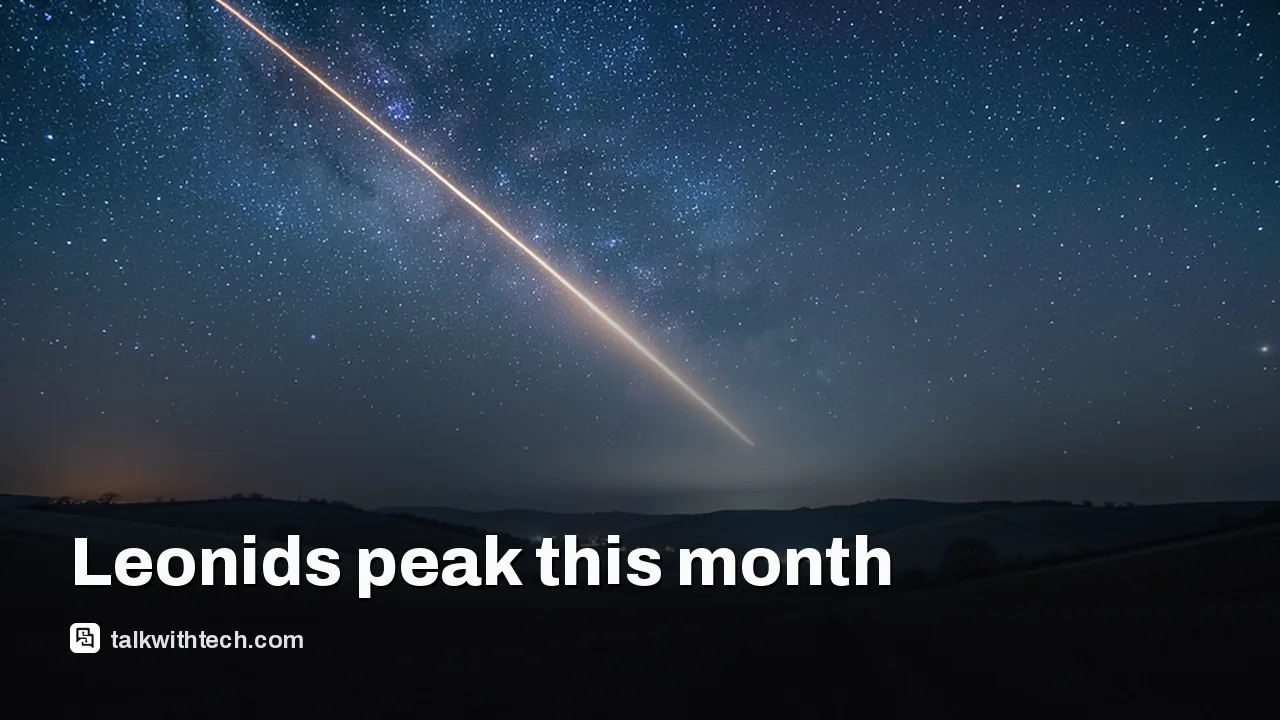
A bright meteor streaks across a starry sky above dark rolling hills

The short version

  • The Leonid meteor shower 2026 peak is predicted for midnight UTC on November 18, so watch late on November 17 until dawn.
  • Expect about 10 to 15 meteors an hour under a dark sky, a little fewer this year because of a first quarter Moon.
  • The Moon sets around the time Leo rises, so the hours after midnight are the darkest and best for viewing.
  • No storm is expected in 2026; the parent comet, 55P/Tempel-Tuttle, returns in early 2031.
Quick read · 1 min

The Leonid meteor shower 2026 peaks overnight from November 17 into November 18, with the peak predicted for midnight UTC on the 18th. Some guides name the night before, so try both if the weather is clear.

The best time to look is after midnight, when the constellation Leo rises in the east, and especially in the last hours before dawn. Under dark skies you might see 10 to 15 meteors an hour. The first quarter Moon sets around the time Leo comes up, so the key hours stay fairly dark this year.

  • No telescope needed: lie back and watch the whole sky.
  • Get away from streetlights and let your eyes adjust.
  • For photos, put your phone on a tripod, use the ultra-wide lens and night mode, and shoot lots of frames.

No meteor storm is expected. The parent comet returns in early 2031.

The Leonid meteor shower 2026 peak arrives overnight on Tuesday, November 17, into the early hours of Wednesday, November 18, and the real show starts after midnight. That’s when the constellation Leo climbs above the eastern horizon and the fast Leonid meteors start showing up in numbers.

Under a truly dark sky you could count 10 to 15 meteors per hour at best. From a suburb, think closer to a handful. The good news for 2026: the Moon is only half lit and drops out of the way at about the time the shower’s home in the sky rises, so you won’t be fighting a bright glare during the hours that matter. It costs nothing, needs no telescope, and works the same way from New York, Manchester or Toronto.

01

When is the Leonid meteor shower 2026 peak?

The peak is predicted for midnight UTC on November 18, which makes the night of November 17 into the 18th the main event for North America and the UK. Go out late in the evening, and keep watching until the sky starts to brighten before dawn.

One wrinkle: guides don’t fully agree. Some list the peak as the evening of November 16 and the morning of November 17. The Leonids don’t switch on and off in a single hour, so if the forecast is clear on both nights, go out on both. If you can only pick one, pick the 17th into the 18th.

The shower is active for most of November. Most guides put the window at November 6 to November 30, while one widely used meteor calendar stretches it from November 3 to December 2. Either way, any clear, dark morning in mid-November gives you a shot at a stray Leonid.

An empty camping chair and blanket in a dark field under a starry sky
02

What time to look, and which way to face

The best time to watch is between midnight and dawn. The radiant, the spot in the sky the meteors seem to fly out from, sits in Leo, which rises around midnight and is highest in the sky right before sunrise. Leo is at its best somewhere between 4 a.m. and 6 a.m. local time, which is the sweet spot if you’re an early riser.

You don’t need to stare at Leo itself. Meteors near the radiant look short and stubby because they’re heading almost straight at you. The long, dramatic streaks show up farther away, so lie back and take in as much of the sky as possible.

If you want a landmark anyway, Leo is easy this year. Mars and Jupiter sit right next to it in the eastern sky, along with Regulus, Leo’s brightest star. The exact radiant is close to Algieba, a star in the lion’s mane.

  • Best night: November 17 into November 18 (also try November 16 into the 17th)
  • Best hours: after midnight, ideally the last two hours before dawn
  • Where to look: the whole sky, with Leo low in the east after midnight
  • Gear: none, just warm clothes and a reclining chair
03

How the Moon affects the 2026 Leonids

Moonlight is the biggest threat to any meteor shower, and in 2026 the Leonids get off lightly. The first quarter Moon falls at 11:48 UTC on November 17, so on peak night it’s a half-lit Moon in the evening sky, not a full one.

Better still, it’s on its way down as the radiant comes up. One UK forecast says the Moon will set shortly before midnight. That leaves the post-midnight hours, the only hours that really count for the Leonids, under darker skies. If you head out on the earlier night instead, the Moon is a little under half lit, enough to hide the faintest meteors if it’s still up.

Timing matters later in the month too. The full Beaver Moon on November 24 is also a supermoon, and the Moon stays close to full for several nights around it. If clouds wipe out the Leonid peak, don’t wait until late November to try again.

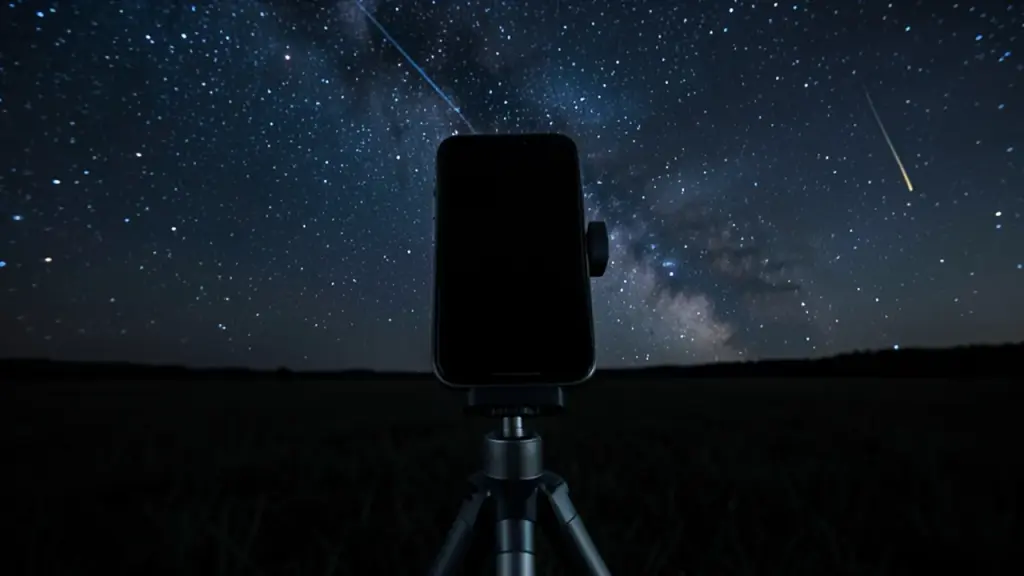
A smartphone on a small tripod pointed at the night sky in a dark field
04

Where to watch in the US, UK and Canada

Anywhere in the Northern Hemisphere works, and because the timing follows Leo’s position in your own sky, the advice is identical in all three countries: go out after midnight, local time. The thing that changes your count the most isn’t your country but your light pollution.

Get away from streetlights if you can. A park on the edge of town, a rural road with a safe pull-off, or a hilltop all help. In Shropshire, for example, the summit of the Wrekin, Carding Mill Valley and the car park at Pole Cottage all carry a Milky Way Class dark-sky rating, meaning the Milky Way itself is visible without any optical help. Many national parks and dark-sky parks in the US and Canada offer the same kind of skies.

Royal Museums Greenwich advises patience: bring a comfortable chair, dress warmly, and leave the binoculars at home, since meteors are a naked-eye sight. Give your eyes time to adjust, and keep your phone screen dim, because one glance at a bright screen resets your night vision.

05

Will 2026 bring a Leonid meteor storm?

No, a storm isn’t expected this year. Astronomers usually call a shower a storm once it passes about 1,000 meteors an hour, and a normal Leonid year delivers a tiny fraction of that.

The reason people still talk about the Leonids is their history. In 1833, observers saw more than 100,000 meteors an hour. On a November morning in 1966, sky watchers in the US saw thousands per minute for about 15 minutes. Smaller outbursts followed in 2002, 2001 and 1999.

Those storms track the parent comet, 55P/Tempel-Tuttle, a small comet with a nucleus about 2.24 miles across that loops around the Sun roughly every 33 years. It is due back in early 2031, and the odds of a big Leonid show may improve after that pass. Until then, enjoy the normal version: fast, bright streaks, often with a green tint, as bits of comet dust hit the air at up to 45 miles per second.
06

How to photograph the Leonids with your phone

A modern phone can catch a bright Leonid if you set it up for the dark and leave it running. Meteors are random, so the trick is to take lots of shots, not one perfect one.

  1. Steady the phone. Use a small tripod or prop it against a bag. Any shake ruins a night exposure.
  2. Use the widest lens. Switch to the ultra-wide camera. A wider view means more sky and a better chance a meteor crosses the frame.
  3. Turn on night mode. Most recent phones switch it on by themselves in the dark. If yours has a Pro or manual mode, set the focus to infinity.
  4. Aim away from the radiant. Point the camera at a dark patch of sky to one side of Leo, where streaks look longer.
  5. Shoot in bursts or time-lapse. A time-lapse or an interval shooting app lets you leave the phone alone and check the frames later.
  6. Include the Moon if it’s up. One astrophotographer’s advice for moonlit nights is to make the Moon part of the scene instead of fighting it.

Bring a power bank. Cold drains phone batteries quickly, and long exposures eat power too.

Bonus: more to see on the same mornings

Leonid hunters get a bonus. From around November 14 to November 25, a planet line-up is visible before sunrise, with Jupiter, Mars, Venus and Mercury low in the east and southeast. Mercury reaches its greatest distance from the Sun in our sky on November 20, the best morning to spot it.

A few late Taurid meteors may also drift through around the Leonid peak. Taurids are slower and known for producing bright fireballs, so a long, lazy streak is probably one of those rather than a Leonid.

07

Quick answers

What time is the Leonid meteor shower 2026?

Watch after midnight on the night of November 17 into November 18, local time. The best views come in the hours just before dawn, when Leo is high in the sky.

Can you see the Leonids in the UK and Canada?

Yes. The Leonids are visible across the Northern Hemisphere, including the US, UK and Canada. Clouds and city lights are the only real obstacles.

How many Leonid meteors per hour can I expect?

About 10 to 15 per hour from a dark site in a normal year. In 2026, the first quarter Moon may trim that a little, so a dozen or fewer is a realistic goal.

You're reading the quick version.