Concrete thermal battery stores 150 kWh and survives 500°C
Lehigh researchers demo a concrete-based thermal battery that stores heat from data centers and other sources, offering flexible cooling and power options.
Researchers at Lehigh University created a concrete thermal battery with 150 kWh storage capacity that can handle temperatures up to 500°C.
The device stores recovered heat from computing equipment and can release it for data-center cooling, electricity generation, and other high-temperature needs.
Efficiency after a full charge-discharge cycle exceeds 70%, with flexible charging paths including waste heat and electricity.
The system uses engineered cement with embedded thermosiphons to move heat, enabling higher-temperature use and more flexible timing.
Quick read · 2 min
Lehigh University’s engineers have built a concrete thermal battery that stores heat from data centers and other sources. The 150 kWh prototype can reach temperatures as high as 500°C and relies on embedded tubes to move heat through the concrete. It promises flexible cooling and power options by reusing waste heat rather than wasting it.
Why it matters: data centers generate a lot of heat, and cooling is a major cost. If this concrete battery scales, facilities could cut electricity use during peak times and repurpose heat for chillers or other high-temp processes.
What happens next: researchers will scale the design and test larger systems, aiming to connect to existing energy networks and industrial users. A private energy partner is already involved, moving the project toward real-world deployment.
Stores 150 kWh of heat
Withstands up to 500°C
Could feed cooling and power with recovered heat
A new concrete thermal battery from Lehigh University could help data centers reuse heat that would normally be wasted. The prototype stores heat at high temperatures and can release it later for cooling, power generation, or other industrial uses. The team says the 150 kWh storage is enough to support a range of high-temperature needs while keeping the system compact enough for real-world facilities.
The battery operates by cooling servers and other equipment and then storing that heat inside a concrete medium. Embedded thermosiphons move heat through the material during charging and discharging, so heat can be tapped quickly when demand shifts. The researchers say this hybrid approach combines cement-based storage with different heat-transfer methods to enable faster response times and more flexible timing than conventional cooling alone.
Testing shows an efficiency greater than 70% over a full charging and discharging cycle, meaning a large portion of the stored energy remains usable after storage. The design also allows charging from electricity or directly from waste heat, creating two routes to power the system depending on what’s available at any moment.
Applications aren’t limited to cooling. For data centers, the system can push heat into a useful temperature range of about 120°C to 220°C, which could feed absorption chillers or other high-temperature processes. In other words, the stored heat could help run cooling and other operations without drawing as much electricity from the grid during peak times.
Officials say the project could eventually connect with existing energy networks and broader industrial needs. The research received federal funding and has been licensed to a private energy company, signaling a path toward real-world deployment beyond the lab.
What this means for the everyday data consumer is simpler cooling bills and a potential reduction in the energy footprint of large computing facilities. If it scales, many data centers could reuse waste heat instead of dumping it, improving efficiency without requiring major new infrastructure investments upfront.
Looking ahead, researchers will likely test larger versions and explore how this concrete battery could integrate with district heating networks or industrial heat users. The question for operators is whether this approach can deliver steady, cost-effective cooling and energy at scale, without adding maintenance headaches.
NASA will preview U.S. spacewalks 100 and 101 to install the final roll-out solar arrays on the International Space Station, boosting power by about 30%.
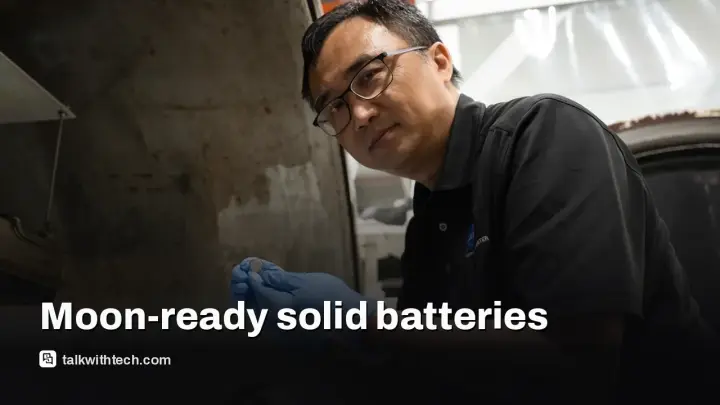
NASA’s SPEARS project is developing solid-state batteries that can survive the Moon’s extreme temperatures, a step toward powering Artemis missions and space tech on Earth.
3 min read
We use cookies to understand how readers use Talk With Tech, so we can make it better. Is that OK? Privacy policy
The Daily Brief
Today's biggest tech stories, in 5 minutes
Every morning, the news that matters from AI, phones, apps and the people shaping tech. Explained in plain English. Free.
One email a day. No spam, unsubscribe anytime. Privacy policy