DeepSeek China export nod: why your AI apps keep working
Beijing proposed new limits on exporting AI, then cleared its two biggest challengers to keep selling abroad within days. Here's what the rules do and don't touch.
China proposed adding 23 AI technologies, including large models and agents, to its list of restricted or banned exports.
A WeChat account tied to state broadcaster CCTV says DeepSeek and MiniMax have already registered and won overseas licensing rights.
Offering AI through apps, websites or APIs does not count as an export under the draft rules, and open-source releases are exempt.
Public comments on the proposal close on November 15.
Quick read · 1 min
China has proposed adding 23 AI technologies, including large models, AI agents and computing clusters, to its list of technologies that are banned or restricted from export. Companies must register before exporting them.
Days later, a WeChat account linked to state broadcaster CCTV said DeepSeek and MiniMax had already registered and won rights to license their models overseas and as open source. The account said most AI stays free to export, and that serving models through apps, websites and APIs isn't an export at all.
Models trained on sensitive Chinese data and military-focused agents face bans.
Open-source releases get automatic licensing.
Public comments close on November 15.
For users in the US, UK and Canada, Chinese chatbots and open models should stay available, though local rules may still apply.
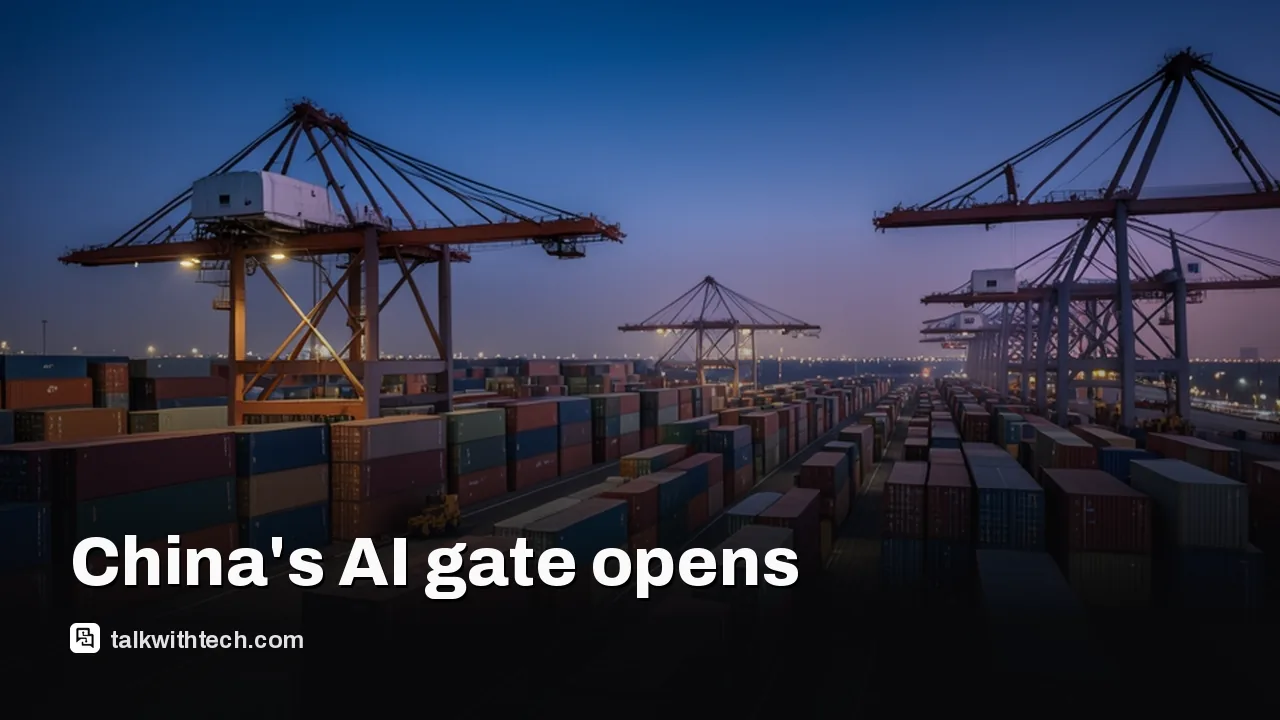
China spent mid-October drafting rules that could stop its best AI from leaving the country. Within about a week, it waved two of its strongest AI companies through. A WeChat account linked to state broadcaster CCTV says DeepSeek and MiniMax have completed registration and secured rights to license their models abroad and as open source.
If you have tried the DeepSeek chatbot, run one of its open models on your own computer, or use an app built on Chinese AI, this is the reassuring part: nothing you do today looks set to change. The bigger story is what the rules reveal about how Beijing plans to compete with American AI, and what it wants to keep for itself.
01
What China’s new AI export rules cover
On October 16, China’s Ministry of Commerce and Ministry of Science and Technology published a draft revision of the country’s catalog of technologies that are banned or restricted from export. It adds 40 technologies in all: 23 in AI, 12 in solar power and five in biomedicine. Of the additions, 14 go into the banned category and 26 into the restricted one.
The AI entries cover large models, intelligent agents, computing clusters and information processing. Under the plan, companies must register before exporting a listed technology, and restricted items need a license. According to the state-linked WeChat account, the rules focus on three areas:
Data: models trained on China’s core data would be banned from export, and models trained on important data would be restricted whatever their size.
Sensitive uses: agents built mainly for critical infrastructure, defense or core government work would be banned, and agents above a set performance level would be restricted.
Computing power: AI chip design and the high-speed links that tie big computing clusters together are on the list.
The draft also sets thresholds for what counts as a large model, including more than 2 trillion parameters (the internal settings a model learns) or ranking among the top ten in the world on capability.
02
Why DeepSeek and MiniMax got through so fast
Both companies are credible rivals to American AI firms, and letting them sell abroad fits Beijing’s goal of building tech exports. The approval reportedly came in a post late on Thursday, a week after the draft appeared. Neither company immediately responded to requests for comment, and the post has not been independently verified. DeepSeek also reportedly raised $15 billion from Tencent and battery maker CATL this week.
The quick approvals send a message: the controls are a gate, not a wall. Lawyers who took part in the consultations told the account that restricted technology can still go overseas with a license and that the rules should not disrupt companies’ plans abroad. Some control points changed after the first draft in response to company concerns.
The catalog still gives Beijing a lever to hold back any AI it sees as a strategic asset, such as tools that are unusually good at finding software bugs or that have military uses. China’s commerce ministry says the aim is to keep AI safe and under human control, pointing to risks like AI that can write or modify malicious code.
03
What stays open, including the apps you use
Here is the line that matters most for anyone outside China. Under the draft, offering a restricted model through API calls, apps, web pages, software subscriptions or lightweight local installs does not count as exporting technology. As the state-linked account put it, in plain terms, AI companies can keep selling as usual.
Open-source models get automatic licensing, described as report-and-export. So do Chinese companies’ own computing centers abroad, chip production overseas, joint research and work on international standards. Anything already public through open-source releases or academic papers falls outside the rules entirely.
04
What this means for you
For people in the US, UK and Canada, the practical answer is that Chinese AI chatbots and open models should stay available, at least as far as Beijing is concerned. Whether your own government or employer restricts them is a separate question, so check workplace rules before installing one on a work device.
If you use these tools, the usual advice applies. Assume anything you type into a cloud chatbot is stored by the company that runs it, keep personal and work secrets out of prompts, and if privacy matters, consider running an open model locally on your own hardware, which keeps your data on your machine.
For the wider AI race, the rules mark a contrast with Washington. The US has relied on on-again, off-again bans on selling advanced GPUs to China and a January 2025 framework limiting the spread of AI chips. The state-linked post pointedly said China did not take that path, and is instead keeping models flowing while fencing off sensitive data and military uses.
Public comments on the draft close on November 15, so the final version could still shift.
A 235-page court order forces Apple to allow other app stores, website downloads and cheaper payments, and Fortnite is already back on Australian iPhones.