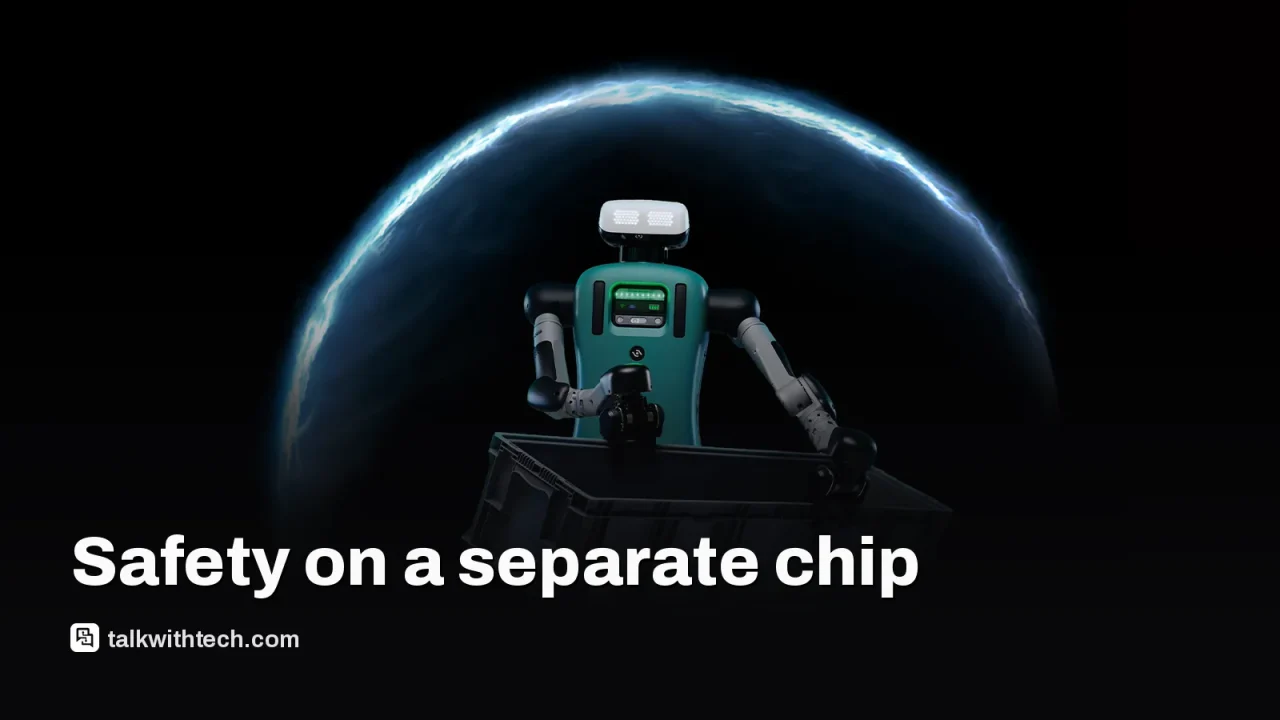
Nvidia launched Halos for Robotics in June 2026 to extend its safety stack to autonomous machines.
The system combines hardware and software to run safety workloads on a dedicated processor within robotics hardware.
The goal is to reduce harm risk as AI models and robot hardware become capable enough for real-world deployments.
Quick read · 1 min
Nvidia is expanding its Halos safety framework to cover robotics, not just self-driving cars. The new Halos for Robotics includes hardware and software tools to embed safety guardrails in autonomous machines like warehouse robots or humanoid robots.
The goal is to reduce the risk of harm as robots become more capable. A key piece is the IGX Thor computing module with a dedicated safety processor, so safety tasks run alongside AI workloads without adding lag.
This move fits Nvidia’s broader push into physical AI, aiming to make real-world deployments safer and more reliable for workers and customers.
Hardware + software for safety guardrails
Dedicated safety processor in the module
Broader adoption in warehouses, factories, and service robots
The big bet on practical AI isn’t just in data centers. Nvidia is pushing a full-stack safety framework for physical AI, expanding its Halos safety architecture to robotics. The company announced Halos for Robotics in June 2026, building on the initial Halos system for autonomous vehicles to cover warehouses, humanoid robots, and medical or industrial robots.
CEO Jensen Huang has described the physical AI business as one of Nvidia’s fastest-growing areas, and Halos for Robotics is the latest move to address a key concern: how to deploy capable robotic systems without creating risks for people nearby. The new offering ties together silicon, software, and safety tooling so developers can embed guardrails directly into the machine’s operation.
01
What exactly is in Halos for Robotics?
At its core, Halos for Robotics pairs hardware and software to manage safety-focused workloads. A primary piece is the IGX Thor computing module for robotics and industrial use, which includes a separate processor dedicated to safety tasks. Nvidia argues that in physical AI, the safety system needs to run on the same silicon as the main AI workloads to avoid latency and ensure reliable monitoring of risky actions.
02
Why this matters for the real world
As robots become more capable in places like warehouses or even in customer-facing roles, safety guardrails aren’t a luxury, they’re a necessity. Nvidia’s approach aims to give robot developers a ready-made toolbox to enforce speed limits, obstacle checks, compliance with safety rules, and other checks without slowing down critical operations. The goal is smoother, safer deployments in environments where humans and machines share space.
03
How it relates to Nvidia’s broader AI strategy
Nvidia has long positioned physical AI as a major growth pillar, with the company reporting strong demand for AI-focused hardware and software in both data centers and edge environments. Halos for Robotics extends the same safety philosophy that Nvidia applied to self-driving cars to other autonomous machines, aiming to unify safety governance across multiple kinds of robots and use cases.
04
What this means for everyday tech users
Most people won’t buy a Halos box for their home. But the safety ideas ripple outward: robotic systems in warehouses, hospitals, or service settings could operate more predictably, with built-in checks that help prevent accidents. For workers and customers, that could translate to fewer disruptions caused by unsafe robot behavior and more reliable service in places where robots are increasingly common.
Nvidia says Halos for Robotics will be the backbone for developers building autonomous mobile robots and humanoid platforms. Expect broader adoption as partners bring products to market and as hardware availability ramps up for commercial robotics projects in the coming years.
06
Quick answers
What is Halos for Robotics?
It’s Nvidia’s safety system for physical AI, pairing dedicated hardware with software tools to enforce safeguards in autonomous machines.
When did it launch?
Halos for Robotics was announced in June 2026 as an expansion of the original Halos safety platform.