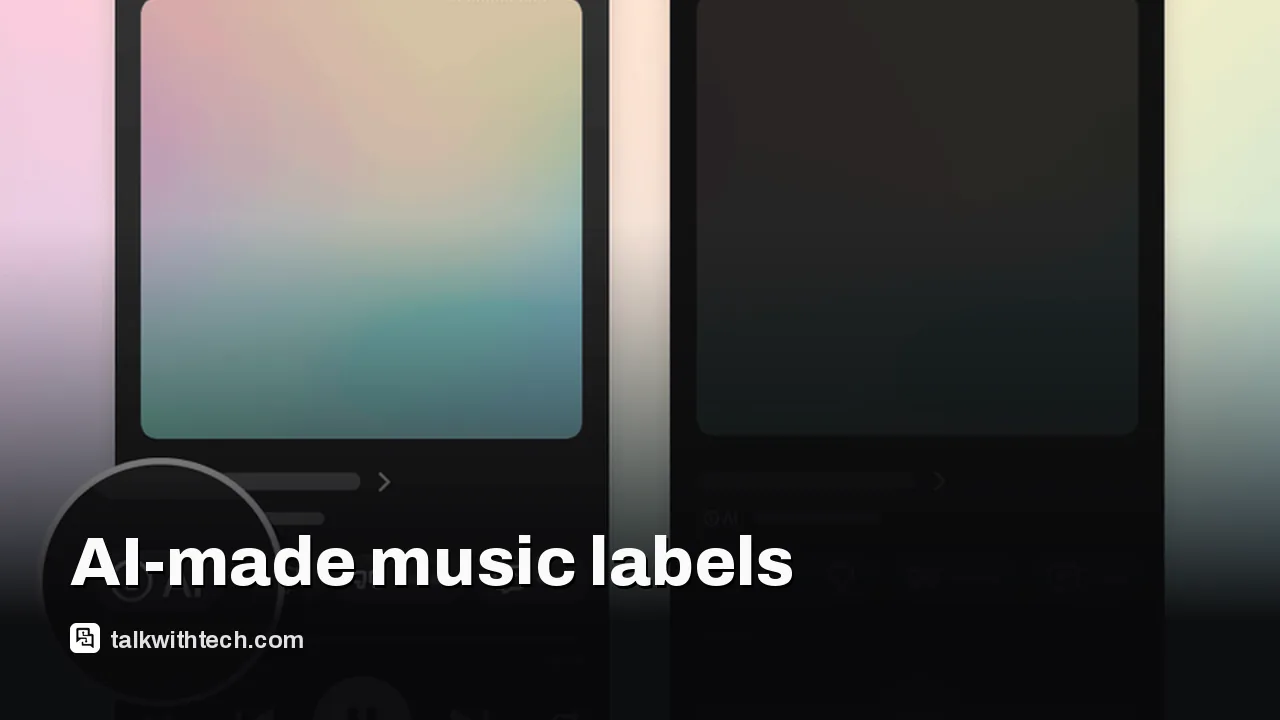
YouTube Music is introducing labels to show when AI helped create or heavily alter a track.
The label sits on the player and can be tapped for details about AI’s involvement.
The move is part of a broader industry push toward transparency around AI-generated music.
Quick read · 1 min
YouTube Music is adding labels to indicate when AI helped create or heavily shape a song. The label appears on the player and can be tapped for details, giving listeners a clear sense of AI’s role.
This is part of a larger push toward transparency across streaming services. Labels don’t ban AI music; they simply reveal how AI contributed to the track and expand to the main YouTube app over time.
Labels show AI involvement in fully AI-generated tracks or tracks using AI for key elements like vocals.
Tap the label to see how AI contributed.
Other platforms are experimenting with AI labels or filters, but YouTube focuses on disclosure.
YouTube Music is rolling out a new labeling system designed to help listeners understand when AI plays a significant role in a track. Songs that were created or substantially modified with generative AI will display a label on the player, and tapping it reveals more details about how AI contributed. The goal is to give fans clear, upfront information without removing AI-assisted songs from discovery or monetization.
In practical terms, the label signals whether AI helped compose the music or contributed major elements like vocals. It distinguishes levels of AI involvement, from fully AI-generated works to pieces that used AI for specific parts while human performers remain central. YouTube says the labels are meant to be straightforward and informative and will eventually appear in the main YouTube app as well.
To implement this, YouTube is partnering with music creators and using its own AI-detection tools. If a track is uploaded without proper disclosure, YouTube says it may rely on other signals to determine whether AI played a meaningful role. This labeling approach mirrors moves by other services that are experimenting with AI tags and filters.
Why it matters to everyday listeners is simple: it helps you decide what you want to hear. Some listeners want to avoid AI-driven content, while others are curious about how AI is used in music production. The labels give you a quick, trustworthy signal and do not restrict access or monetization for AI-influenced tracks. Different platforms have taken varied routes, with some filtering or limiting royalties for fully AI-generated music, but YouTube’s approach centers on disclosure rather than bans.
01
Who gets labeled and what the label shows
YouTube says the tag appears on tracks where AI played a substantial role, whether in the construction of the song or in the vocal elements. Tapping the label opens a brief menu that explains how AI contributed, so you can decide if you want to continue listening or explore more information.
02
A broader trend across streaming services
Other services are exploring similar ideas. Spotify has started labeling impersonator or “fake” artists, while Deezer is testing filters to weed out AI-heavy tracks. YouTube’s plan focuses on transparency and letting listeners choose, rather than outright blocking AI music.
03
What this means for creators and listeners
For creators, these labels could help distinguish AI-assisted work from purely human performances. For listeners, they offer a clearer picture of how a track was made, so you can decide if you want AI involvement in your playlists. The labels are meant to be informative and non-punitive, simply sharing the AI role in the music you play.
04
What happens next and how to use it
The labeling is live now on YouTube Music and will expand to the main YouTube app. If you’re curious, watch for the AI label on tracks you stream and tap it for more details. As more services adopt similar transparency, you’ll start seeing AI involvement described more consistently across platforms.
Apple’s new HomeView smart display relies on an iPhone for essential apps like Apple TV, Books, Music Classical and News Plus, raising questions about its standalone usefulness.
Apple adds new Faces to HomeView, including Snoopy and Photos, turning the 7-inch display into a moving photo frame and smart home control hub. Arrives November 13 for $299.
3 min read
We use cookies to understand how readers use Talk With Tech, so we can make it better. Is that OK? Privacy policy
The Daily Brief
Today's biggest tech stories, in 5 minutes
Every morning, the news that matters from AI, phones, apps and the people shaping tech. Explained in plain English. Free.
One email a day. No spam, unsubscribe anytime. Privacy policy