AI-driven materials startup raises $25M to diversify beyond China
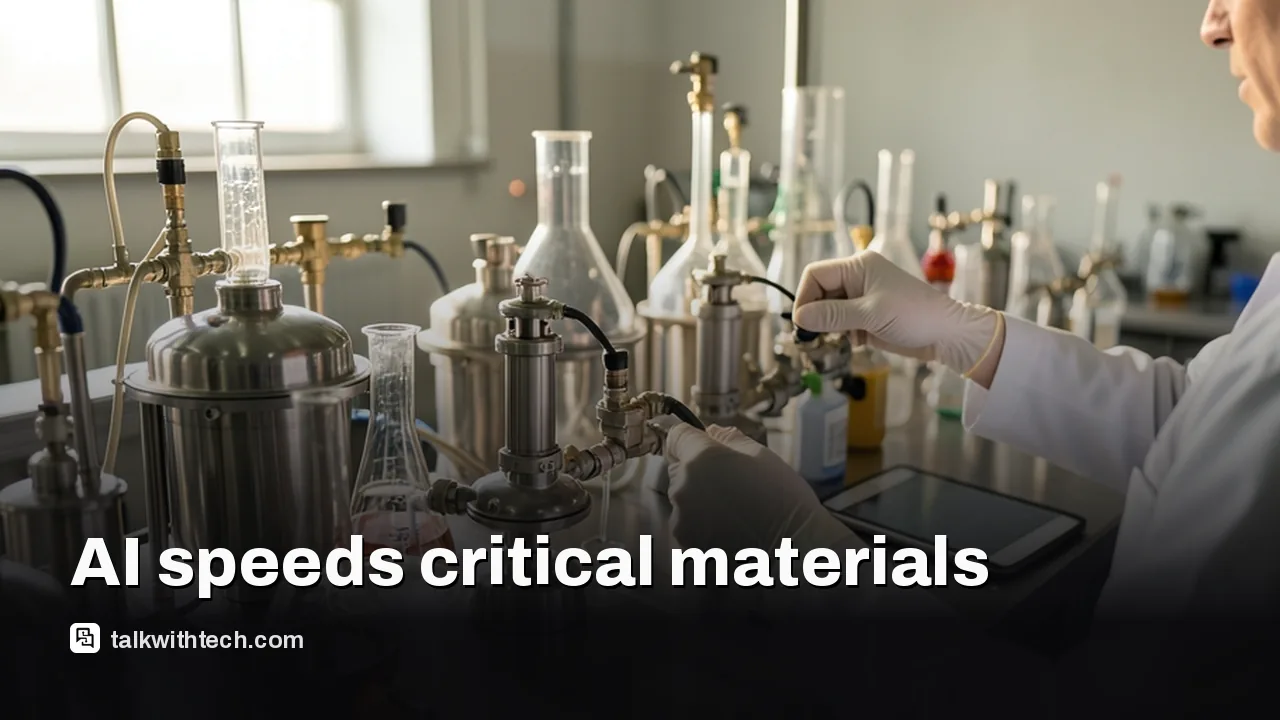
Scimplify uses an AI platform to speed up production of specialty chemicals and critical materials outside China, with expansion plans for the U.S. and Japan.
Talk With Tech Newsroom
The short version
Scimplify secures $25 million in an all-equity round led by Hitachi Ventures to expand AI-assisted production of specialty chemicals and strategic materials outside China.
The Bengaluru-based startup plans U.S. and Japan expansion, earmarking about $7.5 million for the U.S. move and additional funds for platform development.
Scimplify’s Scinode platform uses specialized AI agents to design production routes, coordinate factories, and monitor quality and regulatory steps.
The company aims to diversify away from China-dominated supply chains for materials like tungsten derivatives and rare earths, aligning with European and global policy concerns.
Quick read · 2 min
Indian AI startup Scimplify raised $25 million in an all-equity round led by Hitachi Ventures to scale AI-guided production of specialty chemicals and critical materials outside China. The company plans to push into the U.S. and Japan, with about $7.5 million set aside for U.S. expansion and funds to grow Scinode, its AI platform.
Scimplify’s approach relies on AI agents that guide everything from research to manufacturing and quality control, aiming to shorten timelines from concept to delivery. The company says some projects can move from customer requirements to delivered material in as little as two months, a stark contrast to the usual 12-18 months in traditional chemical production.
The round signals growing interest in diversifying global supply chains for critical materials such as tungsten derivatives and rare earths, a topic of recent policy attention in Europe and elsewhere. The expansion into the U.S. and Japan is intended to build resilience among manufacturers who want reliable sources beyond China.
An Indian AI startup is doubling down on faster, more diversified production of critical materials and specialty chemicals. Scimplify has raised $25 million in an all-equity round led by Hitachi Ventures, with notable new investors including Henkel and Teknor Apex. The funds are slated to accelerate Scimplify’s AI-guided approach to moving chemistry from lab concept to mass production, while expanding the company’s footprint outside China.
Most of Scimplify’s manufacturing today happens in India, where it has built a network of partner facilities and a roster of more than 1,000 customers across more than 40 countries. The new money is earmarked to broaden that network into the United States and Japan over the next year. About $7.5 million is specifically allocated to U.S. expansion, with the remainder supporting plant-scale deployment and further development of its AI platform, Scinode.
What makes Scimplify different is its end-to-end use of artificial intelligence to shorten product development timelines. The company’s platform coordinates across discovery, process design, regulatory checks, and quality control. It relies on a cadre of AI agents, each handling tasks from research to manufacturing to compliance, to work backward from a customer’s specification to find feasible production paths and compatible facilities. In practice, that means customers can, in some cases, move from a customer requirement to delivered material in as little as two months, a dramatic improvement over the traditional 12 to 18 months often required for complex specialty chemicals and strategic inputs.
Expansion into the U.S. will involve building out Scimplify’s manufacturing network with local partners, a strategic move as American and Japanese manufacturers push for more resilient, geopolitically diversified supply chains for critical materials. The company’s leadership frames tungsten derivatives and rare earths as primary targets, both because they’re central to electronics and defense technologies and because Europe and other regions have highlighted the risk of overreliance on a single country for strategic inputs.
Industry watchers say AI-enabled materials production is part of a broader trend toward reshoring or regionalizing supply chains for high-tech components. Scimplify’s model is to couple rapid ideation with real-world production capacity, then scale through a global partner network. The round also reflects growing interest from industrials and chemicals players who want faster routes to supply assurances in a world where politics and tariffs can disrupt steady material flows.
The funding adds to Scimplify’s growth story, lifting its total equity financing to about $80 million. While people familiar with the deal decline to disclose official post-money valuation, they suggest it sits around $250 million after this round. The company remains professionally private about exact figures, emphasizing execution and rapid expansion as the core goals for the coming year.
For readers, the practical takeaway is that more critical materials could become available from a wider set of sources, potentially reducing dependence on a single region. But it also underscores how AI is changing the way complex chemicals and materials get produced, faster, with more oversight and cross-border collaboration.
Google.org's Impact Challenge selects 17 groups to advance scientific breakthroughs with AI, backed by $36 million in funding and six-month accelerators.
3 min read
We use cookies to understand how readers use Talk With Tech, so we can make it better. Is that OK? Privacy policy
The Daily Brief
Today's biggest tech stories, in 5 minutes
Every morning, the news that matters from AI, phones, apps and the people shaping tech. Explained in plain English. Free.
One email a day. No spam, unsubscribe anytime. Privacy policy