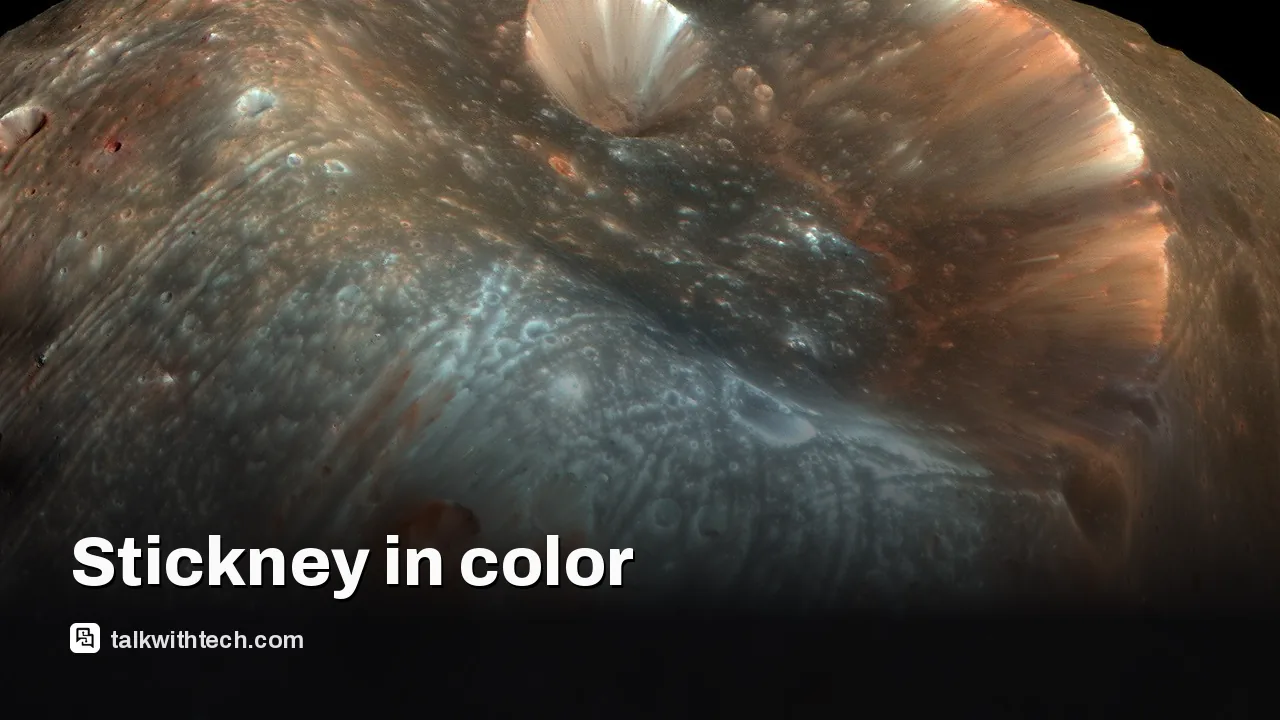
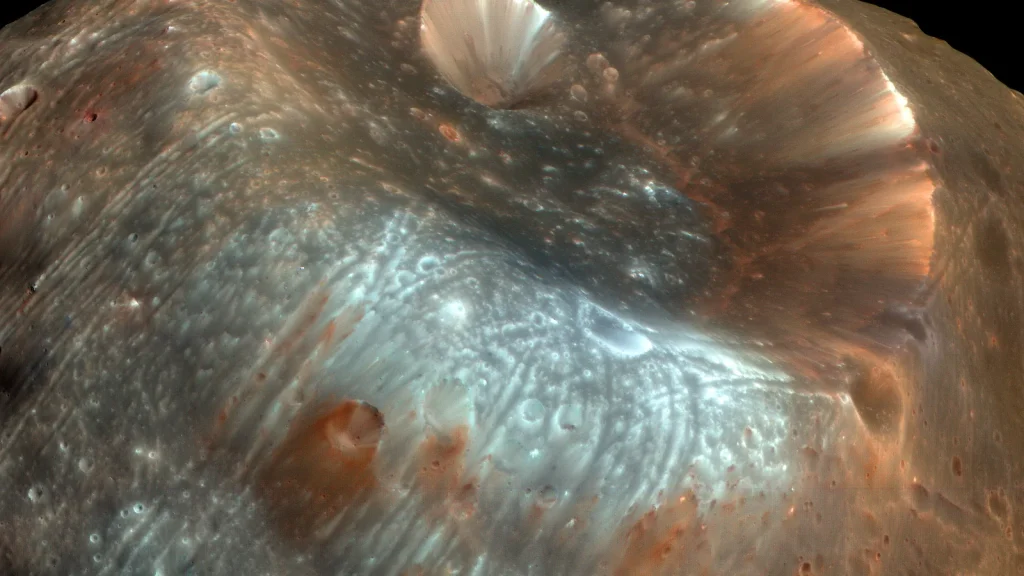
NASA’s APOD for Oct 9, 2026 showcases Stickney Crater on Phobos, the largest crater on the tiny Martian moon.
The enhanced-color image was captured by the HiRISE camera aboard the Mars Reconnaissance Orbiter during a March 2008 flyby, about six thousand kilometers away.
Stickney Crater is more than 9 kilometers across, indicating a major past impact that shaped Phobos’ appearance.
The image reveals surface variations and features that scientists use to infer Phobos’ geological history and surface processes.
Quick read · 1 min
NASA’s APOD for Oct 9, 2026 spotlights Stickney Crater on Phobos, the largest crater on the small Martian moon. The enhanced-color image was taken by the HiRISE camera on the Mars Reconnaissance Orbiter during a March 2008 flyby, about six thousand kilometers away. Stickney’s size on Phobos hints at a dramatic past and helps scientists study how the moon’s surface has evolved under Mars’ gravity.
The photo highlights rim details and subtle color differences that can indicate varying rock types or ages of surface features. Grooves and streaks nearby suggest slow movement of loose material under Phobos’ weak gravity and tidal forces from Mars.
What’s next for readers? Expect more APOD features tied to spacecraft data. Space fans get a front-row seat to how small moons tell big stories about our solar system.
NASA’s Astronomy Picture of the Day (APOD) for Oct 9, 2026 spotlights Stickney Crater, the largest impact feature on Phobos, the small moon that orbits Mars. The enhanced-color image comes from the HiRISE camera aboard the Mars Reconnaissance Orbiter, which passed about six thousand kilometers from Phobos in March 2008. This kind of image helps scientists study Phobos by showing details not visible in ordinary color photos.
Stickney Crater spans more than 9 kilometers across, a size that stands out on Phobos given the moon’s relatively tiny size. The magnitude of the crater suggests a dramatic event in Phobos’ past and helps researchers piece together how the moon’s surface has evolved under Mars’ gravity and tidal forces over time.
Along the crater’s rim and nearby areas, the enhanced colors reveal subtle variations in brightness and texture. Such differences can point to different rock types or grain sizes, and they help scientists gauge the age of surface regions. Grooves and streaks near Stickney may indicate slow movement of loose material, a reminder of how even a small body like Phobos responds to gravitational tugs from Mars.
01
What Stickney Crater can tell us about Phobos
As the largest crater on Phobos, Stickney serves as a natural landmark for scientists studying the moon’s origin and evolution. By analyzing crater size, rim structure, and surrounding terrain, researchers infer how Phobos has been shaped by impacts and by the constant pull from Mars as the moon orbits.
Images like this help space agencies plan missions to Phobos and Mars by improving risk assessments for landers and rovers. They also help scientists understand what a small, irregular moon can tell us about the formation of binary systems and the history of the inner solar system.
03
What this means for everyday readers
This APOD feature is a reminder that even tiny moons bear the imprint of dramatic events. The image shows how careful photography and color processing can reveal a world that’s millions of miles away, offering a tangible window into planetary science that’s accessible to anyone curious about our cosmic neighborhood.
04
What happens next
APOD will continue to pair striking space images with concise explanations. In Phobos’ case, scientists will likely keep studying Stickney and surrounding terrain as more data from Mars missions and telescopes arrive, helping refine models of how small moons evolve in strong planetary gravity.
Persistent rains and a stalled system left parts of Thailand under water in late September to early October 2026, with Landsat imagery capturing floodwaters and floating solar arrays.
Researchers report an experimental entanglement between a glass bead and a light beam, a stride toward practical quantum memory and new ways to store quantum information.
4 min read
We use cookies to understand how readers use Talk With Tech, so we can make it better. Is that OK? Privacy policy
The Daily Brief
Today's biggest tech stories, in 5 minutes
Every morning, the news that matters from AI, phones, apps and the people shaping tech. Explained in plain English. Free.
One email a day. No spam, unsubscribe anytime. Privacy policy