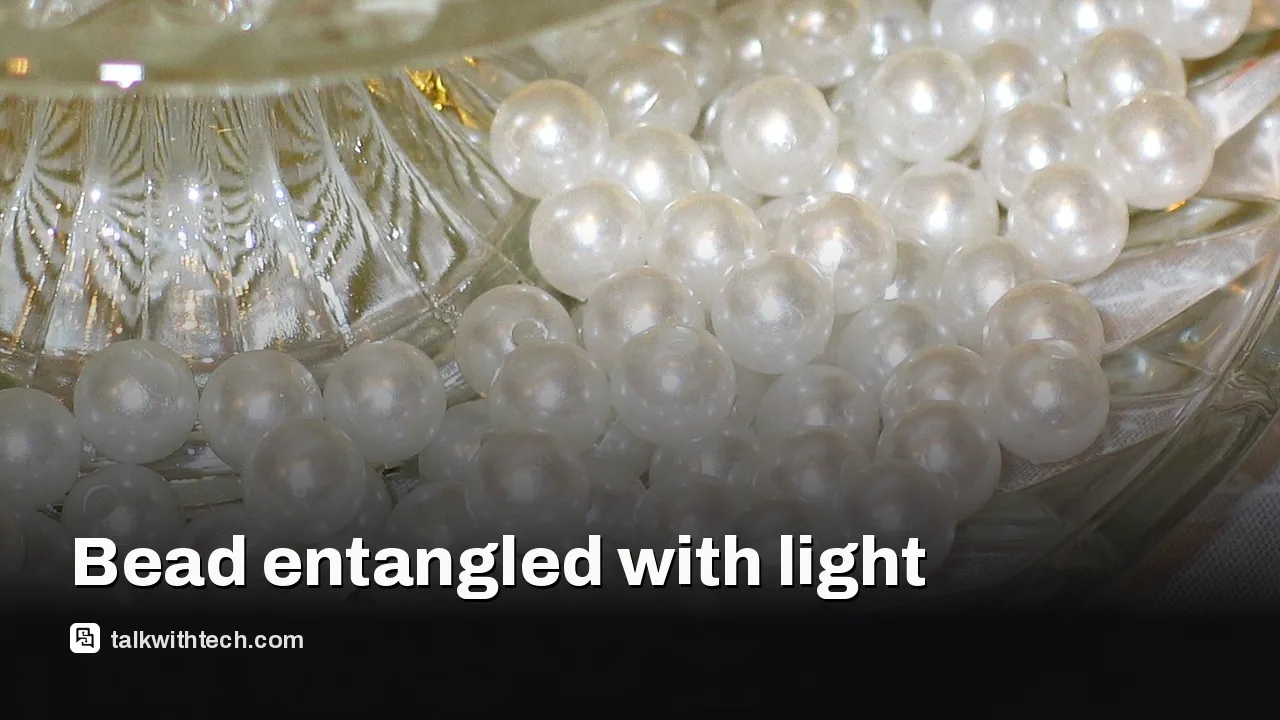
Glass bead entangles with light in a step toward quantum memory
Researchers report an experimental entanglement between a glass bead and a light beam, a stride toward practical quantum memory and new ways to store quantum information.
Researchers demonstrate entanglement between a light beam and a glass bead, linking two physical systems in a single quantum state.
The result helps show how quantum information could be stored and retrieved more reliably in future devices.
Experts caution that this is an early experiment, with practical quantum memory still years away and many engineering hurdles ahead.
The work emphasizes how measurements in quantum systems reveal connections that aren’t obvious in everyday life.
Quick read · 1 min
A team has entangled a light beam with a glass bead, an experimental advance in the search for practical quantum memory. This means scientists are closer to devices that can store quantum information for later use, potentially enabling faster, more secure communications and sensors in the future.
While exciting, this remains a laboratory result. Researchers will work on making the memory longer lasting, more reliable, and easier to integrate with other quantum components. In plain terms, this is a building block, not a finished product. Expect more tests and refinements in coming years.
Hybrid quantum systems
Storage of quantum information
Future quantum networks
In a lab somewhere, a glass bead and a pulse of light have become inseparably linked. That isn’t a metaphor. Researchers have experimentally created entanglement between a light beam and a tiny glass bead, a feat that could deepen our understanding of quantum memory and how to store quantum information for later use. Entanglement is a quantum connection where two objects act in concert even when separated, in a way that defies our everyday intuition about cause and effect.
To explain without the jargon: when two quantum objects are entangled, measuring one instantly influences the state of the other, no matter how far apart they are. In this experiment, the light and the bead form a shared, correlated state. This is the kind of link that scientists have long sought as a path toward memory for quantum bits, or qubits, which are the basic units of quantum information.
The bead is a solid, tangible object, while light is a quantum particle of the electromagnetic field. Making them share a single quantum state is tricky because light and a macroscopic bead live in very different physical worlds. The team used careful laser pulses and precise measurements to coax the systems into a joint quantum state and then verified the correlations that prove entanglement.
01
Why this matters for quantum memory
Quantum memory is the ability to store quantum information long enough to be used by a quantum computer or a quantum network. Entangling a light beam with a solid object like a glass bead shows another route to hold quantum information in a stable form. Light is great for carrying information because it travels fast and can move through optical fibers, while a bead or other solid object could serve as a storage unit. Bringing the two together is a step toward memories that can be written with light and read out later without losing the quantum information.
02
What exactly did the researchers show
The experiment demonstrates a specific kind of entanglement between the optical field and the bead’s motion. By analyzing how the light and bead influence each other under controlled conditions, the researchers confirmed the presence of a shared quantum state. The result aligns with theoretical predictions about how such a system should behave when entangled, even though the setup involves delicate, nanoscale effects that can easily fall apart with a stray vibration or temperature drift.
03
How this compares to other quantum memory efforts
There have been other demonstrations of entanglement and quantum memory using atoms, ions, or superconducting circuits. What makes this glass bead approach interesting is its simplicity and potential compatibility with more conventional materials. That could make it a useful building block alongside other memory candidates, rather than replacing them. Still, turning a laboratory demonstration into a reliable, scalable memory device will require years of engineering work and rigorous testing in real-world conditions.
04
What this means for everyday life
For most people, the headline is not a new gadget you can buy tomorrow. It’s a reminder that advances in quantum science creep into future technologies we rely on, like sensors that can detect faint signals or ultra-secure communications that rely on quantum properties. In practical terms, we’re watching a thread of research that could eventually lead to more capable quantum networks or specialized computing hardware capable of solving certain problems faster than today’s machines.
Researchers will likely work on refining the bead-light interaction, extending the storage time of the quantum state, and integrating the system with other quantum components. The aim is to show the memory can be written, stored, and retrieved with high fidelity under less-than-ideal conditions. If these efforts pay off, we could see a family of memory devices that leverage hybrid approaches, combining the strengths of light for communication with solid-state storage.
06
Quick answers
What did scientists achieve?
The team demonstrated entanglement between a light beam and a glass bead, a key step toward quantum memory.
Why does this matter?
Entanglement is foundational for storing and sharing quantum information, and this work explores a practical platform for that future.
When could this affect consumer tech?
This is early-stage science. It will take years before anything like a commercial device uses this exact approach.