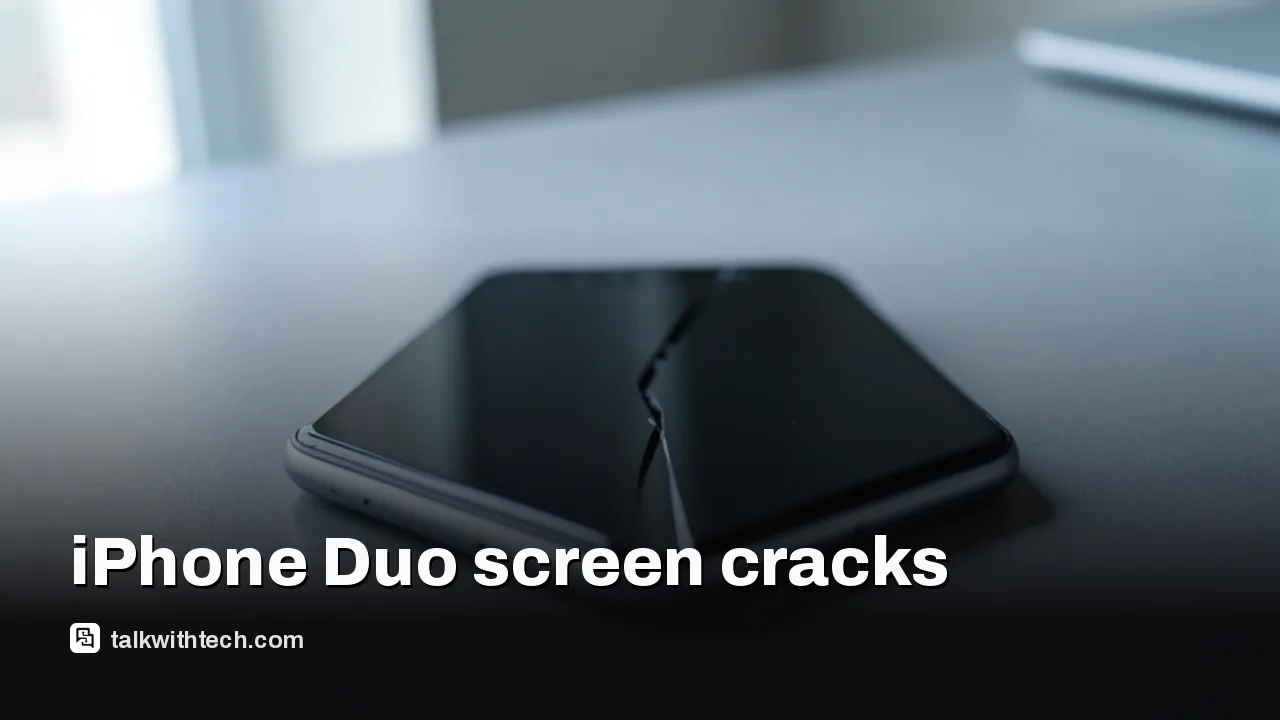
iFixit’s best guess is that a small support bar in the middle of the hinge sometimes doesn’t drop far enough when you close the phone, so the bending screen presses down onto it. To test this, the team built a 3D model of the hinge from teardown footage, Apple’s patents and CT scans (detailed X-ray images), then matched it against photos of broken screens.
Here’s how the hinge is meant to work. When you fold the Duo, several curved guides slide out to give the screen a smooth, gentle bend, and a center bar drops down to make room. That’s how Apple keeps the crease so faint. In one of iFixit’s simulations, the bar stayed too high and created a small pressure hotspot right where owners are seeing cracks.
The damage also clusters just below the thin cable that links the phone’s two screens, a spot where several different parts meet. iFixit’s own writeup admits that leaves lots of possible suspects. Other explanations could include:
- a manufacturing defect in an early batch of hinges;
- tiny particles trapped in the hinge;
- repeated pressure or bending stress;
- a damaged internal cable that makes the screen look cracked even when the glass is intact.
Some people online also suggest you shouldn’t close the phone by pressing on the middle of the inner screen. Apple hasn’t given any official guidance on how to fold it, so treat that as a sensible habit rather than a proven fix.