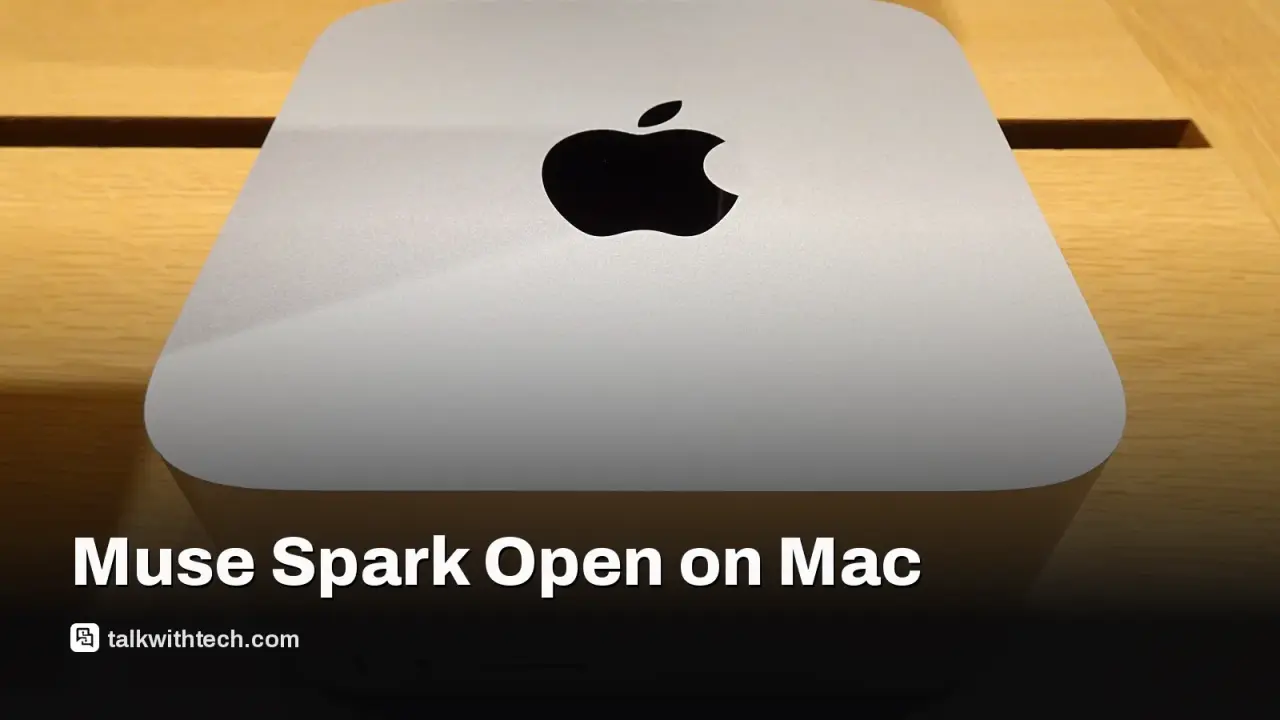
Apple and Meta confirm Muse Spark Open weights can run locally on two M5 Ultra Mac Studios using the MLX framework.
The model is 816 billion parameters with 42 billion active at once and a 1 million token context window, optimized for coding and multi-step tasks.
Prices referenced in CAD for Canadian readers; US readers should watch for official US pricing and availability when announced.
Quick read · 1 min
Apple and Meta say Muse Spark Open can run locally on Mac Studio hardware, a big step for on‑device AI. The setup uses two M5 Ultra Mac Studios and the MLX framework to keep heavy AI work off the cloud.
Muse Spark Open is an 816‑billion‑parameter model with 42 billion active at once and a token context of up to a million. It’s aimed at coding and multi‑step tasks, not just chat. Prices cited for Canada show a high barrier to entry, but the broader point is clear: more powerful AI can live on your desk, not just in the cloud.
What happens next? Look for US pricing and availability details, plus broader support from platforms and vendors as developers experiment with on‑device AI workflows.
In a surprising collaboration, Apple and Meta say Muse Spark Open, one of the tech world’s most capable open‑weight AI models, can now run locally on Mac hardware. The two companies publicly celebrated the partnership on X, underscoring a move toward on‑device AI that sidesteps cloud reliance for certain workloads.
Meta describes Muse Spark Open as the most capable US open‑weight model to date. It’s built with 816 billion total parameters, with 42 billion active at once and a context window that can handle up to one million tokens. The model is tailored for coding, software development, and multi‑step reasoning. Running it on‑device means the heavy lifting happens on your hardware rather than in the cloud.
Apple says the setup works best with two M5 Ultra Mac Studios, paired with the latest MLX framework. The configuration is designed to let the model run locally, at desktop scale, thanks to Apple’s unified memory architecture and the high memory bandwidth of the M5 Ultra GPUs. In practice, that could mean developers and power users can edit code, generate responses, and run AI agents without streaming data to a remote server.
That pairing was highlighted by executives from both companies in a light, often joking exchange on social media. Meta’s Mark Zuckerberg praised the collaboration, while Apple’s John Ternus replied that it’s amazing to run a model of Muse Spark Open’s caliber from your desk. Their remarks came as part of a broader discussion about where on‑device AI is headed and which tasks are practical to push into local silicon.
Price and availability details are still shaping up for the US market. Canadian reporting notes two Mac Studios would be needed to host the full model, with the CAD price for a single Mac Studio starting at CAD 7,799. Canadian readers should expect price guidance to continue as more US and international details emerge, but this marks a notable shift toward higher‑end on‑device AI setups becoming viable outside specialized labs.
So what does this actually mean for you? If you’re a developer, researcher, or enthusiast who often runs large AI tasks locally, think coding assistants, video editing with AI, or multi‑step automation, you’ll see less latency and fewer privacy concerns since sensitive data could stay on your machine. For everyday users, this is a sign of where on‑device AI could head, even if most people won’t own two Mac Studios for a while.
What happens next could hinge on US pricing, availability, and how developers port Muse Spark Open to more hardware. If the model proves reliable at scale on Mac Studio workstations, we may see broader enterprise tools and consumer apps that rely less on cloud servers while delivering advanced AI capabilities on a familiar desktop setup.