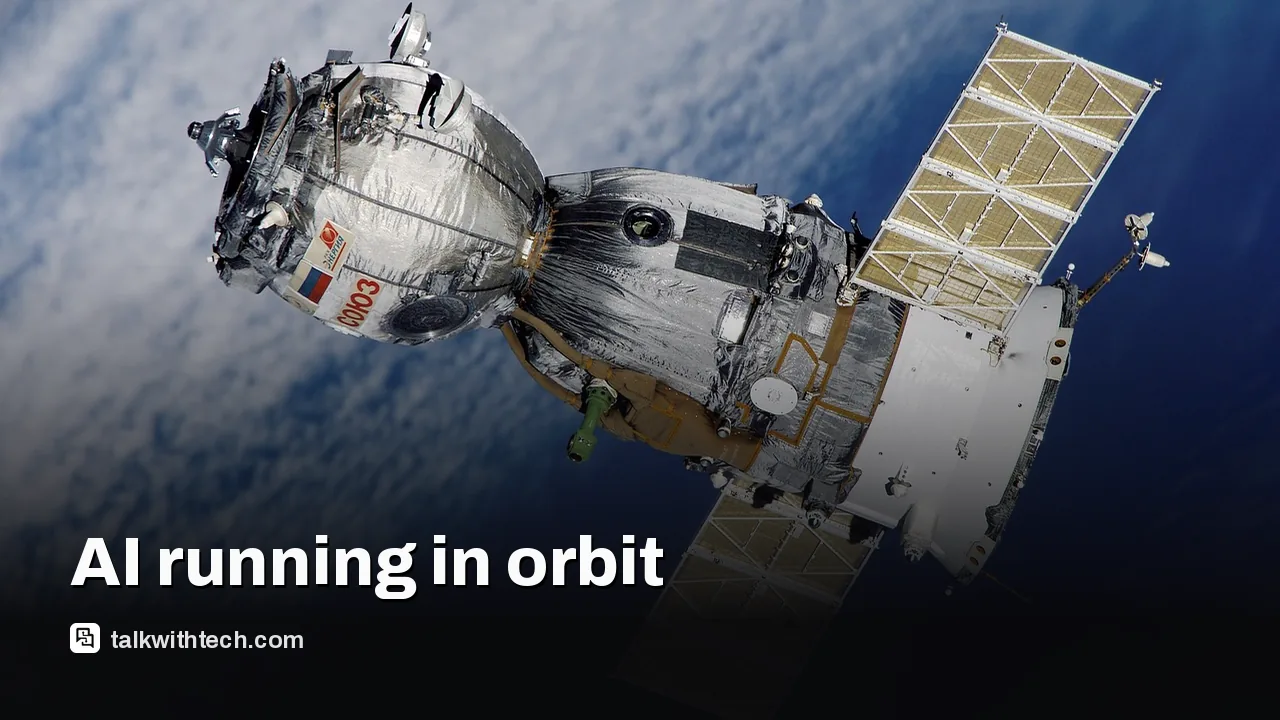
Satlyt raises an $8 million seed round to run AI directly on satellites, not just on ground servers.
The company has pilots with NASA and other clients and aims to deploy on 20% of satellites by the end of the decade.
Its software is designed to act like a cloud for spacecraft, enabling AI workloads to run on-board.
The launch will accompany a SpaceX rocket and a prototype tied to Google’s space data center efforts.
Quick read · 1 min
Satlyt has raised $8 million to run AI on satellites, aiming to process data aboard space vehicles rather than sending everything to Earth. The goal is to cut downlinks, speed up decision-making, and create a shared in-space compute cloud across different satellites. The company has already demonstrated its software on a couple of missions and plans further tests with a SpaceX launch and partners including NASA.
Why it matters to everyday readers: faster satellite data could improve weather monitoring, disaster response, and space surveillance without big cost jumps. In the longer run, it could help enable new space services that rely on onboard AI processing.
What happens next: Satlyt will broaden its demonstrations and target about 20% of satellites by the end of the decade, as it expands partnerships and pilots.
Satlyt, a new space software company co-founded by Rama Afullo, has raised an $8 million seed round to bring AI computing directly to satellites. The plan is to let satellites run AI models onboard rather than sending every decision or data packet back to Earth for processing. The funding, led by Non Sibi Ventures, aims to turn satellites into revenue-generating managed services through software that can operate across different spacecraft and hardware platforms.
Afullo, a former Google cloud manager and SpaceX Space Data Center veteran, says the vision is to create a shared, in-space compute cloud. The idea is to let satellites handle workloads locally, such as anomaly resolution or sensor data processing, which can dramatically cut down on expensive and slow downlinks to Earth. Satlyt has already demonstrated its software on two missions, including a model onboard a spacecraft operated by Momentus that used Google DeepMind’s Gemma AI model. In tests tied to that demonstration, the amount of data sent back to Earth for processing shrank by more than 60% when the AI handled the issue reporting on the spacecraft itself.
Satlyt’s seed round comes at a time when SpaceX is pushing orbital data centers, and Google has its own space data initiatives. Satlyt isn’t building its own spacecraft; instead, it provides the operating software so other satellite builders can run AI workloads on their hardware. The company plans a broader demonstration this week on a SpaceX rocket alongside TakeMe2Space’s first satellite computing prototype. The mission will involve NASA as a customer to test cloud-like protocols for space computing, plus Stellerian, a surveillance-focused startup, and TakeMe2Space itself to validate hosting third-party software in orbit.
In practical terms, Satlyt is pitching a space-based alternative to cloud computing: a way to process data where it’s collected, reducing the need to downlink massive datasets and potentially enabling faster decisions for tasks like observation, navigation, or anomaly detection. Afullo compares Satlyt’s goal to VMware and Snowflake in the space context, framing the product as a platform that lets many satellites share compute resources much like modern cloud providers on Earth.
Satlyt’s investors see opportunity in the growing number of satellites and the push to add GPUs and other powerful processors to spacecraft. Non Sibi partner Kent Lucas says the business case doesn’t require every satellite to carry the most expensive hardware; it’s about enabling the right workloads to run onboard and on a scalable software layer. The plan is to have a foothold on roughly one-fifth of satellites by the end of the decade, a target that underlines how quickly in-space AI ideas could scale if the economics line up.
What this could mean for everyday readers is easier access to timely, space-based data processing without long waits for ground-based analysis. It could also influence how satellite services are priced and how quickly new space applications reach users on Earth. For now, Satlyt is early in its journey, but the company is actively marketing to aerospace companies and agencies looking to reduce latency and downlink costs while expanding the kinds of operations that can run in space.
01
What makes AI on satellites possible right now
The move hinges on increasingly capable onboard processors and smarter software that can operate with intermittent connectivity. Satlyt frames itself as a cloud-like platform for space, letting multiple satellites share compute resources and run AI workloads locally. Demonstrations have shown noticeable reductions in the amount of data that needs to travel back to Earth for processing, which underscores the practical value of onboard AI for missions with limited bandwidth or strict latency requirements.
02
Who’s backing Satlyt and what’s next
With an $8 million seed round led by Non Sibi Ventures, Satlyt can fund further onboard demonstrations and broaden its customer base, ranging from government-backed missions to commercial satellite operators. The company plans to continue pilots this year, including operations tied to NASA and its SpaceX flight, and a multi-customer mission involving a TakeMeSpace satellite platform.
03
How this affects you, the reader
For consumers in the US, UK and Canada, the impact could come through faster, more capable satellite services. Think near-real-time imaging, quicker weather and disaster monitoring, or improved space surveillance without big cost jumps. In the longer run, it could help enable new space services that rely on onboard AI processing.
04
What happens next
Satlyt plans to push its software onto more satellites, aiming for broad deployment by the end of the decade. Expect more demonstrations and partnerships as the company proves its platform can scale across different spacecraft and hardware platforms.
Satlyt announced an $8 million seed round to develop software that runs AI directly on satellites.
Why now?
Advances in onboard processors and AI models make in-space computation practical, offering lower downlink costs and faster insights for space missions.
What happens next?
Satlyt will expand pilots and prepare broader deployments across multiple satellites, with NASA and other customers involved in demonstrations.
Researchers at Johns Hopkins show pencil-tip robots that deliver antibiotics directly to infected heart tissue, potentially trimming weeks of therapy to hours.