Friday, 9 October 2026

30 Mac Minis recreated a Cray-1 and hit 1.3 teraflops

A 50th-anniversary tribute uses 30 consumer Mac Minis to recreate the iconic Cray-1 supercomputer, delivering about 1.3 teraflops in tests.

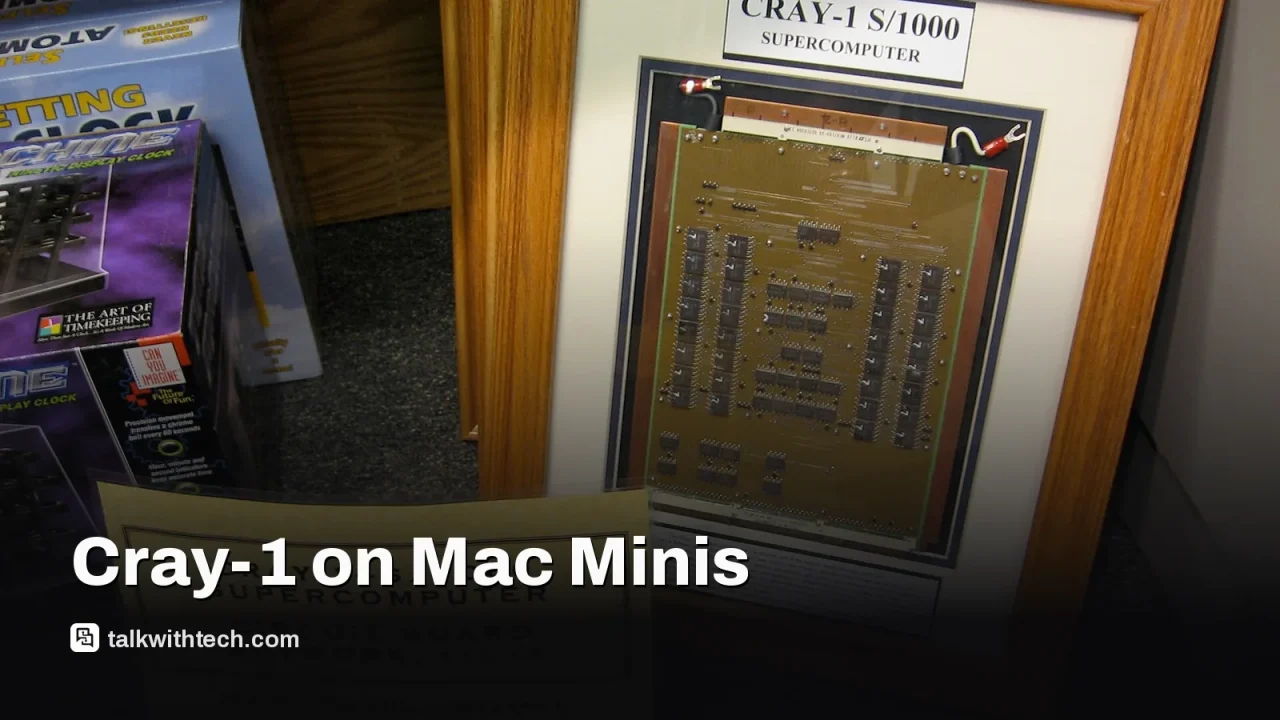
Cray-1 supercomputer, related to: 30 Mac Minis recreated a Cray-1 and hit 1.3 teraflops
Photo: Marcin Wichary from San Francisco, Calif. / CC BY 2.0 (modified)

The short version

  • A museum in Spain unveiled a 1:1 scale Cray-1 replica powered by 30 Mac Minis from 2012.
  • The cluster delivers about 1.3 teraflops of performance in recent tests when running parallel tasks.
  • The project took 18 months and uses macOS Mojave with MPI to coordinate the nodes.
  • Cooling is handled by passive convection, keeping the setup nearly quiet compared with modern data centers.
Quick read · 1 min

A museum in Spain built a 1:1 scale Cray-1 supercomputer using 30 Mac Minis from around 2012. The setup, unveiled as a 50th‑anniversary homage, demonstrates how far parallel computing has come.

In recent tests, the mini-cluster delivered about 1.3 teraflops of performance by linking 64 cores with MPI on macOS Mojave. The project took 18 months to complete and uses a passive cooling approach, so it stays quiet, more like a display than a buzzing data center.

For everyday readers, the takeaway is simple: today’s devices can work together to handle big problems, and software wisdom matters as much as hardware power. The exhibit invites visitors to see how parallel processing evolved from the Cray-1 to the cluster era and why that matters for the apps we use.
The Museo de Historia de la Computación in Spain unveiled a 1:1 scale visual replica of the Cray-1 supercomputer from 1976. Instead of using high-end workstation gear, the project wires together 30 Mac Minis from around 2012 to simulate the classic machine. It’s a 50th‑anniversary tribute to both the Cray-1 and the era that defined modern parallel processing.

Developers reported they could marshal 64 active processing cores into about 1.3 teraflops of performance in their latest tests. Earlier benchmarks hit about 1.5 teraflops when they used all 70 available cores, though one node went offline during that run. The team measured performance with a custom matrix-multiplication script written in Python.

The replica isn’t just a novelty. It’s built as a teaching tool, letting visitors see how architecture shifted from the Cray-1’s vector approach to today’s cluster-style computing, where many processors work on separate pieces of a problem at once. The original Cray-1 used a single instruction to operate on multiple data elements in parallel, while the Mac Minis-turned-cluster spreads tasks across independent CPUs that cooperate through a distributed system.

01

Why build a replica with consumer hardware?

The project deliberately uses readily available consumer hardware to illustrate a big point: the scale of computing power today is accessible in ways it wasn’t in the 1970s. By using Mac Minis and a networked setup, the museum can demonstrate parallel processing with familiar, off-the-shelf parts while avoiding the cost and noise of modern data-center gear.

Museum display of a large vintage computer and wiring
02

Which software ties the machines together?

The team chose macOS Mojave (10.14) because it provides built‑in support for MPI, the standard that lets many computers pass tasks to one another. That choice makes the cluster feel like a real, usable parallel system rather than a mere display piece.

03

What it sounds like and how it’s cooled

Cooling is handled with passive convection in a steel rack and aluminum trays for each Mac Mini. In practice, the arrangement is quiet compared with a modern server room, which helps visitors hear the idea of flow and timing behind parallel workloads instead of hardware noise.

Array of small computers connected for parallel tasks
04

What this means for everyday people

For most of us, this project is a reminder of how computing power has ballooned over the last few decades. It shows why today’s phones, laptops and cloud services can run sophisticated tasks at a scale that would have needed a dedicated lab a generation ago. It also underscores the importance of parallel thinking in software, bit by bit, problem by problem, multiple devices work together to get the job done.

05

What happens next

The replica serves as a public exhibit and an educational tool. Visitors can watch live performance tests and learn about the shift from single‑machine computation to distributed processing, a story that’s echoed in every modern data center and cloud service.

06

Quick answers

What exactly did they build?

A 1:1 scale replica of the Cray-1 supercomputer powered by 30 Mac Minis from 2012, networked to run parallel tasks.

How fast is it?

In tests, the cluster reached about 1.3 teraflops with 64 active cores; earlier tests hit around 1.5 teraflops with more cores but one node offline.

Why Mojave and MPI?

macOS Mojave includes built‑in MPI support, which makes it feasible to coordinate all the minis as a single cluster without adding extra software layers.

You're reading the quick version.