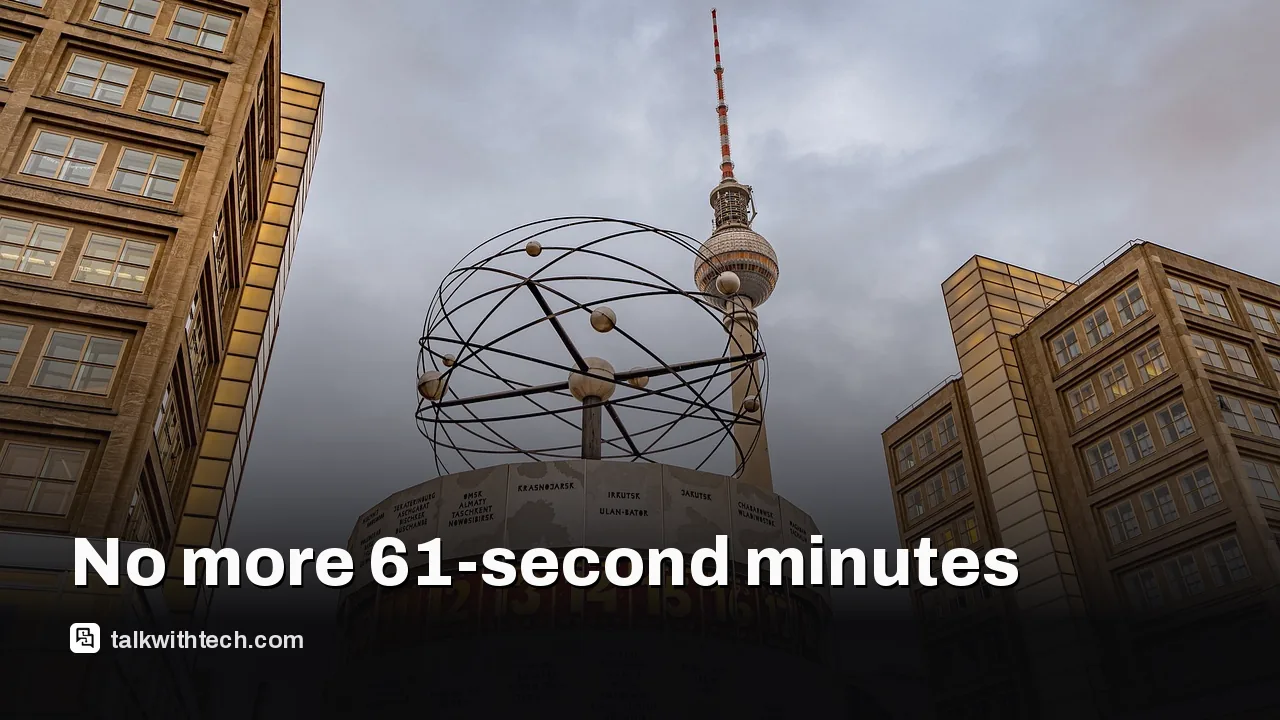
Leap hour timekeeping ends 61-second minutes, keeps UTC aligned
official timekeepers vote to swap a 61-second minute for a 60-minute hour in order to reduce computer glitches and keep UTC aligned with Earth’s rotation.
Talk With Tech Newsroom
The short version
World timekeepers will replace the leap second with a leap hour starting next year to avoid computer glitches from 61-second minutes.
The decision aims to reduce risks to critical infrastructure like telecommunications and electricity grids that rely on precise timing.
The change is driven by the Earth's irregular rotation and the increasing likelihood of software issues when a minute lasts 61 seconds.
Quick read · 1 min
Timekeepers have decided to replace the leap second with a leap hour starting next year. This aims to prevent computer glitches that happen when a minute lasts 61 seconds and to keep UTC aligned with Earth’s rotation over the long term.
The leap hour is a behind-the-scenes change to how we synchronize clocks. It reduces the risk of outages in critical systems like telecoms and power grids that depend on precise timing.
What happens next is still being finalized. Expect updates on when and how leap hours will be applied and what software patches might be required for servers and networks.
Clocks around the world are getting a makeover, not a facelift but a fundamental shift in how we keep time. After years of debate, delegates from 69 countries voted to replace the leap second with a leap hour, starting next year. The move aims to prevent the kinds of computer hiccups that organizations have feared when a minute stretches to 61 seconds or shrinks to 59, a problem that can ripple through networks, satellites and grids.
In plain terms, the leap second added a little extra time sporadically to sync atomic time with Earth’s rotation. The leap hour drops that correction in favor of allowing UTC to drift up to an hour from astronomical time before a correction is needed. The practical effect is simpler: fewer moments where software has to account for an extra second that some systems can’t handle. Officials say this should cut the risk of outages and errors in critical systems around the world.
Leaders at the Versailles meeting say the change will still keep timekeeping tied to the planet’s rotation, but in a way that reduces the chance of software failures. The new rule still preserves the fundamental link between our global time standard and the rotation of the Earth, just on a much longer leash.
Historically, leap seconds were introduced in 1972 to keep UTC aligned with the Earth’s gradually slowing spin. But the Earth’s rotation is not perfectly steady. It’s affected by factors like ocean currents, geophysical shifts, and other natural forces. In recent years, there has even been talk of negative leap seconds, where time could be subtracted. The leap hour design acknowledges these uncertainties while prioritizing the reliability of digital systems that rely on precise timing.
So what happens next? Coordinated Universal Time, or UTC, will no longer be the last word on every minute. Instead, once in a while, clocks may wander a bit relative to the stars, until a leap hour is deemed necessary in the distant future. The goal is to prevent the kind of widespread outages that have occurred when software isn’t prepared for 61 seconds in a minute, which has happened before, affecting online services and even flights in rare cases.
For everyday users, the change might feel invisible most of the time. It’s a behind-the-scenes adjustment meant to keep digital services running smoothly without forcing frequent clock corrections on devices. Researchers, data centers, and network operators will be watching how this transition unfolds and adapt their software and scheduling systems accordingly.
What matters most to readers is this: the way we measure time could shift gradually, and the cadence of updates in critical systems will be designed to minimize disruption. Timelines for when and how leap hours will be applied will be announced as the process moves forward, with details about any necessary software patches or protocol updates to come.
Apple lays out its position in a fresh court filing, arguing OpenAI’s latest accusations aren’t tied to the central case and were filed without prior notice.
lawmakers gear up to probe government data and systems from the Trump years, yet agencies resist, leaving questions about what lawmakers can actually uncover.