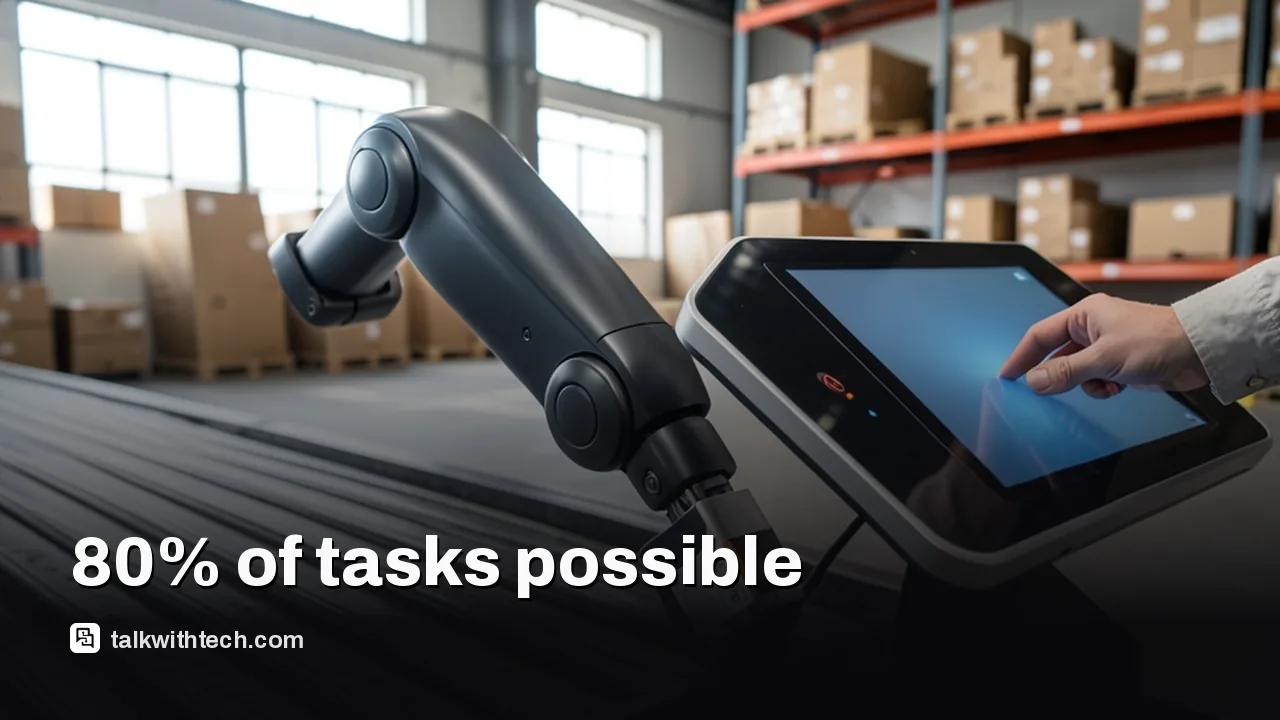
Anthropic finds AI models plus robots could cover about 80% of U.S. work tasks, with robots adding significant reach in physical jobs.
Cost remains the biggest hurdle; robotics are cheaper for only a small fraction of tasks today.
If robot prices drop, automation could expand further, but widespread replacement would still unfold over decades.
Quick read · 1 min
Anthropic’s new robotics study suggests AI models plus robots could cover about 80% of U.S. work. The catch: robots aren’t cheap for most tasks yet, so adoption will be slow.
What this could mean for you is a future where many tasks are shared with machines, potentially changing job roles and how services are delivered. The main barrier remains cost and practical reliability.
What happens next? Look for continued progress in AI and robotics, with cost reductions and better workplace integration. If you want to prepare, focus on skills that are hard to automate and watch for opportunities in your field.
Automation could cover many tasks in the long run
Costs and practical limits slow adoption
Prioritize skills that complement machines
A new look at automation paints a big picture: AI models combined with robotics could tackle roughly 80% of the work Americans do. That’s the headline takeaway from Anthropic’s latest robotics study, which extends its earlier work on how AI chatbots affect employment. In plain terms, AI handles information and decision tasks, while robots take on physical, hands-on activities. Together, they could cover a large swath of everyday work.
Why this matters to you? It signals a future where some tasks you perform might be shared with machines or handled by automation in service delivery. The study highlights that AI alone already touches many cognitive jobs, but adding robotics expands the reach into physical tasks, especially in sectors like transportation and packing where the combination pushes exposure higher. Importantly, Anthropic stresses that being exposed to automation does not automatically mean jobs disappear; the study maps three possible AI-driven economies from mild shifts to heavy disruption.
Cost remains the main roadblock. While robots can technically perform about 74% of physical tasks, most of those tasks work only in tightly controlled environments, such as assembly lines. For now, upfront costs and ongoing maintenance keep humans in the loop in many workplaces. The analysis notes that if robot prices fell by around 20%, more tasks would become cost-effective for automation. Still, at current trends, reaching a meaningful level of replacement would take decades.
That means the future isn’t a quick industrial takeover. It’s a gradual blend of machines and people across more tasks, shaped by price, reliability, and how businesses choose to deploy new tools.
01
Which jobs could be affected first
Robots tend to reach physical, lower-wage roles first. The study points to transportation and packaging as areas where automation could become more common when robots join AI, while AI alone targets cognitive tasks. The result could shift job roles rather than simply erase them.
02
The cost hurdle, plain and simple
If a business can’t justify the total cost of ownership, automation stalls. Today, robots are only cheaper for a small slice of tasks. The hope rests on cheaper hardware, smarter software, or business models that spread costs over time, making automation affordable for more operations.
03
What this could mean for your daily life
For everyday readers, the main takeaway is that services and workplaces may evolve as machines take on more routine tasks. Expect adjustments in job roles, training needs, and how services are delivered, rather than a sharp, immediate shift in employment.
04
What happens next
Progress in AI and robotics will keep pushing forward, but price and real-world practicality will set the pace. If you’re an employee or an employer, look beyond sticker price to total cost of ownership, training, and how well a system integrates with existing workflows.
No. The study points to a gradual expansion of automation, with cost and reliability shaping how quickly it spreads.
What should I do now?
Build skills that are hard to automate, like complex problem solving and people management. If your field seems ripe for automation, seek training that complements machines rather than competes with them.
Sergey Brin hints Gemini could start learning to improve itself, with AI assisting in building the next Gemini model. Here's what that could mean for safety and speed.
An AI lab will subsidize plumbing, electrical, HVAC, air-duct cleaning, and carpet cleaning in three cities in exchange for recording the work inside homes.
4 min read
We use cookies to understand how readers use Talk With Tech, so we can make it better. Is that OK? Privacy policy
The Daily Brief
Today's biggest tech stories, in 5 minutes
Every morning, the news that matters from AI, phones, apps and the people shaping tech. Explained in plain English. Free.
One email a day. No spam, unsubscribe anytime. Privacy policy