Maia 300 memory bandwidth boosts HBM4 to 18TB/s per accelerator
Microsoft’s Maia 300 marks a shift from raw compute to memory bandwidth, aiming for multi‑gigawatt deployments and tighter integration with in‑house AI systems.
Talk With Tech Newsroom
The short version
Microsoft will make Maia 300 the main inference engine for its AI products and services, with multi‑gigawatt deployments planned for 2027.
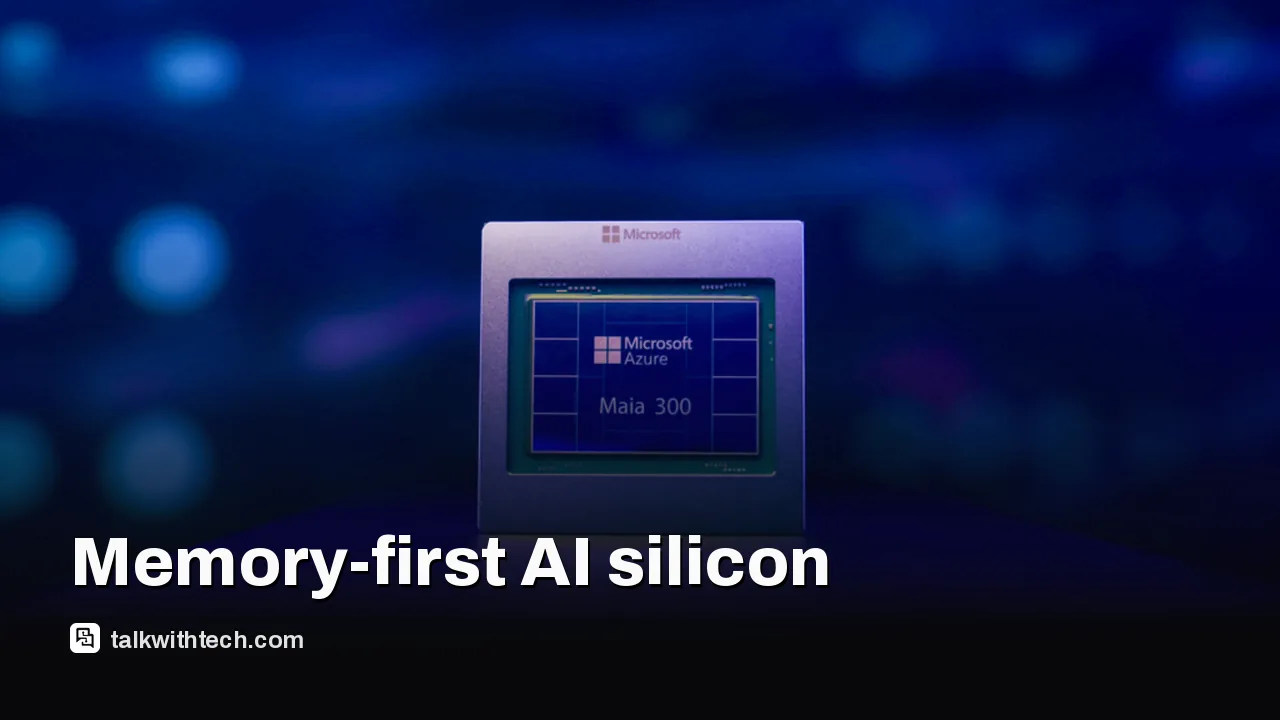
Maia 300 emphasizes memory bandwidth over raw compute, delivering 288GB of HBM4 at 18TB/s per accelerator across eight memory stacks.
The shift to in‑house silicon mirrors moves by Google, Amazon and others, and could pressure Nvidia margins as buyers seek tailored AI chips.
Production uses a multi‑chiplet design to keep data near processing units and improve efficiency during decode-heavy AI tasks.
Quick read · 1 min
Microsoft will make Maia 300 its main AI inference engine, aiming for multi‑gigawatt deployments starting in 2027. The big change: Maia 300 trades some compute for 2.5x more memory bandwidth, with 288GB of HBM4 and 18TB/s per accelerator. It uses a multi‑chiplet design to keep data close to the processor, reducing memory wait times. This continues the industry push toward in‑house silicon to control cost and performance as Nvidia GPUs remain a backbone for many AI workloads.
What it means for you: AI services could run more efficiently at scale, possibly speeding up features in cloud apps and reducing latency for complex tasks. What happens next: production starts in 2027, with continued emphasis on own‑silicon approaches across major clouds.
Microsoft is doubling down on memory as the engine for its AI efforts. The company says Maia 300 will be the primary AI inference engine for its products and services, with deployments at multi‑gigawatt scale planned to begin in 2027. In other words, it’s reorienting around data movement as much as arithmetic power.
Maia 300 is not simply a faster Maia 200. Microsoft describes a trade that trims some compute gains in exchange for a 2.5x jump in memory bandwidth. The accelerator uses a multi‑chiplet layout, combining compute on one die with memory, input/output and control on others. Eight stacks of HBM4 memory deliver 288GB and about 18TB per second of bandwidth per accelerator, compared with Maia 200’s 216GB and 7.1TB/s.
Central to the design is software‑driven data management. Microsoft relies on a non‑uniform memory layout and on‑die SRAM for fast access, so data stays close to the processing units. In practical terms, it means AI models can fetch the information they need without waiting long for memory, which matters in decode and other data‑heavy parts of inference.
The Maia 300 approach fits a broader industry trend: hyperscalers wanting more control over their AI stacks by building custom silicon. Google and Amazon have pursued similar routes, and Nvidia faces pressure as customers explore in‑house accelerators to control cost and performance. Industry chatter has focused on whether such shifts will erode Nvidia’s edge in data centers, where margins have been high and growth fast.
Microsoft notes Maia 300 uses a multi‑chiplet design and a high‑density memory system built on a TSMC process. The goal is scale and efficiency, not just speed, as the company expands its AI services and workflows across Azure and beyond. Production is slated to begin in 2027, with the broader plan to move Maia 300 to the core of Microsoft’s AI infrastructure over time.
For everyday users, what this means is quieter, more efficient AI services at scale and potential lower operating costs for providers that could translate into faster, smoother experiences when you use AI features in apps and cloud services. The broader impact: a shift in how large AI workloads are designed and financed, with more control over the silicon stack potentially altering pricing and feature timelines across the industry.