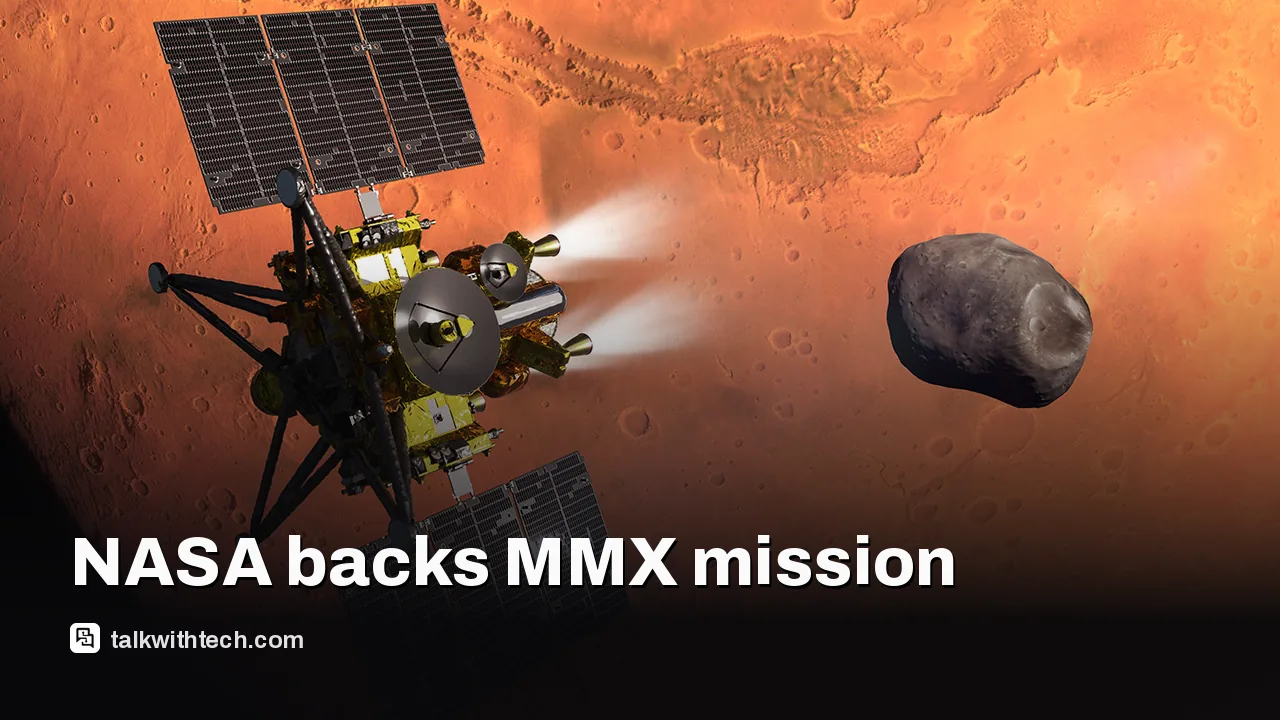
NASA will support the MMX mission by contributing instruments, ground support and sample curation for Phobos and Deimos.
The MMX spacecraft aims to analyze the moons’ origin and return a sample to Earth by 2031.
NASA’s MEGANE spectrograph and Pneumatic Sampler are part of the agency’s contribution to the mission.
Quick read · 1 min
NASA is teaming with Japan’s JAXA on the MMX mission to study Mars’ moons Phobos and Deimos and to return a sample to Earth by around 2031. NASA adds key instruments, ground support and a portion of the samples for study. If you’re curious about what this means for ordinary readers, think: more data about where Mars’ moons came from could influence future space science and education here on Earth. The mission aims to launch Oct 19 from Japan, with Earth-based science starting soon after arrival at Mars in 2027."
The plan to unlock the mysteries of Mars’ moons just took a big step forward. NASA is teaming with Japan’s space agency, JAXA, on the Martian Moons eXploration (MMX) mission to study Phobos and Deimos and, crucially, to bring back a sample of Phobos to Earth. The MMX spacecraft is set to launch from Japan’s Tanegashima Space Center at 3:41 p.m. EDT on Monday, Oct. 19, with a 4:41 a.m. JST window on Oct. 20, if weather and schedules cooperate.
NASA’s role isn’t to replace JAXA’s mission plan, but to add essential science gear, communications support, and Earth-based analysis that could shape human missions to Mars in the next decade. As NASA puts it, this partnership is about expanding humanity’s understanding of the solar system for everyone on Earth.
01
What MMX hopes to learn
Scientists have debated where Phobos and Deimos came from. One idea is that they’re remnants from a big Mars-impact event, while another is that they’re ancient asteroids captured by Mars’ gravity. MMX intends to measure the moons’ composition and surface features to help scientists answer that question, and to better understand how water and organic compounds may have moved through the inner solar system.
02
The NASA pieces: MEGANE, P-Sampler and more
NASA supplies several key parts. The MEGANE spectrograph, which measures neutrons and gamma rays to determine surface composition, will help researchers see what Phobos is made of. The Pneumatic Sampler, a ground-sampling tool, uses bursts of high-pressure gas to collect surface material. In total, NASA will contribute equipment, data analysis, and a share of the mission’s scientists to the MMX science team.
03
Timeline and sample delivery
MMX is expected to reach Mars in August 2027 for a detailed survey of Phobos and Deimos. After surveying the moons, the spacecraft will collect a surface sample from Phobos no earlier than December 2028, and deliver it to Earth around 2031. NASA will curate roughly 15% of the total samples at Johnson Space Center’s Astromaterials Lab in Houston, making that portion available for researchers for decades.
04
What this means for everyday readers
From a non-technical angle, this is a rare case of international teamwork that could ripple into education and future tech. The mission expands our ability to study planets and moons in a hands-on way, which often feeds back into new materials science, data handling, and even public-interest science outreach on Earth.
If weather and launch constraints cooperate, MMX will lift off from Japan in mid-October, and NASA will continue coordinating instrument operations, data sharing, and sample curation planning as the mission proceeds toward 2031’s Earth return.
06
Quick answers
When does MMX launch?
Launch is targeted for Oct. 19, with a JST time of 4:41 a.m. on Oct. 20, depending on weather and readiness.
What will NASA contribute?
NASA supplies the MEGANE spectrograph, the Pneumatic Sampler, Deep Space Network support, and Earth-based sample curation and research participation.
Rocket Lab confirms another hold on its medium‑lift Neutron rocket due to manufacturing issues with carbon composite tanks, pushing first flight into 2027.
4 min read
We use cookies to understand how readers use Talk With Tech, so we can make it better. Is that OK? Privacy policy
The Daily Brief
Today's biggest tech stories, in 5 minutes
Every morning, the news that matters from AI, phones, apps and the people shaping tech. Explained in plain English. Free.
One email a day. No spam, unsubscribe anytime. Privacy policy