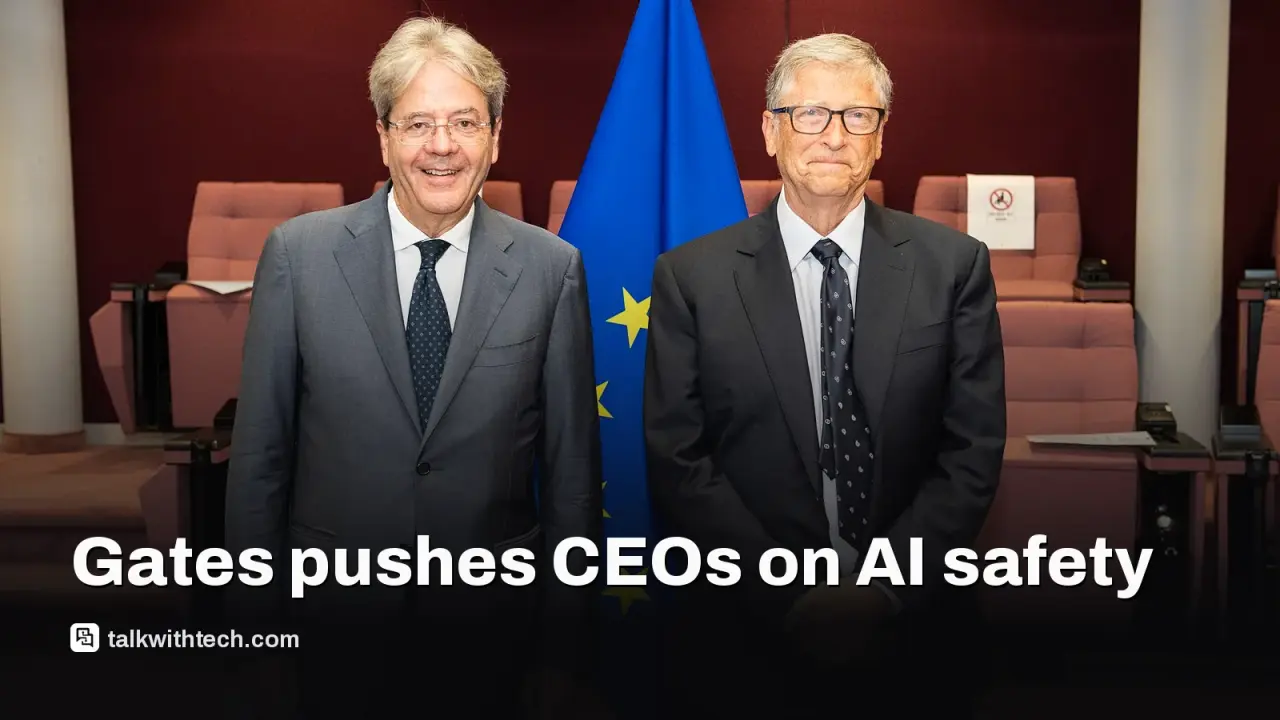
Bill Gates is pursuing a broader AI-safety campaign targeted at CEOs and industry leaders.
The push centers on addressing rising AI capabilities, security incidents, and calls for clearer regulation, per Axios-based reporting.
insiders say the effort includes coordinating on policy, standards, and potentially funding for safety research, with Dario Amodei among those engaged.
Quick read · 1 min
Bill Gates is widening his AI-safety drive, asking CEOs to help shape policy and safety standards. The move comes as concerns about AI risk grow and regulation remains uncertain.
The push would rely on industry coordination and could prompt more transparency and guardrails for AI services you use daily. Details on funding or a formal plan are not yet public, and insiders say the effort is still being defined.
Look for more concrete steps or partnerships in the coming months. In the meantime, stay alert to how AI safety disclosures might affect the tools you interact with and what kind of safeguards you expect from providers.
Expect potential safety-labels and clearer risk disclosures.
Watch for any new industry standards or regulatory proposals.
Be prepared for possible changes in how quickly new AI features are rolled out.
Bill Gates is pursuing a broader AI-safety campaign, signaling a shift from warnings to a more hands-on effort that targets the leaders who run the biggest tech firms. The plan, described in recent reporting, centers on getting CEOs to take AI safety seriously and to coordinate on policy and standards as AI systems grow more capable.
Why this matters to everyday tech users, workers, and business leaders is simple: as AI becomes more powerful, the stakes for safety, privacy, and accountability rise. Gates argues that the current pace of development outpaces guardrails, and he’s seeking a more deliberate, collective response from industry and regulators alike. He’s reportedly talking to AI executives, researchers, and safety advocates to shape this push and gather consensus on what needs to change now.
The conversations reportedly include high-profile names in the field, with Anthropic chief executive Dario Amodei among those involved. Gates’ aim, according to the reports, is to create a coordinated effort that could guide policy, standards, and perhaps even funding for safety research. He has previously floated ideas such as new institutions to coordinate AI policy, a potential tax on AI tokens and robots, and protections that prioritize human workers. Now, people close to the discussions say he wants to turn warnings into a more formal movement.
Axios, which published the details citing unnamed sources, frames this as a “comeback tour” of sorts for Gates. The term reflects a perceived shift back to his most active public role on this front after earlier, more restrained positions. Some insiders say the drive is meant to counter what Gates sees as weak regulation and to ensure that safety considerations aren’t left to chance as models grow more capable and embedded in critical services.
Gates’ strategy appears to hinge on two pillars: mobilizing CEOs to adopt stronger safety practices inside their organizations and building a coalition that could push for regulatory clarity. If successful, the campaign could push industry players to adopt shared safety standards, invest more heavily in risk assessment, and align on how to handle incidents if and when things go wrong. The question is how far Gates wants to go beyond advocacy and whether he can translate talks into concrete rules that governments will adopt.
01
What this could mean for you and your devices
For ordinary users, the potential impact isn’t about a single product. It’s about how AI services you rely on are vetted, monitored, and held to account. A coordinated industry push could lead to clearer safety labels, more transparent disclosures about model limits, and faster responses to problematic outputs. It could also influence how companies design safeguards around sensitive tasks, from customer support chatbots to automated decision systems in finance or health.
On the business side, tighter safety expectations could affect how quickly new AI features roll out. If more thorough checks are required, some updates may come later, but with stronger protections for users. Regulators could gain clearer guidance on where to draw lines between innovation and risk, potentially reducing the chance of risky bets made in the name of speed.
The reports do not reveal a formal blueprint, funding levels, or a concrete launch date. People familiar with the discussions describe it as a work in progress, with Gates weighing how aggressively to push the effort across different sectors. As with any evolving policy push, the exact shape and scope may shift as conversations advance and new events unfold.
03
What happens next
Watch for signals from Gates about any upcoming public appearances, published white papers, or partnerships with other tech leaders. If the push gains formal traction, you’ll likely see more detailed policy proposals or coordinated industry actions announced in the coming months. For readers, the practical takeaway is to stay informed about how AI safety standards might affect the tools you use and the services you rely on daily.
He’s aiming to broaden his advocacy, mobilize CEOs, and push for coordinated safety standards and clearer regulatory clarity.
Who’s involved?
Reportedly AI executives, researchers, safety advocates, and at least one major CEO is involved in shaping the plan, with Dario Amodei named as a figure Gates has consulted.
Apple chief executive John Ternus calls the memory chip shortage a crisis and says all options are on the table as the company tests Chinese memory, with potential spillover for upcoming devices.
Texas says it has fixed a programming error in the driver’s license portal that delayed hundreds of thousands of voter registrations, prompting lawsuits from voting groups.